Showing posts with label Mass Transit. Show all posts

Tuesday, February 3, 2009

Why Highways and Cities Never Get Along (Pt. 4 of 4)

BOULDER, Colorado -- To conclude our series on infrastructure spending and the federal stimulus plan, I will provide a little historical perspective on these sorts of vast national projects, specifically the largest such effort ever undertaken by this country, the construction of the Interstate Highway System.

America's cities have never gotten along well with its network of highways in large part because nobody put very much thought into how the two would interact. Historian Lewis Mumford denounced the project in the 1950's, noting, "When the American people, through their Congress, voted a little while ago for a $26 billion highway program, the most charitable thing to assume about this action is that they hadn’t the faintest notion of what they were doing.”

The federal government had never paid very much attention to building roads, leaving much of the responsibility for it up to the states. It was not until 1912 that a nationwide road-building program was introduced, but this was limited to rural areas only. Cities were expected to cover the costs of their own infrastructure, and this bias of Washington in favor of funding rural projects was reiterated in appropriations bills in 1919, 1921, 1928, and throughout the New Deal programs. The purpose of building roads was to "bring the farmers out of the mud."

Then came the great day for the country's roads: the passage of the Federal Aid Highway Act in 1956, which established what we now know as the Eisenhower Interstate Highway System. This network of multi-lane, limited-access, high-speed roadways would link the country together more closely, facilitate commerce, allow for settlement of suburban and rural areas, and aid the national defense. According the president's highway committes, the particular design of the highways was chosen for four main reasons: (1) it could carry more vehicles at higher speeds than existing types of roads; (2) limited-access highways have fewer accidents per vehicle-mile; (3) they are cheaper to build then other types of roads of similar size; (4) they preserve “natural roadside beauty, prevent roadside blight, open up new territory for industrial commercial, and residential development, and can serve as buffers between different types of land development.”

Many planners did not anticipate the rapid outward migration from the central cities that the highways created, but the US military did, and they actively encouraged it. They felt that lower density with dispersed population centers and industry would make the country less susceptible to nuclear attack by providing the Soviets with fewer high-value targets. The spoke and wheel configuration of most cities' highways would also facilitate evacuation in the event of a strike. Nuclear armageddon is no laughing matter, but perhaps this was not the best use of resources.

While these purposes seemed appropriate for the nation as a whole at the time, the system was utterly devoid of any attention to how highways would serve cities. There was no means for coordinating between federal planners and city administrators, and roadbeds were laid without consideration of the urban environments they cut through. The disruption from highway construction fell disproportionately on cities' low-income residents, and there were no federal appropriations for resettling displaced people. Rather than being arteries for the city, highways became barriers and outward conduits, drawing the population, commerce and life of the city out to the suburbs. Chicago's Skyway, Boston's central artery, and countless others are glaring examples of the bifurcating effect of elevated highways. But Boston especially illustrates how difficult these problems are to rectify; the Big Dig cost $22 billion just to recover 25 acres of land from the downtown's impenetrable maze.

As I often do, I will now turn to my hometown of New Haven for an instructive example about the damaging effect of highways on urban environments. Construction of the Oak Street Connector, a spur off of the interchange between I-91 and I-95 that cut right into the downtown, was tied directly to a "slum removal" program. Most of the highway was never built, but the neighborhood was still razed, leaving a swath of still unoccupied land where a neighborhood used to be.

It is worth noting that until very recently, pedestrians, cyclists, and buses were not given much thought when planning highways. New Haven's downtown is now crossed with broad one-way streets, designed to facilitate access to the interstate on-ramps. But the traffic patterns allow cars to travel too quickly through the central business district, which does not encourage commerce and makes the streets dangerous for people not in automobiles. As part of the effort to slow traffic and develop more walkable urban spaces, the city is installing bike lanes and new transit options, like streetcars. Eventually, they may even turn the one-way thoroughfares back into tight, two-way streets with curbside parking, all of which encourage people to slow and see what the city has to offer. It may be difficult to admit, but if we want to reconstruct the dense urban environments with walkable neighborhoods and reliable mass transit, we may have to sacrifice some of the speed of travel that we have become accustomed to.

'

If the feds won't build it, bring your own bike lane.

How does this all relate the the stimulus bill that the Senate is currently slicing and dicing? Well, when it comes to highways, we still do not really know what we are doing. Highway construction is attractive because of its "shovel-readiness" (a totally made up and fatuous notion), but it is still wrought with problems, especially for cities. Building roads and bridges for the sake of building provides few economic benefits, and simply makes the environment less livable, as Japan learned in the 1990's. Meanwhile, important mass transit services are being slashed just when ridership is increasing, and they have little hope of being rescued by federal cash.

We do have innovate transportation alternatives that are deserving of funding, like light rail systems, dedicated bus lanes, and congestion pricing. This is a better use of money, and will be better for the nation's cities, than road widening and re-paving, which may only exacerbate existing transit problems.

Monday, February 2, 2009

What the Stimulus Could Do for Our Built Environment (Part 3 of 4)

NEW YORK, New York -- Now that we've made the case for a) why Congress and the Obama administration should focus on public spending, rather than tax cuts, in the stimulus bill; and b) why infrastructure spending should look past the conventional wisdom of throwing money at tar to repave roads and toward mass-transit spending, the next two posts will take up the question of what it might actually look like -- what aesthetic principles, (in this post) in infrastructure or (in the following post) in our lives in general, we would do well to embrace.

Let's start by putting things in a near-term historical perspective. It may be appropriate to characterize the recent boom years, fueled as they were by real estate development, by the architecture that came to dominate them: Sparked by Frank Gehry's Guggenheim Bilbao, the age was defined by massive (and massively expensive) museums and other showpiece buildings warped into alternate-reality computer-generated shapes as well as legions of "signature" skyscrapers across the world's third- and fourth-tier cities. In other words, unreality and excess.

And with the boom times gone, so are the Bilbao days, with Boston Globe architecture critic Robert Campbell swinging the reaper for the days of cartoonish show architecture.

With the election of the first "metropolitan" (i.e., not rural or exurban) president since Teddy Roosevelt, combined with his emphasis on rebuilding the bonds of community and on urban policy, there are great hopes for what may emerge from under the Obama administration. Congress, the states, and the president himself would do well to understand a few general trends and, er, hopes:

1. Urban: As Blair Kamin of the Chicago Tribune writes, conversations about urban planning are taking place that are a level of magnitude more ambitious than anything that ever happened during the Bush years. At the same time, architects are scrambling toward urban planning and public projects and away from the Bilbao era's "icon" architecture.

Amid that, there is a sense the city -- and urban planning -- are mounting a "return," with the inauguration festivities and the huge crowds they attracted onto Pierre L'Enfant's as evidence. That may or may not be very accurate reasoning (it sounds like excessive Obamamania-inspired exuberance, though the inauguration did make for one hell of a mob scene), but architects and planners are nonetheless alternately holding their breath and jockeying for funds to make cities vital and sustainable as never before.

There are calls for creating grand urban spaces that only central planning can do, like New York's grid or DC's Mall -- both of which were successful, but that sort of central planning has a sketchy record. Three simpler ways to advance urban planning are to focus construction of new buildings funded by the stimulus (schools, hospitals, government buildings) on dense urban areas; on urban infill (i.e., building on empty lots, like parking asphalts); and on brownfield development (renewing existing, unused buildings, rather than building anew). And new buildings outside of cities should be built as part of transit-oriented developments -- accessible by mass transit and embracing the urban principles of density and mixed-use.

2. Grand:
Campbell of the Boston Globe fired an eloquent and perspective-filled volley across the new administration's bow last month when he called on any new public works programs to recall the days when America was still an up-and-coming power with a chip on its shoulder, as opposed to the more arrogant creature it's become on a governmental and collective level.

Before WWII, government at all levels in the United States built monumental, lasting structures that exuded a sense of pride and faith in classical democratic ideals. Afterward, government buildings became pared-down temples to the ordinary, as if embarrassed by their very existence. Think of any 1970s post office or school -- it's probably not only a depressing eyesore but falling apart. The 1990s saw a return of grand federal courthouses, but under George W. Bush (fittingly) government building projects were de-urbanized and moved to vanilla suburban sites deemed safer from terrorists; cookie-cutter and stripped-down Bauhaus designs were churned out; and the result was strip mall-esque structures like the new US Embassy in Berlin (left), which ignited much of Germany in anger against Washington for building such a hideous structure next to the Brandenburg Gate.

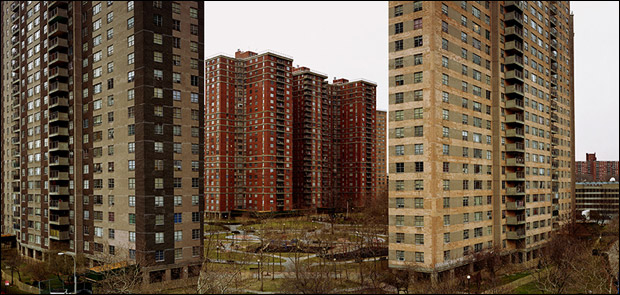
Campbell's words probably convey a warning as much as hope. Amid a general expectation that public works and other stimulus-propelled government spending will be the engine driving construction over the next few years, nobody knows what that new era of architecture will actually look like. Will it be grand, like the lasting bridges and buildings of the New Deal? Or will it be "value-engineered" to be as post-Gropius cheap as possible, similar to what characterized the last wave of government spending on buildings that stretched from 1946 with subsidized apartment projects for returning veterans to the 1970s and the Co-op City-style housing projects built across America's cities?

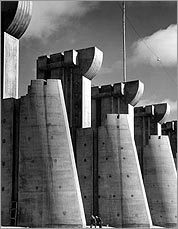
Our Canadian friends, also expecting infrastructure spending to head off deepening recession, remind us that infrastructure isn't merely functional, as it was treated in the postwar 20th century. As North Americans on either side of the US-Canada border rediscover cities and urbanization, it makes sense to again embrace public works. Sewage facilities, water-treatment plants, electrical stations (or turbines) can all be made into elements of beautification and pleasure. They are powerful enough to either chase away existing residents and result in deadzones; or, if built with the timelessness and sturdiness as a WPA dam, they can lead to the creation of new, hip neighborhoods, spurring development and construction at a time when house prices desperately need a pick-me-up. What Bob Corker may call a "boondoggle" could be a great stimulus for the housing markets of Nashville or Memphis.

Co-op City: Bob Corker, you do NOT want to wish this upon Ebeneezer Brezhnev himself

On the depressing topic of the Bob Corkers of the world, though, there are vocal critics in Congress of any spending that doesn't benefit their own district (they're generally called Republicans), which may mean our cities and landscapes will be scarred with more dollar-bin "tower-in-the-park" Bauhaus atrocities and housing projects. That may save a few billion dollars, but it arguably costs that many times over in damage done to quality of life and the built environment.

3. Traditional:
If schools, government buildings and public works are going to be built, one of the most efficient -- temporally, environmentally and fiscally -- ways of doing so is to quit the Modernist cigarettes the world has been smoking since WWII and re-adopt traditional building techniques.

Locally sourced natural materials like brick, wood and stone; windows that actually open; courtyards; densely built streets. All of those traditional practices are cheaper and less energy-intensive than the modernism that has come to define most institutional buildings for the past half century. And, since the institutional buildings are often designed by committee and picked by committee, it may be no surprise that most people who use them don't really care for them. Research suggests more traditional proportions (e.g., a building that isn't a dark rectangular slab 2 blocks wide and 21 stories tall) have fractal patterns found in human features that are inherently pleasant to our eyes and minds; that may help explain why Americans overwhelmingly prefer older buildings to newer ones (amenities aside) and choose to live in faux Colonial houses.

But that shouldn't prevent tomorrow's WPA architects from creating their own aesthetic: Just as FDR's administration channeled money into a contemporary style with a solidly traditional basis (Art Deco), so might we see a new style emerge that picks up where Art Deco left off, allowing us to move beyond the fake Cape Cod houses but staying safely away from Zaha Hadid's latest mothership.

4. Coordinated: Finally, if billions of dollars is going to be dropped on infrastructure, it would pay to think about what it looks like and how it interplays with the people who use it, transportation systems, and other infrastructure before it's built.

When transportation systems are built or upgraded, they should be connected across different modes of transport and done so in a way that attracts people rather than repels them. James Russell of Bloomberg uses Riverside Park in Manhattan as a case in point: The New Deal park continues to draw millions of New Yorkers who seek recreation there for its grand, commanding stone walls, monumental stairs and views of the Hudson and the cliffs that hem it in. But within, under and among the running and biking paths, baseball diamonds and picknicking areas, commuter rail and Amtrak trains carry millions to work; and a cleverly disguised highway runs through its center.

Sadly, as Russell argues, we can't even consider something like that today, so debased are our capabilities, expectations and (among Republican congresspeople) ability to plan for the long term. But if we're going to be building new schools, hospitals or government buildings, building them so in densely built neighborhoods and connecting them to the communities they're in via dedicated bus lanes or bike lanes planted with local vegetation could allow "mini Riverside Parks" to come about. What's clear is that the focus on costly, quality-of-life-killing highways and the dependence on elected officials in choosing projects are not going to help.

A little sense in coordinating the various functions of a community when building public works goes a long way: Would Phoenix or Las Vegas be built today, starved as they are of any sustainable water source? Should money be thrown at draining the Colorado River to quench Vegas' thirst? (New motto: "What's drunk in Vegas, probably didn't come from Vegas.") Should stimulus money be used to rebuild a place like Galveston, TX, which will only be knocked down again in a matter of time, or flood-prone areas? Good coordination focuses on successful ideas and communities rather than throwing money at the poorly performing ones.

Perhaps by focusing on those broad principles we can overcome our terrible postwar track record. After all, if they could build Riverside Park when that was prime shanty-town real estate, what's preventing us from attempting something similar in other shanty-towns?

Sunday, February 1, 2009

How to Make Infrastructure Investments Smart: Trends in Urban Planning (Pt. 2 of 4)

NEW YORK, New York -- Tonight brought the surprisingly-good-but-still-far-from-a-sealed-deal news that Republican Senators are looking to modify the stimulus bill and a re-worked plan may increase infrastructure spending in the stimulus bill by as much as $20 billion to $30 billion.

As we argued in Part 1 of this mini-series on stimulus spending, with a bill so large and unprecedented (as a Washington Post op-ed notes, it reverses a long trend of Congress shirking from any spending to increase US economic competitiveness), money should be spent wisely and in a way that improves the country's long-term economic prospects.

Infrastructure spending sounds like a good idea for reasons we already discussed. But once Congress decides to put money toward infrastructure, there of course is a wide range of choices that await. "Infrastructure" means anything from the electrical grid to telecoms to transportation infrastructure like ports, airports, roads and rail.

Since transportation infrastructure appears to be the area of stimulus infrastructure that attracts the largest amount of debate in Congress and would have the greatest effect on the economy, we'll focus on that. As the Brookings Institute notes, the sophistication and quality of a country's transport infrastructure play (and will increasingly play) an important role in its economic competitiveness -- and the US, while its postwar investments continue to pay dividends, has been coasting for the dangerously long period of 40 years and now needs $2.2 trillion in investment, according to the American Society of Civil Engineers. Since we've underinvested for so long, it's worth asking what's the best way to undertake a major capital renovation and rebuilding (or kapremont, as I would say if I was redoing my Soviet apartment) of America's infrastructure.

Most of the discussion of infrastructure spending seems to assume a) that most money should be given to "shovel-ready" projects that can be started quickly; and b) that these projects are exclusively road and bridge repairs. But while the logic of funding projects that can be quickly implemented (and quickly put people to work) is sound, the assumption that only re-tarring roads meets this description folds like me playing poker (f$%# you, poker). As the Legionnaire pointed out last week, there are dozens of major mass-transit infrastructure projects in New York City alone that are "shovel-ready," and not only do other cities have similar numbers of ready-to-go mass-transit projects, but dozens of major public transportation systems are facing budget shortfalls that will lead to service cuts.

The justification, then, of putting the vast brunt of stimulus money toward road and bridge repairs because no other "shovel-ready" projects can be found is chimerical and largely based on legislative desire to appease testy rural voters, on hopes to gain kickbacks from the mobsters who have a monopoly on road-repair industries, or on the misplaced priorities of state legislatures that oversee most infrastructure spending. But do road and bridge repairs stand on their own merits as worthy expenditures, or are other areas of transportation spending (mass transit, rail projects, ports or airports) a better investment?

As the Wall Street Journal reported last week, the "shovel-ready" roads-and-bridges spending as currently construed would be used mainly for repairs to existing roads. A large part of this is that state and municipal governments are cutting back new road, bridge and other infrastructure projects because of budget shortfalls and declining revenues from gasoline taxes as that commodity's price (and the taxes that are pegged to it) falls. The WSJ writes that these cut-backs are so large that the stimulus money would only partially offset them -- meaning that it would be used to repair (i.e., put some tar on) existing roads, not create new ones.

Beyond that, given what we now know about environmental concerns, economic efficiencies and even emerging demographic patterns, building a new network of roads would be, like, so 1950s.

As a large number of Americans (fueled in part by empty-nester Baby Boomers looking both to downsize their suburban homes and reinvigorate their lives as well as by 20-somethings who grew up on Seinfeld and Friends and are opting to live in cities) move to cities from suburbs, light rail and other transit schemes that link the various anodes of economic and cultural activity of a metro area would be more in tune with sustainable development trends than building more highways. There's a fairly widespread recognition of that, including by David Brooks here.

Perhaps even more intriguingly, Scientific American writes that building roads actually hurts efficiencies not only for the empty-nesters who think moving to New York and taking the subway turns them into Lou Reed but also for ... drivers themselves. Recent studies show that removing streets actually makes traffic flows more efficient. That's because drivers, when given fewer choices, don't strive as much to maximize their own efficiency, which paradoxically allows both them and other drivers to get to their destination faster. The science behind this is based on Game Theory's Nash Equilibrium (named after Russell Crowe, before he got fat and started hitting people) and a mathematical theorem called Braess's Paradox that applies to networks.


These theorems are reflected in driving activity, as shown in studies that Scientific American cites. For anyone living in San Francisco (see video above) or Boston, you may know that the removal of 10-lane megahighways from city centers does not result in increased congestion. And cities in the US are following European patterns in converting city streets into pedestrian plazas -- and finding that gridlock is little affected.

Instead of paying for roads or even traffic lights or signs (which Scientific American notes also lead to traffic inefficiencies), Congress would be smart to invest in municipal transportation planning offices, which don't exist in many cities and states, or in innovative new open-source software that lets city planners use data collected by crowdsourcing and analysis of movement patterns to create more efficient public transit systems. Similarly, rather than repave a parking lot, doing away with on-street parking spaces altogether increases efficiencies by encouraging people to take public transit, bike, or walk. Of course, Rush Limbaugh will call a dime spent on any of this a boondoggle. But listening to him when allotting infrastructure funding is as smart as asking a Tennessee Senator for help studying for a biology exam (oh, wait, that friend of William Jennings Bryan actually went to Harvard Medical School -- note to self: Harvard Medical School must be a mess).

Other ways to put stimulus infrastructure spending to intelligent use could include
  • Addressing the in-the-works mass-transit and other non-road-and-bridge infrastructure projects in New York and elsewhere, and funding the public-transit systems forced to cut service
  • Setting up a national infrastructure bank to oversee long-term spending to coordinate ports, airports, rail of all types and roads
  • Upgrades to ports and the air-traffic control system
  • New runways and even airports in the most congested areas that cause flight delays across the US and world (Step One would be to convert the existing New York-area Stewart Airport into a commercial hub and constructing a high-speed train to allow easy access to it)
  • Light-rail to connect otherwise unconnected points of metro areas (e.g., suburb-to-suburb routes)
  • High-speed train corridors that are close to shovel-ready including the Northeast Corridor's Acela route and California's rail corridor
  • Incentives for transit-oriented development around new commuter- or light- or subway-rail hubs (as the West Coast is already doing)
  • Spending on grand new rail stations would create a powerful, immediate stimulus and recapture some of the glory and inspiration we once saw as desirable (and if we no longer care about creating monumental spaces, we can at least justify it economically by knowing that tourists sure like seeing them)
  • Simple additions of bike lanes; plazas and sidewalk space in place of traffic lanes; and dedicated bus lanes on streets would make cities more walkable, satisfying the nearly 80% of Americans who surveys say would like to see more walkable cities realized via increased public-transit investment
  • Upgrades to the existing freight rail network to save hundreds of billions of dollars in enery costs and transportation efficiencies, as Washington Monthly writes this month
  • And investments in IT to coordinate on a city level both parking for cars as well as traffic flows via stoplights and other mechanisms, electronic toll systems, congestion fees, and (on a somewhat-unrelated note) emergency-responder coordination software -- IBM is pioneering this space
"Shovel-ready" projects could be found in any of those areas, and they'd be a good first step toward the later introduction of a substantive gasoline tax, creation of a National Infrastructure Bank and coordinated investment in ports, airports and ... you get the picture.

But that doesn't mean we should forget about the interstate highway system, which is still an engineering marvel and connects population centers in the US better than any other country does. However, we do need to think about it more ambitiously than as a roadway that billions ought to be spent to repave -- after all, its primary use (as a conduit for getting goods from the shopping mall) is going the way of the dodo as malls lose their lustre. As Metropolis Magazine argues, using highway median strips for new high-speed or commuter train routes is both an efficient and natural move, and is already happening. Additionally, a nationwide smart grid that allows wind power from North Dakota or solar power from Arizona to reach the East Coast could also be built under or along the interstates. Connect the dots and you see that if highways become transit and energy corridors, perhaps the Roy Rogerses and acres of parking lots at rest stops could actually give way to densely built transit-oriented developments. It sure as hell wouldn't take much arm-twisting to convince the Legionnaire and me to move into a Dairy Queen.

Saturday, January 31, 2009

Why Public Spending, Not Tax Cuts, Is Needed for the Stimulus (Pt. 1 of 4)

NEW YORK, New York -- As the stimulus bill makes its way to the Senate this week, Republican politicians and pundits are increasing calls to strip it of spending and add tax cuts.

The New York Times' David Brooks has denounced the "permanent Democratic agenda" of healthcare spending, alternative energy investment and ... Pell Grants, calling instead for cuts to the payroll tax that funds Social Security. Meanwhile, noted prescription drug abuser and all-around lardass Rush Limbaugh (whose power over Republican lawmakers is reportedly growing) wants to use the stimulus as an "experiment" to "prove" how well corporate tax cuts work.

It's not just enough to say, "Are you f&$%ing kidding me, you Oxy-Contin-addicted swine?!" because millions of Americans (and probably no more than a dozen people in any other country) take these things seriously.

In this post we'll sketch out a quick (because it's almost 1 a.m.) defense of public spending as an economic stimulus; and in the following three posts, we'll argue for ways that money could be spent to improve quality of life by showing how urban planning principles are currently changing; how infrastructure spending can take advantage of that; and why putting some of the money toward the arts would be a good idea.

So why do we think public-works spending will be a more effective stimulus than Rush Limbaugh and John Boner's tax cuts?

The quickest explanation is that the reason many consumers seem to be cutting back their spending -- and thereby sending the economy into a tailspin -- is that people are afraid for their income rather than their wealth. This is a point raised in a slightly different context by James Surowiecki in the New Yorker last week; the short of it is that we're buying fewer Wiis, Chevys and expensive meals not because we are flat-out broke (i.e., lacking in wealth) and, if given $20 or $500, we'd be purchasing like a panhandling wino who gets a tenner, but because we're worried about having a solid income in a year's time. Unemployment could hit double digits this quarter, and consumer confidence is in the doldrums. If most of us who aren't dirt-poor get a $500 tax break (an addition to our wealth, not a permanent increase in our income), we'll stash it away for the rainy day we fear is ahead, rather than take our stimulative duties seriously and buy 20 lbs. of steel, put in a few orders for some durable goods, and grab ourselves a 42" TV.

What's needed to rev up consumer confidence is jobs confidence. When employment expands, the broader economy jumps, and we all start breathing a sigh of relief that we will indeed still have an income in half a year -- freeing us to re-max out our credit cards today and kick the economy back into debt-driven gear.

But if we're going to max out our national credit card with China, we need to do more than just create jobs. John Maynard Keynes might have famously said that a government could stimulate an economy by paying people to dig holes and fill them up (see the dudes to the right), but even if that pulls us out of recession a tad faster, a policy of utterly wasteful spending is not worth potentially indebting ourselves for decades to come.

The challenge, then, is to create jobs that do lasting good, something that President Obama and advisers like Rahm Emanuel are certainly aware of. But, as David Leonhardt, David Sanger and ... David Leonhardt have explored in the New York Times, determining how to successfully transform the economy into a 21st-century "star" that can quickly get back on the trail to strong long-term economic growth is no small feat.

As Leonhardt notes, America has fallen far from benchmarks it once set in research and development, transportation efficiencies, education, healthcare and even Internet access. If we are to thrive in the 21st century, we need to get back to work in re-establishing these areas and many others.

The rub, however, is that investing into these areas doesn't necessarily equal the short-term growth that can help snap the recession. Economist and former Federal Reserve member Alice Rivlin has argued to Congress that it should quickly adopt a scaled-down stimulus package intended to defibrillate the economy, then pass the legislation that puts us on firm footing for the longer term. The question becomes: What sort of targeted spending can put us in good stead to grow over the long run while also attack the recession?

Tax cuts, if confined to the poorest Americans, would be fast-acting. But because their return is terrible (30 to 40 cents on the dollar), and because of the need for income stability rather than wealth that we described above, tax cuts may provide a short-term kick but will clearly need to give way to spending to create jobs and pull up the economy.

The greatest need -- and most glaring hole in the bill the House passed -- is infrastructure spending. As Leonhardt notes, the infrastructure spending the House lazily fell back on is unlikely to provide the transportation paradigm shifts needed to improve our decaying 20th-century infrastructure to make it the virtue in the 21st century as it was in the 20th:

In the current system, the federal government sends money to states without any real effort to evaluate whether it will pay for worthy projects. States rarely do serious analyses of their own. They build new roads before fixing old ones. They don’t consider whether those new roads will lead to faster traffic or simply more traffic. They spend millions of dollars on legislators’ pet projects and hulking new sports stadiums. In the world of infrastructure, cost-benefit analysis is still a science of the future.

So what should be done? As Leonhardt advocates, an infrastructure bank could be created (as Obama promised in the campaign) to oversee spending and make less pork-minded decisions than Congress does; new state cost-benefit-analysis offices could be created to make sure money is spent intelligently (which it isn't now); and rather than spending $30 billion to re-tar roads, money could be spent covering the budget shortfalls of 51 transit systems. As it stands, with service cuts and fare increases proposed, people will have a harder time getting to work -- or looking for it, as Leonhardt says. And only by investing in mass transit will we be following our own credos on building a green economy.

While Congress appears stubbornly set on infrastructure projects it calls "shovel-ready" (the meaning of this Orwellian phrase has apparently been set to mean: "tarring of highways and doing other things that the Mafia-affiliated construction companies that donate to my campaign tell me they like"), others are pushing for longer-term transformative projects.

The excitement of charts is ... off the chart! (Charts from the Brookings Institute)

Bloomberg is one of many media outlets pushing for public works, and the American Institute of Architects says infrastructure projects could create 1.6 million jobs. But the most salient voice in the debate may be the Brookings Institute. Noting that the US is the one country in the developed world that has no national infrastructure strategy; accounting for spending of infrastructure funds; or coordination of ports, highways, airports, freight rail, mass transit and passenger rail -- and hammering home how much of a disadvantage that puts us on compared to competitor nations -- the Brookings Institute released a laundry list of recommendations that should be developed immediately to increase efficiencies in the economy. These include smarter strategizing, investments in mass transit, and in particular the admonition that stimulus spending should be concentrated on the 100 largest metropolitan areas that generate 75% of GDP. That sounds good to me. Leave the big-time health and education stuff for later, perhaps, but get a big, targeted infrastructure bill passed ASAP to create jobs and restore income and consumer confidence. Oh, and let's embrace innovative infrastructure thinking (as every other country on Earth has), rather than Don Guido and his $50,000 donation to our campaign war chests.

UPDATE: Ok, it's after 2 a.m. I'm tired. The Walter Duranty Report will get back to you with parts 2 through 4 tomorrow. G'night.

Wednesday, January 28, 2009

City Governments Want to Cut Out the Middleman for Stimulus Cash

BOULDER, Colorado -- With billions of dollars for infrastructure, medical care and education about to be disbursed to the states as part of the federal stimulus bill, many cities are trying to bypass their respective state houses and receive the federal dollars directly for their favored projects.

Recently officials from three of Connecticut's largest cities - New Haven, Stamford, and Bridgeport - gathered to discuss how to approach the Washington beancounters without having to go begging to Hartford and Gov. Jodi Rell, the New Haven Independent reported.

The cities, along with Hartford and Waterbury, are part of a group known as Connecticut Elected Local Leaders Organized, or CELLO. Connecticut lacks any sort of regional planning or administration for its cities, meaning there is little coordination with suburban communities when it comes to things like infrastructure planning. Instead, plans are imposed on the state level, and impoverished cities are usually given less attention than more affluent suburbs.

The Connecticut cities are not alone in these sentiments. Chicago has already made an appeal to receive stimulus money directly, and many others will likely follow suit. Certainly New York City has an interest in bypassing Albany, since the state government has stymied a number of major projects in recent years, such as the West Side Rail Yards development and the city's congestion pricing scheme. As Itchy mentioned to me earlier today, the city also has a host of so-called "shovel-ready" projects that would benefit from federal dollars (some of them had their ground breaking in the 1970's and are still unfinished):
LIRR extension to Grand Central (tunnels currently being drilled under East River)
New Amtrak/NJ Transit tunnel under Hudson (under construction)
2nd Ave Subway (under construction)
No. 7 Subway Train extension (under construction)
Fulton St. Downtown Transit Hub (foundation built; out of money)
WTC Transit Hub (under construction, financing a mess)
Platforms over Midtown and Brooklyn Railyards (under construction, private financing coming undone)
Major new parks: Brooklyn Bridge Park, Governor's Island Park, Hudson Parks, East River Park (all under construction and stalled)

Ferry service (getting cut)
Subway service (getting cut)
Dedicated bus lanes (pilot programs already exist; money for new buses and lanes falling apart)
But of course, the federal government would rather spend their money on clean coal technology (currently $9 billion of stimulus money is budgeted for just that) than give any money for mass transit projects in a Northeastern liberal city.

This initiative is not without precedent in Connecticut. New Haven's most famous mayor, Richard C. Lee, was a master at directing federal funds to his city. During his 16 years in office from 1954 to 1970, Lee brought in millions of federal dollars for his urban renewal projects. His city planning offices, which were then known as "the Kremlin" due to secretive cabal of bureaucrats who ran them, had a direct pipeline of money from Washington. New Haven was dubbed "the Model City" during these years for its vast urban renewal and slum clearing projects, and it was the pilot site for a number of Lyndon Johnson's Great Society programs. Today, the city is still trying to undue much of the damage done by Lee's slash-and-burn projects which razed historic neighborhoods and replaced them with now-crumbling brutalist edifices (for more on these urban renewal projects, check out the New Haven Oral History Project and listen to interviews with city residents at the time).

The stimulus money would likely be better spent by struggling cities, but it can be squandered just as easily in city hall as in the state house. Having a president who actually understands city politics and the plight of the country's impoverished urban centers will hopefully put these important issues back on the national political agenda.

Read This Now

NEW YORK, New York -- Thank you, David Leonhardt:

New York Times article on why we can't miss the best opportunity we'll get to invest in 21st-century infrastructure


The stimulus is a huge missed opportunity to get serious about the most important investment America refuses to make: in infrastructure, especially mass transit. Write your Congresspeople and tell them what you want is to be able to take a damn high-speed train to Chicago -- or even just the airport -- and not a tax rebate check you won't spend.

Tuesday, January 27, 2009

Is Congress Economically Illiterate?

NEW YORK, New York -- I noticed something strange when doing my part to save the global economy from oblivion. Congresspeople, by and large, have not traditionally cared or thought much about the economy.

That statement, of course, begs two questions: 1) What ass goes around with this Jebus complex, and why?; and 2) How could you say something like that about the people who brought us Freedom Fries?

All things in turn.

After growing exasperated as craven Democrats sold out mass transit so that I can put $500 I don't need in the bank, I decided to write my Senators and representative to ask that they not give in to Republican ideological tax-cut demands.

Of course, Senator Tracy Flick doesn't have any functioning web site at the moment, so there was no way to write her. But the stranger thing was that none of the New York Congressional delegation that I looked at had any option available to speak out on the economy. When you write a Congressman, you usually have to fill out your name, address, etc., and then select the topic of your query from a pull-down menu. Time and time again, Congresspeople's pull-down menus included "Immigration," "Defense," and "Education." But nobody had an option for "Economy," and a minority had "Fiscal Policy" or "Taxes" or anything vaguely related to the economy -- even Chuck Schumer, legendarily beholden to Wall Street, doesn't seem to think that much about the economy, judging by the sorts of comments he expects to get from constituents.

Try it yourself here by searching for your Congressperson's contact page.

I guess the point is that Representatives and Senators don't expect to hear from constituents about the economy and may simply not really know or think much about the economy in the broadest terms themselves. Quite possibly that's why the US, unlike other countries, has never engaged in debate about adopting a competitiveness policy or taken measures (like school reform or granting more H1B visas to skilled workers) that would improve our economy. Perhaps it will also mean Congress fails to pass the stimulus bill that prevents 7% employment from reaching 15% (so I say as a strip porno noodie lounge advertises on CNN in prime time -- as sure a sign of recession as they come).

Monday, January 26, 2009

Why We Need a Gas Tax, or Mass-Transit Insane-o Hatred From Congress

NEW YORK, New York -- President Barack Obama today signed orders asking the Environmental Protection Agency to grant California and 13 other states waivers to enact automobile emissions standards tighter than the national standards, drawing plaudits from the Governator and others.

Raining on the progress parade, however, was the noticeably unhappy and reputedly generally backward auto industry.

That much-maligned group of Detroit sneaks, lobbyists, engineers, executives and blue-collar workers may actually be worth listening to, however.

California's emissions standards would force cars sold in the state to cut current emissions levels by roughly 30% by 2016, four years ahead of a similar federal law. Automakers say that the requirement would cause them to build one set of (generally less-profitable and small) cars for California and another set of (generally higher-margin) cars for the rest of the country.

While emissions standards have a noble objective and it would be good for Detroit to produce profitable small cars (i.e., not the Dodge Neon), the Big Three are correct to point out fundamental contradictions in government policy.

The Neon: Not very gangster

On the one hand, Detroit is excoriated for not producing profitable vehicles; on the other, it's scolded for not producing small vehicles. The fact of the matter is that meeting these two demands creates a bind. Big SUVs are very profitable automobiles, and Detroit was actually very, very profitable in the cheap-oil days of the 90s and early 00s. Detroit is only doing the smart thing when it sells people SUVs. So do we want Detroit to be solvent or green? ("Soylent Green" is not the compromise answer.)

The issue is that reducing emissions is best done by giving cars better mileage. To reduce emissions by 1/3, average mileage would have to rise to 36 mpg, from under 30 now. To arrive at that average, an automaker could produce only cars making 36 mpg. Or it could also produce a number of unprofitable, smaller cars that it may fob off on fleet sales (companies, rental agencies, municipalities and others who buy in bulk) while producing a smaller number of what it specializes in -- high-margin, gas-guzzling SUVs.

And if a handful of states demand the 36 mpg standard while others don't, it means you can still produce lots of SUVs because some people can buy them -- but it's a mess to do so. So while you'd be an idiot for not producing profitable SUVs and trucks, you'd be forced to sell them only in certain places. A bit of a mutant case of government regulation.

Here's the bind: We want to be serious about reducing emissions. But we try to do it by saying this to Detroit: "You can legally produce the SUVs that keep your faltering balance sheets afloat, but we'll hate you for it. Get profitable, you lazy bums, but build unprofitable small cars, even though there will still be a market for high-margin SUVs and your competitors will slide into it."

That's a flawed approach. What we need much, much more than a patchwork of different state laws -- or legislators setting an arbitrary emissions standard even on a national level that would encourage a model of selling loss-leading small cars with enough high-profit SUVs and trucks to stay afloat -- is a gasoline tax.

The best way to ensure people and producers behave in an organic, market-based way is to simply make gasoline too expensive to waste. Every other First World country does it; why don't we? Implementing a gas tax, we would evaporate the market for SUVs as happened this summer. This would push the Big Three to make more fuel-efficient cars, without dangling the ever-enchanting prospect of a hugely profitable SUV market in front of their noses. The resulting tax dollars could be used to repair roads, build mass transit that is so sorely lacking, or even be cycled back into Detroit as loans, rather than putting tax dollars on the hook.

And it needn't even erode purchasing power by causing people to spend all their income on gas. As Dr. Evil prototype and all-around kook Charles Krauthammer suggested, Congress could introduce a $1/gallon gas tax and deduct from everyone's taxes the amount that the average American pays in new gas taxes. (Krauthammer's proposal deducted payroll taxes, likely to bankrupt that bane of neocons, Social Security, but if the money came out of income taxes, it would be pretty ideal in theory, if -- absent electronic gas transactions -- a mess come tax-declaration time.)

Sadly, every time a voter brings up the idea of a gas tax, politicians dismiss it as a "political third rail" that voters can't stand. Oddly, though, more and more voters seem to be pushing for it.

Meanwhile, there is huge demand for public transit as people grow more urban and for various reasons less reliant on automobile commuting, but less and less money for public transit, as the LA Times reports today. Meanwhile, Congress keeps letting us down by refusing to invest in mass transit, despite ever-increasing calls to do so (here's today's token plea). When Congress botches its best chance to turn around mass transit by selling it out to unwanted tax cuts in Obama's stimulus package, let's just hope it comes to its senses and secures funding for transit via a much stronger federal gas tax -- and that it finally stops offering Detroit Catch-22s in doing so.

So why aren't the politicians listening?

Wednesday, January 21, 2009

No. 1 Obama Disappointment: The Stimulemon

NEW YORK, New York -- So that's it. Barack Obama is president. That's a relief. But as CNN, CBS, MSNBC and whoever else continue to marvel at how cute Obama's daughters are or for the 89th time ask Puff Daddy, Kevin Johnson and Seal how they feel about the fact that a black man is president (they still feel pretty good), somebody has to keep the president on his toes. So, as promised, we'll be doing some dirty dancing at the Stimulemon Ball to cap off the inaugural evening -- expressing why we feel the proposed stimulus package is the greatest Obama disappointment thus far.

First of all, here's my understanding of the plan, with line items expressed in $bn:

$300 - tax breaks
$177 - education spending
$102 - benefits for low-income/unemployed
$90 - infrastructure
$87 - Medicaid assistance for states
$70 - energy/science/broadband
-------
$826


There are three main problems with it: It may be too small; less of it should go toward tax refunds; and more of an emphasis should be put on what will streamline, transform or update the economy and workforce for the future.

1. First, size: I've hardly done my own analysis, but I haven't heard anyone effectively rebut Krugman's critique, so in my mind it stands: http://www.nytimes.com/2009/01/09/opinion/09krugman.html

Put more succinctly, as Martin Wolf of the Financial Times noted, if the CBO is estimating output to be 7% less than its potential the next two years, a stimulus of 5% is too small.

(See also the FT's Clive Crook on this.)

2. Tax refunds: $300 million, or 40% of this, is going toward tax refunds.

Over $100 billion was for businesses, which seems absolutely unnecessary. Democratic legislators seem to have realized this as well, since reports now say this part of the tax cut is in jeopardy.

The rest of the tax cut is to be directed at people in the form of $500 checks. People earning up to $200K get these. Here's the rub: These tax cuts are being given with the sole and explicit purpose that people spend them to revive the economy. In reality, very few people will spend these.

I earn substantially less than $200K, and I have no intention of spending the money. I don't think anyone but the poorest among us is going to spend this money. The problem isn't that most people don't have any cash; the problem is that they're afraid they might have less of it in a year. Giving fairly well-off people checks isn't going to stimulate anything; it'll just result in huge fiscal deficits that will take years of tax increases to pay off -- or, if not paid off, much worse consequences. (Again, Crook is smart on this issue.)

I find this part of the plan (also known as the "John Boehner part of the plan") to be the most frightening thing about it. The fiscal deficits we're facing are unprecedented and 40% of what we're now adding to them comes from greasing businesses and people who don't need the money, because John Boehner (pronounced "Boner") thinks it's a good idea? That's a big mistake.

3. Focus on transformative infrastructure that puts this $800bn toward giving us long-term economic competitiveness: Obama and his aides have put a consistent emphasis on "shovel-ready" projects, with the tacit understanding that this means repairing roads and bridges. That's not good enough. There are huge needs for long-term investment in infrastructure to amend the 20th-century infrastructure we have. Car traffic cuts billions from GNP. Port, air and rail delays hurt efficiencies (and GNP) more. Why spend billions to get a few freshly paved roads that, in 20 years, will be as cracked and congested as they are today? In a word, transportation system needs a major rethink, and lots of investment.

The current infrastructure plan seems like it will rely on fixing roads in Iowa that neither transform the economy, create new sources of long-term demand for the private sector to meet, nor streamline our efficiencies as an economy. That sort of transformative infrastructure is needed, as Joe Garreau wrote last year in the Wilson Quarterly, and as cities like New York are strongly urging Congress -- with some success -- to undertake.

Fired up and ready to go: Congress passed this idea for a system of regional high-speed train networks in October 2008

Moreover, despite what Congress takes as conventional wisdom, this can all be done quickly, since many people have spent many years thinking about it (including banker and diplomat Felix Rohatyn).

Let's also take a big step back into the fun land of fiscal deficits. As Martin Wolf has harped on, the country's biggest problems down the road will be the deleveraging and growth in the private-sector "real economy" needed to fix the current-account structural deficit. Deleveraging isn't really the purview of the stimulus, it's more to do with TARP. But creating real growth hinges on finding new sources of demand and new ways to be competitive. New sources of demand come about when you have a transformative public-works package. Putting tar on roads in Alabama does not do that. Investing in public-private high-speed train lines does: It creates demand to employ large numbers of people to build items for which there is a long-term, constant need.

NYC alone has tens of billions in backlogged large-scale mass transit and other projects (and many worthy smaller ones), which are getting dusty as the city's own coffers run dry, deprived of real estate income from bankers buying condos. And the country as a whole should be reconnected by rail to improve regional commerce and make it more attractive for people to travel from, say Cleveland to Kansas City on business (since commercial air service is dying in second-tier cities), or to manufacture and ship things quickly and cheaply to other cities in their own region.

So what do we do? Well, take that $300M in tax cuts, and slash it. Give people earning $40K and less the $500 checks, because they'll spend them. Don't give them to the rest of us, because we won't. Let's say that's about $140 billion in tax cuts. We take the leftover $160 billion and give it to infrastructure -- transformative infrastructure -- so that what we have looks like this:

$140 - tax breaks
$177 - education spending
$102 - benefits for low-income/unemployed
$87 - Medicaid assistance for states
$70 - energy/science/broadband
$250 - infrastructure
............$50 billion - traditional infrastructure
............$175 billion - new/ "transformative" infrastructure
..................................$100 - mass transit (high-speed intercity rail, light rail, subway, BRT)
..................................$25 - airports (renovations, new airports/runways in places like NYC)
..................................$25 - ports
..................................$20 - sustainable construction (urban infill, brownfields, green buildings
and, most importantly, mass-transit hubs -- high-density mixed-use
development built around transit stations; to be achieved primarily
through tax incentives)
..................................$5 - public art projects (see WPA precedents)
...........$25 - "manufacturing infrastructure" -- in the form of funds for research into advanced
manufacturing processes and greentech research to create the infrastructure for a large new class of jobs; biotech/health, defense and space research could also be eligible for these funds
-------
$826


How do you manage this? Public-private partnerships should be sought out as a way of determining what sort of projects can make money and should be pursued. Additionally, giving infrastructure into private management cuts down on public costs in the years to come.

And a blue-ribbon Infrastructure Reinvestment Bank should oversee funding decisions on what what big-ticket (>$500 million) items get built, not congressmen or state governments. Only that way would Obama cut down earmarks and focus on projects that would benefit the long-term structural competitiveness of the economy.

Other creative ideas abound; clearly, repaving Alabama backroads like Cool Hand Luke is hardly the only way to guarantee that projects with an immediate impact on the economy are chosen. The only benefit of those "shovel-ready" projects is for the congressmen who get donations from construction companies (aka the Mob) that are too thick to think a little bit more creatively.

In short, there is no shortage of ways to spend money that could put people back to work and meet long-needed structural demands of the economy/society. Bush famously didn't invest in this country for eight years. Obama was elected to do that, and now he's bending over backwards to compromise with Boehner and McConnell. And what we seem to be getting is an Obama who doesn't want to be Obama, when he was resoundingly elected to be just that -- himself, and not Bush.

The WSJ/NBC poll shows that Americans by a 2-to-1 margin think the stimulus should have more public spending and less tax refunds than it does -- alas, Mr. Obama is forcing us to take money we don't want because we know we won't spend it and that what we need is structural change to create medium- to long-term jobs growth.

Tuesday, January 20, 2009

Obama's 10 Greatest Transition Disappointments

NEW YORK, New York -- Barack Obama is to be sworn in tomorrow (make that today -- it's early, early in the morning now), and this is a good thing.

I put in a few weekends of hectoring sometimes-hostile Pennsylvanians to do my part to get Obama elected. I am fully, fully convinced that America picked the best of all the candidates running at any point in this election. And I'm cautiously encouraged that something like 75% of Americans now support Obama, a show of moving national unity.

But at the same time, in the past two months the coverage of Obama has been almost worryingly positive. From time to time, it seems almost to justify Fouad Ajami, who wrote days before the election that the messiah-like status Obama can be argued to have taken on was somehow un-American, that it was more evocative of the Middle East he grew up in during the 50s and 60s. That region then dipped from one would-be redeemer Arab nationalist to another, with Egyptians and others taken with the charisma of men like Nasser and duped wild dreams of what they might do for them. The unspoken connection is that the American people should be more self-reliant than to look for deliverance -- economic, social, or otherwise -- from a politician.

Sing, Muse

Mr. Ajami's probably overstating the case a bit -- great hopes do ride on President-elect Obama, arguably too great, but in times of great difficulty, the public has swooned for Roosevelts (T. and F.D.), Washington, Jefferson, Jackson, Lincoln and (here's looking at you, Alex P. Keaton) even Reagan. Nonetheless, I think the Legionnaire and I, though openly supportive of Obama, will gladly take up Mr. Ajami's challenge and do Tocqueville some justice. It's exactly when someone's popularity is at its height that we must be most vigilant (as Alan Greenspan failed so stupendously to realize).

So we'd like to christen the Obama presidency with a list of the Obama Transition's Top 10 Disappointments:

10. Inexperienced military man may head NASA: At a moment when the existence and success of NASA hang in the balance as seldom in the last 45 years: with the emergence of a host of wannabe space powers (China, India, Japan and Europe), with both Russia and China outwitting the US in gaining valuable commercial business (not to mention international goodwill and dependencies) in launching satellites, warnings of a "perishable" American lead in space, and with NASA riven by infighting and soon to be reliant on Russian rockets as it retires the shuttle and dithers about what comes next while the military and intelligence services want a piece of NASA -- at a moment, in short, when NASA can either become a better-funded organization by expanding a mandate to work commercially and internationally or grow more inward and militarily focused -- Obama is reported to have chosen Major General Jonathan Scott Gration, a lifelong military man with no experience at NASA. We don't need military thinking or unfamiliarity with space and rocket science here. Not now. Mr. Obama, America hopes these rumors are unfounded. Pick a capitalist-minded NASA man or scientist.

9. Wall street donor with no car experience may be car czar: Steve Rattner, head of private equity firm Quadrangle and a big-time Democratic donor, is rumored to be tapped to be Obama's "car czar."

Rattner has no experience -- as in ZERO experience -- in the automobile or manufacturing industries. Manufacturing is still about 15% of the US economy, and auto is its crown. And, given the fall of finance and the unsustainable trade deficits facing us, manufacturing and auto-making will only grow in importance, if we're lucky. Now, if you're going to put one person almost singlehandedly in charge of rebuilding the auto industry and the billions in government money that will take (and already has taken), wouldn't it be nice if his experience went beyond buying up movie studios and being part of the leverage orgy that got us into this mess, as Slate asks? Even the normally stoic Bloomberg thinks Rattner would be a disaster. Not to mention that Detroit will be automatically suspicious and resentful of any Wall Streeter who comes in telling them why they don't know their own trade. Obama, you're a masterful politician. Think like one here.

8. Obama nominee for Secretary of Agriculture, Tom Vilsack: This is a place where Obama has failed to bring change to a post that was ripe for it. (It's also one of three traditionally neglected Cabinet posts that should have become as important as they deserve to be but continue to be neglected. See below for the other two.)

Why is the Agriculture Department ripe for change? Well, although many voices from the center, south and west of the United States are always vigilant about any government interference in any aspect of life, many of the residents and businesses of these regions benefit from the most egregious warpings of free trade and government interference that, if it were transposed to television (by better funding, say, a PBS science-focused network to finally offer people smart science programming where the Discovery Channel and Discovery Science have so failed) would create outrage in these very constituencies.

Three areas of the economy that we allow government to run roughshod over are infrastructure, which is normally publicly owned but might be better served by public-private partnerships; water, which is wastefully used in the West, where rivers and lakes are dying because of a publicly subsized thirst for precious water resources by farms and unsustainable cities (what privately owned water utility would ever give Las Vegas golf courses water?); and agriculture, the biggest source of market-distorting government subsidies in America, and one of the biggest WTO complaints against the US.

Additionally, the Department of Agriculture has for years been little more than a lobby for big industrial farming conglomerates. They're given handouts of cash and allowed to run almost unregulated. While America's farms are one of its largest sources of exports and the most productive food-producing concerns in the world, the big industry farms that dominate sales are incredibly wasteful, feed people unhealthy food, and are actually one of the most socialist industries in the country.

As Nicholas Kristof said last month, when more than one-third of Americans were farmers 100 years ago, the Agriculture Department made sense. Today, when fewer than 2% of Americans farm, it doesn't. What we all do, however, is consume food; and broadening and restoring the Agriculture Department into a Food Department would have been the true "change" play.

An interesting pick -- though no doubt a problematic one given his lack of managing a large organization -- would have been the writer Michael Pollan, who has also spoken of the need to shift the Ag Dept into the Food Dept.

So why doesn't Tom Vilsack appear to be on the cusp of reforming the Agricultural Department in 21st-century America's image?

Well, Vilsack is a major supporter of arguably the dumbest use of farmland ever to be implemented outside the Soviet Union or Maoist China: corn ethanol.

Additionally, Vilsack has proven himself to be a staunch defender of genetically modified food, which, while extremely profitable, cooler heads might argue should be treated skeptically until the jury has definitively spoken in favor of its safety.

Finally, and perhaps the most nakedly disturbingly, Vilsack has directly benefited from the US's agricultural subsidies to the tune of $40K+. Why did this not come up during his hearing, where, as the LA Times reports, he "sailed through" apparently promising ever more ill-conceived subsidies?

7. Obama nominee for Secretary of the Interior, Ken Salazar: OK, this isn't just another department that's traditionally treated as unimportant. It's an unbridled wreck. It's 10,000 times more corrupt than Agriculture. For crying out loud, it's so corrupt that there was barely a stir when it was revealed that Interior officials were taking drugs and sex from the oil companies they allegedly regulate.

It's gotta be hard not to improve this beast, right? I'd say so, but Salazar seems like a pretty crappy pick -- and it's not (just) the annoying cowboy hat. As the Legionnaire is out in Salazar's home state of Colorado, I'll let him speak at greater length if he chooses. But, given the mandate of the Interior Department to protect the United States' flora and fauna -- as it was envisioned by conservationist-extraordinaire Teddy Roosevelt -- it's quite disheartening, for starters, that Salazar threatened in the 1990s to sue the Interior Dept if it put the black-tailed prairie dog on the Endangered Species List.

But much more importantly, as the New York Times reported last month, Salazar appears to be a pushover harlot to mining and fossil fuels interests (just like almost all Interior Secretaries -- why the F&$# can't any president name a competent, serious person to this post who does what the job entails rather than fully undermine it? If nobody else wants it, give it to me).

Salazar has pushed for legislation to make it difficult to sue mining concerns and to allow oil and gas drilling in Colorado. His statements about the misguided notion of "energy independence" absolutely miss the mark as we thought only Sarah Palin could. Salazar thinks it somehow helps the US if we drill more oil, failing to realize that 1) US oil peaked in 1973 and will never again be a majority of the oil we use; 2) oil is fungible, so when the US drills more and uses more, it pushes up prices on the world market, enriching Iran and Venezuela; 3) fossil fuels cause global warming and while we all would like to live in Palm Springs, this is a bad thing.

The answer, of course, is to seek energy independence via alternative fuels. But that's too nuanced, perhaps, for Senator Salazar. Anyway, we'll shut up now and let his colleagues speak for him.

Luke Popovich, spokesman for the National Mining Association, released this statement upon Salazar's nomination: “Nothing in his record suggests he’s an ideologue. Here’s a man who understands the issues, is open-minded and can see at least two sides of an issue.”

Daniel Patterson, a former official in the Interior Dept's Bureau of Land Management and current Colorado legislator: “Salazar has a disturbingly weak conservation record, particularly on energy development, global warming, endangered wildlife and protecting scientific integrity. It’s no surprise oil and gas, mining, agribusiness and other polluting industries that have dominated Interior are supporting rancher Salazar — he’s their friend.”
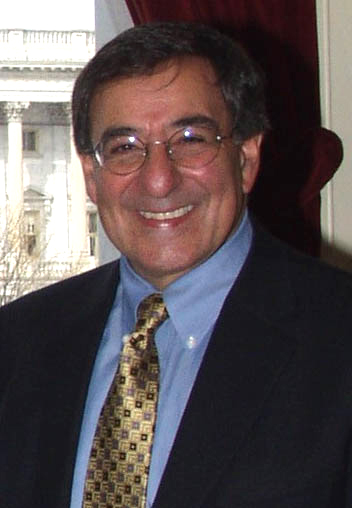
6. Naming Leon Panetta to head the CIA: This is pretty well-publicized. His lack of experience seems galling for someone at so important an agency. Panetta has his supporters, and he may well turn out to be an inspired pick. But he's on the list (and at #6) because if it doesn't go well, it'll be a disaster. Playing with the CIA is like playing with matches.


5. The fifth columnism of Obama nominee for Secretary of Energy Steven Chu: As chronicled in an earlier Walter Duranty post from January 15. Never good when accomplished scientists start saying they support "clean coal." Or the Tooth Fairy.


4. Obama's choice of mega-pastor Rick Warren to provide his inaugural invocation: Not only is this bloated televangelist a vehement homophobe, but as the also-bloated Christopher Hitchens notes, he's got a touch of the anti-Semite to him as well as the anti-Mormon. And he propagates the black-and-white anti-evolution views that retard the development of science and generate hostility to modernity in America.

Maybe you don't like gays, Jews, Mormons, or nerds. But can you really say that someone who openly disdains all of them should be giving the invocation at the inauguration of the president who seeks to represent the inclusiveness of America and govern for the entire nation?

Let's keep this short. Barack, WTF?

3. Amnesty for Bush: This seems like a simple one. We were lied into a war. There should be a truth panel for this (see Yale Law's Professor Jack Balkin for more). And if crimes are revealed, nobody can ever be above the law, as Paul Krugman argues here and Dalia Lithwick here.


2. Obama nominee for Secretary of Transportation, Ray LaHood: This is indeed the #2 greatest disappointment.

The Transportation Department has traditionally been a back-burner agency (the third one, as mentioned above). Perhaps that's why our country is unparalleled in the developed (and much of the developing) world in its astouding lack of mass-transit options. There is, effectively, no commercial train travel, depriving regional economies (the Northeast, Mid-Atlantic, Florida, Midwest, California, Northwest all could benefit) of a powerful engine of commerce and trade. Subways in big cities are underfunded and disgusting. Almost nowhere can you take good public transit to the airport. Airports and ports are a mess.

Things need to get done, in short. Transformative transportation policies could be a major driver of US business. The kind of US business that isn't selling Chinese crap at Wal-Mart, outsourcing banking jobs to Mumbai, or giving people NINJA mortgages. The kind of business we need if we want to revive the economy in the long-term. Investing in mass transit would improve the economy's efficiencies and logistics to the tune of hundreds of billions of dollars; encourage and grow regionally based economies; and create demand for high-tech, expensive products like trains and light-rail that would be best made in Detroit.

Moreover, moving from highways to transit-based infrastructure would create huge demand for transit-oriented development. Just as the exurbs empty as a result of the financial crisis, gasoline volatility, increasing traffic congestion and aging Boomers looking to scale down their homes as well as younger people wanting to live out the urban "Seinfeld" life, there's a huge opportunity to build new, dense communities around new transit hubs: rail, light-rail, and subway -- a construction trend which could help house prices find a bottom, or at the least create construction jobs. With all these opportunities to make transit transform, and as the guy who'll have a big part in doling out the tens of billions of stimulus bucks marked for infrastructure, the transportation secretary should be an important player.

Enter Ray LaHood, a second-tier House Republican known for being a friend of Obama. Oh, and for being a notorious earmarker, as the Legionnaire recently noted. Indeed, LaHood has taken many contributions from paving companies (aka the mob), exactly the kind of 1950s infrastructure we need to move away from. And, as the Post reports, he's gone hat in hand for federal money to provide hundreds of thousands to a local Illinois cemetery to repave its paths. Hmm. Sounds like we have Jimmy Hoffa for Transportation (and they look slightly alike too).

So is this the guy who's going to be able to direct public and private partnerships toward building a comprehensive national high-speed train network? Dramatically expand light rail and transit-oriented development to reconfigure decades of suburban sprawl across the country? The person who will fix the chronic airport backlogs and plane delays? Fix Mike "Heck of a Job, Brownie" Brown's destruction of FEMA?

I somehow doubt it. (So do The New Republic and the cutting-edge media crew at Worldchanging.) No need to pick a token Republican when there's real work to be done at the Dept of Transportation. Time will tell what LaHood is able to do, but there's real work to be done and this guy is part of the congressional establishment that for years hasn't done a damn thing.


1. The stimulus package is shaping up to be a non-stimulating raft of rebate checks for people who won't spend them: This one deserves its own post (yes, again). We'll save it for Inauguration Day.