Showing posts with label Dumb Congressmen. Show all posts

Wednesday, September 30, 2009

The Bill Sparkman Murder: The Past and Present of Resistance to the Census

BROOKLYN, New York -- For most Americans, the decennial census is a mundane exercise that goes largely unnoticed. You receive a form in the mail, and occasionally you see census workers walking around with clipboards and knocking on doors. It is only slightly more exciting for researchers and academics, because a few months after the final count, we get a raft of brand new data about the US population with which to tinker and model.

For a narrow slice of the population, mostly those people located far to the right on America's political spectrum and far from the country's urban centers, the census is a favorite boogeyman. For mainline conservatives, the census is regarded with suspicion because every 10 years, the ranks of minorities who don't vote Republican continue to grow; Republicans would rather that it was harder to find and count these poorer, urban populations. For the lunatic fringe, the census is an invasion into their private lives by the hated federal government.

There is now evidence that these two views are converging. The grisly murder of census worker Bill Sparkman in rural Kentucky three weeks ago shows us that despite more than three centuries of census taking in America, suspicions remain. Rather than being driven deeper into the backwoods, this virulent fear of the census - and of government in general - is gaining traction in national politics. No one has condoned this dreadful murder, but certain public figures have chosen to use misinformation about the census to stoke Americans' fears, just as they used lies about the president's citizenship and the so-called "death panels." These conspiracy theories are aired every night by Glenn Beck and repeated continuously in the halls of Congress.

A look back at the history of the census in America, and resistance to it, may be instructive to understand how we reached this place.

The earliest opposition to the census had a religious foundation. Enumerating the population was referred to as the "Sin of David," a reference to the biblical King David's order to count the people of Israel, in defiance of God's will. In some parts of the world, enumerations are still rejected on religious grounds - in 2000, the Russian Orthodox Church opposed a government plan to issue tax ID numbers to the entire population; some members of the clergy called them the "number of the beast." In America today, certain strains of religious fervor drive general resistance to government authority, but few cite King David's hubris.

The first federal census was launched in 1790. In the preceding century, the 13 colonies had each conducted more than 30 censuses, but a single national effort to count every person from Georgia to Maine had never been undertaken. Many were skeptical that it could be done accurately, but few doubted the necessity of a census, especially since America was embarking on an experiment of representative government. No taxation without representation was the battle cry of the Revolution, but there could be no representation without enumeration.

It is important to remember that the census is not an exercise carried out by a faceless state bureaucracy. Mr. Sparkman was one of the thousands of Americans who work part-time and full-time to complete the census. America's first census was carried out by a few hundred individuals; they were poorly paid, had little or no training, and they often had to provide their own materials and transportation. One such person was Edward Carrington, the marshal for the district of Virginia in 1790, who was responsible for the commonwealth's census returns. In March of that year, he wrote a letter to the US Department of Justice outlining his plans for the census; in it he also noted the importance of the census to democracy, and the dangers of misinformation about the undertaking:
When it is considered that this measure is to ascertain the proportions of representation of the several states in the Federal Government, and that the due weight to which this state is entitles therein, depends on the faithful execution of the act of Congress, it is hoped that gentlemen will be careful in their recommendations, and that all the good citizens of Virginia, will be ready to aid a full and fair enumeration of the inhabitants thereof.
Later that year, he also wrote to James Madison, the most ardent supporter of the census, and predicted that there would be active campaigns against the project:
The Assistants [census takers] may compel every one he called on to make him a return by means of the penalty [a small fine levied for non-compliance], but it is not probable he will be able to discover any concealments of parts of families and there is no doubt but that many evil disposed persons will endeavour to impress upon the minds of the people, ideas that their future taxes will be governed by the numbers that shall now return.
In early America, resistance to the census was strongest on the frontier. A healthy distrust of government is what led many into the wilderness in the first place. Most of the people who had settled beyond the Appalachians had done so without the consent of the British or American governments, so they had no proper title to the land they occupied - these squatters feared that any contact with government agents was a precursor to the loss of their property rights. This suspicion, combined with the difficulty of reaching remote populations in places like Kentucky, Vermont, and western Pennsylvania, conspired to make these people undercounted, and thus underrepresented in the first Congress. A report on the first census in the remote areas along Lake Champlain in Vermont described this situation:
Due to inexperience, imagination by the inhabitants that some scheme for increasing taxation was involved, difficulties of no roads, bridges, unsettled wilderness and isolated locations of the early settlers, opposition on religious grounds, all delayed the final enumeration a full year.
It is likely that Mr. Sparkman faced some similar challenges in Clay County, Kentucky. Driving on bad roads to reach isolated populations with little support or supervision, like the census takers before him, he worked to help people be counted so that they could collect what was theirs from the national stock. In return for his service, he was lynched and branded. His killer (or killers) is still at large, and though we have no definitive explanation for this horrible crime, the fact that the word "FED" was inscribed across his chest is a chilling reminder of how deep anti-government sentiment continues to run in many parts of the country.

In reality, the census is not mundane. Embodied within this power to count and catalog the population is the power of the modern state to function. Even if we strip down the government to its most basic activities, as Ron Paul would have us do, an accurate count of the population is necessary for apportioning representatives to Congress, levying taxes, and raising an army. The framers of the Constitution understood this, which is why the census is essential to the operation of the federal government. But it does not represent an immanent threat of tyranny. We do not need Republican congressmen and backwoods survivalists to protect us from the depravities of enumeration. But the Economist described the often ambiguous position of the census like this:
Nowadays, a census is part of the standard equipment of a functioning state. In 1995 the UN called for all member nations to hold a census in the following decade. Yet counting people remains a sensitive business for two reasons, connected with the ambiguous character of government. Where government is oppressive, people want to keep out of censuses, lest information they provide is misused. Where government provides, people want to be in censuses, and to boost their numbers, in order to claim a larger share of the goodies.
As an unambiguously democratic government, America should debate the merits of collecting certain types of information about the population, and how we deploy that information to better the lives of our citizens. In doing so, we should ensure that "gentlemen will be careful in their recommendations" and not whip people into a paranoid, anti-government frenzy in order to gain political advantage or improve television ratings.

Brief bibliography:

American Antiquarian Society. Early American Imprints.

Anderson, Margo J. (2008). "The Census, Audiences, and Publics." Social Science History 32(1): 1-18.

"Census sensitivity" (2007). The Economist, Dec 19.

Hobson, Charles F. and Robert A. Rutland, eds. (1981). The Papers of James Madison, vol. 13. Charlottesville, VA: University Press of Virginia.

Onuf, Peter (1987). Statehood and Union: A History of the Northwest Ordinance. Bloomington: Indiana University Press.

Scott, Ann Herbert (1966). Census, U.S.A.: Fact Finding for the American People, 1790-1970. New York: Seabury Press.

Strelchik, Yevgeny (2006). “Nelzya pronumerovat chelovecheskuyu lichnost” (“You can’t replace a person’s identity with a number”). Nezavisimaya Gazeta, April 5.

Wednesday, February 11, 2009

Boner of the Day

NEW YORK, New York -- No, this isn't anything that John Boner, House minority leader, did -- at least not directly. The day's boner move is the compromise reached between the competing House of Representatives stimulus bill and that put together by the Senate.

Here's the boner move, as reported by the New York Times:

Despite intense lobbying by governors around the country, the final deal slashed $25 billion from a proposed state fiscal stabilization fund, eliminated a $16 billion line item for school construction and sharply curtailed spending to provide health insurance for the unemployed.

The final agreement retained a $70 billion tax break to spare millions of middle-income Americans from paying the alternative minimum tax in 2009. Some Democrats decried the provision as a costly addition that would not lift the economy and that Congress would have approved, regardless of the recession.

Why's this bad? As the Wall Street Journal -- the nation's most conservative big paper -- writes: "A dollar sent to a state government to prevent layoffs or cuts in services yields a $1.38 economic boost, according to models used by the White House and Congress to calculate economic benefit. By contrast, the bill's inclusion of a measure to slow the expansion of the AMT will yield only 50 cents of stimulus for every dollar of avoided tax, the models predict."

So at the insistence of the Three Most Powerful People In The World -- bench-crossing Republican Senators Arlen Specter, Susan Collins and Olympia Snowe -- stimulative funding was replaced with a measure that taxpayers lose half their investment on, and that measure would've probably been passed in another bill later on, as happens every year.

Here's the upshot: "To win Republican votes, the final stimulus package is considerably leaner than what many economists say is now needed to jolt the economy, given its grave condition."

The question now is, what timeframe do we replace "day" with in "Boner of the Day"?

Sunday, February 1, 2009

How to Make Infrastructure Investments Smart: Trends in Urban Planning (Pt. 2 of 4)

NEW YORK, New York -- Tonight brought the surprisingly-good-but-still-far-from-a-sealed-deal news that Republican Senators are looking to modify the stimulus bill and a re-worked plan may increase infrastructure spending in the stimulus bill by as much as $20 billion to $30 billion.

As we argued in Part 1 of this mini-series on stimulus spending, with a bill so large and unprecedented (as a Washington Post op-ed notes, it reverses a long trend of Congress shirking from any spending to increase US economic competitiveness), money should be spent wisely and in a way that improves the country's long-term economic prospects.

Infrastructure spending sounds like a good idea for reasons we already discussed. But once Congress decides to put money toward infrastructure, there of course is a wide range of choices that await. "Infrastructure" means anything from the electrical grid to telecoms to transportation infrastructure like ports, airports, roads and rail.

Since transportation infrastructure appears to be the area of stimulus infrastructure that attracts the largest amount of debate in Congress and would have the greatest effect on the economy, we'll focus on that. As the Brookings Institute notes, the sophistication and quality of a country's transport infrastructure play (and will increasingly play) an important role in its economic competitiveness -- and the US, while its postwar investments continue to pay dividends, has been coasting for the dangerously long period of 40 years and now needs $2.2 trillion in investment, according to the American Society of Civil Engineers. Since we've underinvested for so long, it's worth asking what's the best way to undertake a major capital renovation and rebuilding (or kapremont, as I would say if I was redoing my Soviet apartment) of America's infrastructure.

Most of the discussion of infrastructure spending seems to assume a) that most money should be given to "shovel-ready" projects that can be started quickly; and b) that these projects are exclusively road and bridge repairs. But while the logic of funding projects that can be quickly implemented (and quickly put people to work) is sound, the assumption that only re-tarring roads meets this description folds like me playing poker (f$%# you, poker). As the Legionnaire pointed out last week, there are dozens of major mass-transit infrastructure projects in New York City alone that are "shovel-ready," and not only do other cities have similar numbers of ready-to-go mass-transit projects, but dozens of major public transportation systems are facing budget shortfalls that will lead to service cuts.

The justification, then, of putting the vast brunt of stimulus money toward road and bridge repairs because no other "shovel-ready" projects can be found is chimerical and largely based on legislative desire to appease testy rural voters, on hopes to gain kickbacks from the mobsters who have a monopoly on road-repair industries, or on the misplaced priorities of state legislatures that oversee most infrastructure spending. But do road and bridge repairs stand on their own merits as worthy expenditures, or are other areas of transportation spending (mass transit, rail projects, ports or airports) a better investment?

As the Wall Street Journal reported last week, the "shovel-ready" roads-and-bridges spending as currently construed would be used mainly for repairs to existing roads. A large part of this is that state and municipal governments are cutting back new road, bridge and other infrastructure projects because of budget shortfalls and declining revenues from gasoline taxes as that commodity's price (and the taxes that are pegged to it) falls. The WSJ writes that these cut-backs are so large that the stimulus money would only partially offset them -- meaning that it would be used to repair (i.e., put some tar on) existing roads, not create new ones.

Beyond that, given what we now know about environmental concerns, economic efficiencies and even emerging demographic patterns, building a new network of roads would be, like, so 1950s.

As a large number of Americans (fueled in part by empty-nester Baby Boomers looking both to downsize their suburban homes and reinvigorate their lives as well as by 20-somethings who grew up on Seinfeld and Friends and are opting to live in cities) move to cities from suburbs, light rail and other transit schemes that link the various anodes of economic and cultural activity of a metro area would be more in tune with sustainable development trends than building more highways. There's a fairly widespread recognition of that, including by David Brooks here.

Perhaps even more intriguingly, Scientific American writes that building roads actually hurts efficiencies not only for the empty-nesters who think moving to New York and taking the subway turns them into Lou Reed but also for ... drivers themselves. Recent studies show that removing streets actually makes traffic flows more efficient. That's because drivers, when given fewer choices, don't strive as much to maximize their own efficiency, which paradoxically allows both them and other drivers to get to their destination faster. The science behind this is based on Game Theory's Nash Equilibrium (named after Russell Crowe, before he got fat and started hitting people) and a mathematical theorem called Braess's Paradox that applies to networks.


These theorems are reflected in driving activity, as shown in studies that Scientific American cites. For anyone living in San Francisco (see video above) or Boston, you may know that the removal of 10-lane megahighways from city centers does not result in increased congestion. And cities in the US are following European patterns in converting city streets into pedestrian plazas -- and finding that gridlock is little affected.

Instead of paying for roads or even traffic lights or signs (which Scientific American notes also lead to traffic inefficiencies), Congress would be smart to invest in municipal transportation planning offices, which don't exist in many cities and states, or in innovative new open-source software that lets city planners use data collected by crowdsourcing and analysis of movement patterns to create more efficient public transit systems. Similarly, rather than repave a parking lot, doing away with on-street parking spaces altogether increases efficiencies by encouraging people to take public transit, bike, or walk. Of course, Rush Limbaugh will call a dime spent on any of this a boondoggle. But listening to him when allotting infrastructure funding is as smart as asking a Tennessee Senator for help studying for a biology exam (oh, wait, that friend of William Jennings Bryan actually went to Harvard Medical School -- note to self: Harvard Medical School must be a mess).

Other ways to put stimulus infrastructure spending to intelligent use could include
  • Addressing the in-the-works mass-transit and other non-road-and-bridge infrastructure projects in New York and elsewhere, and funding the public-transit systems forced to cut service
  • Setting up a national infrastructure bank to oversee long-term spending to coordinate ports, airports, rail of all types and roads
  • Upgrades to ports and the air-traffic control system
  • New runways and even airports in the most congested areas that cause flight delays across the US and world (Step One would be to convert the existing New York-area Stewart Airport into a commercial hub and constructing a high-speed train to allow easy access to it)
  • Light-rail to connect otherwise unconnected points of metro areas (e.g., suburb-to-suburb routes)
  • High-speed train corridors that are close to shovel-ready including the Northeast Corridor's Acela route and California's rail corridor
  • Incentives for transit-oriented development around new commuter- or light- or subway-rail hubs (as the West Coast is already doing)
  • Spending on grand new rail stations would create a powerful, immediate stimulus and recapture some of the glory and inspiration we once saw as desirable (and if we no longer care about creating monumental spaces, we can at least justify it economically by knowing that tourists sure like seeing them)
  • Simple additions of bike lanes; plazas and sidewalk space in place of traffic lanes; and dedicated bus lanes on streets would make cities more walkable, satisfying the nearly 80% of Americans who surveys say would like to see more walkable cities realized via increased public-transit investment
  • Upgrades to the existing freight rail network to save hundreds of billions of dollars in enery costs and transportation efficiencies, as Washington Monthly writes this month
  • And investments in IT to coordinate on a city level both parking for cars as well as traffic flows via stoplights and other mechanisms, electronic toll systems, congestion fees, and (on a somewhat-unrelated note) emergency-responder coordination software -- IBM is pioneering this space
"Shovel-ready" projects could be found in any of those areas, and they'd be a good first step toward the later introduction of a substantive gasoline tax, creation of a National Infrastructure Bank and coordinated investment in ports, airports and ... you get the picture.

But that doesn't mean we should forget about the interstate highway system, which is still an engineering marvel and connects population centers in the US better than any other country does. However, we do need to think about it more ambitiously than as a roadway that billions ought to be spent to repave -- after all, its primary use (as a conduit for getting goods from the shopping mall) is going the way of the dodo as malls lose their lustre. As Metropolis Magazine argues, using highway median strips for new high-speed or commuter train routes is both an efficient and natural move, and is already happening. Additionally, a nationwide smart grid that allows wind power from North Dakota or solar power from Arizona to reach the East Coast could also be built under or along the interstates. Connect the dots and you see that if highways become transit and energy corridors, perhaps the Roy Rogerses and acres of parking lots at rest stops could actually give way to densely built transit-oriented developments. It sure as hell wouldn't take much arm-twisting to convince the Legionnaire and me to move into a Dairy Queen.

Wednesday, January 28, 2009

Read This Now

NEW YORK, New York -- Thank you, David Leonhardt:

New York Times article on why we can't miss the best opportunity we'll get to invest in 21st-century infrastructure


The stimulus is a huge missed opportunity to get serious about the most important investment America refuses to make: in infrastructure, especially mass transit. Write your Congresspeople and tell them what you want is to be able to take a damn high-speed train to Chicago -- or even just the airport -- and not a tax rebate check you won't spend.

Tuesday, January 27, 2009

Is Congress Economically Illiterate?

NEW YORK, New York -- I noticed something strange when doing my part to save the global economy from oblivion. Congresspeople, by and large, have not traditionally cared or thought much about the economy.

That statement, of course, begs two questions: 1) What ass goes around with this Jebus complex, and why?; and 2) How could you say something like that about the people who brought us Freedom Fries?

All things in turn.

After growing exasperated as craven Democrats sold out mass transit so that I can put $500 I don't need in the bank, I decided to write my Senators and representative to ask that they not give in to Republican ideological tax-cut demands.

Of course, Senator Tracy Flick doesn't have any functioning web site at the moment, so there was no way to write her. But the stranger thing was that none of the New York Congressional delegation that I looked at had any option available to speak out on the economy. When you write a Congressman, you usually have to fill out your name, address, etc., and then select the topic of your query from a pull-down menu. Time and time again, Congresspeople's pull-down menus included "Immigration," "Defense," and "Education." But nobody had an option for "Economy," and a minority had "Fiscal Policy" or "Taxes" or anything vaguely related to the economy -- even Chuck Schumer, legendarily beholden to Wall Street, doesn't seem to think that much about the economy, judging by the sorts of comments he expects to get from constituents.

Try it yourself here by searching for your Congressperson's contact page.

I guess the point is that Representatives and Senators don't expect to hear from constituents about the economy and may simply not really know or think much about the economy in the broadest terms themselves. Quite possibly that's why the US, unlike other countries, has never engaged in debate about adopting a competitiveness policy or taken measures (like school reform or granting more H1B visas to skilled workers) that would improve our economy. Perhaps it will also mean Congress fails to pass the stimulus bill that prevents 7% employment from reaching 15% (so I say as a strip porno noodie lounge advertises on CNN in prime time -- as sure a sign of recession as they come).

Friday, January 16, 2009

Help Us Decide What to Do With Our Stimulus Checks

BOULDER, Colorado -- After the release of the economic stimulus plan proposed by Democrats in the House of Representatives, Republican Minority Leader John Boehner (it's pronounced "boner" - it really is, I promise) called the $825 billion dollar plan "disappointing."

Itchy and I are also very disappointed with this stimulus package, but probably for very different reasons than Rep. Boehner. We believe that Barack Obama and the Congress are squandering an opportunity to make this a transformational moment for the American economy. This watered-down proposal looks to be little more than a series of Reaganite tax cuts, porkbarrel road-paving projects (a side note: incoming transportation secretary Ray LaHood has very close ties to the paving industry in Illinois. Does anyone else realize that means he totally has connections to the mob?), and stupid refund checks.

As someone who does not make enough money to actually pay federal income tax, I resent the fact that government is going to send me a $500 check anyway. What about paying for all this new spending Obama has promised, like his renewable energy initiative, improving healthcare coverage, and investing in mass transit? We are tired of this populist pandering, so we are staging a protest. The government wants us to go out and spend those checks to "stimulate" the economy, but we are not going to do that.

Itchy wants to just put his in the bank, but I thought we could have some fun with the refund checks and ask our readers to decide for us what we should do with the $500. So, to the left of this posting you will find a poll of what we should do with that check that really isn't beneficial to the economy on the whole. Should the voting reach a reasonable quorum, I will do (I can't really speak for my partner) what the readers desire, and post the results here for all to see. Now, there is no guarantee that refund checks will be a part of the final legislative package, but if that day should come, here are a list of things I would rather do with $500 than put it towards a new Chrysler:
1. Put it in the bank
2. Bet it all at the dog track
3. Donate it to New York City's struggling MTA
4. Donate it to the Kalamazoo Promise, so some kids in Michigan can go to college
5. Give the money to whoever is running against America's Dumbest Senator, Richard Shelby (R-AL), in the next election
6. Donate it to a Palestinian relief organization
7. Have the check framed and never collect the money, like Rickey Henderson did with a $1 million bonus from the Oakland A's
8. Buy a plane ticket to Washington, DC, and try to strike a member of Congress in the face
So vote now and vote often, and once we get this awful, compromised bill made into law (and I get my dumb, wasteful check), I will let you know the results.

Monday, January 5, 2009

We Need a New Deal, Not Another Refund Check

NEW YORK, New York -- After reading in various media (here, here and here, for starters) that the estimated $500 billion to $800 billion stimulus package being prepared is rumored to include -- perhaps as a carrot to get intransigent, knuckle-dragging Republican congressmen like Mitch McConnell and John Boehner on board -- up to $310 billion in tax refunds, I want to send a quick note to the Obama economic team. Maybe, though, they'd be better if they read (or re-read) these thoughts first, from the CEO of IBM.

Jan. 4, 2009

To the Obama team:

Sirs, please do not let fear of the McConnell-Boehner Roller Derby push you into the tax-cut corner. That will not give our economy the help even Reagan's economists say it needs, either in the short term or the long term.

This is a George Bush way of stimulating the economy -- in fact, he tried it; and it didn't work.

I can only speak for myself. I am an American who makes a salary above the national median, but not that much. And, since I live in New York City, I have expenses well above the median.

I do not need a tax refund. I'll do with it exactly what I did with Bush's tax cut -- put it in my bank account. My neighbors might pay down their mortgages with theirs; or buy a new flat-screen TV, fresh off the Shenzhen, China, assembly line.

For the love of God, invest the once-in-a-lifetime amount of money you'll have wisely. We need to bring our country into the 21st century. Invest in basic research centers for Midwestern cities, so that they might create advanced manufacturing techniques that will allow us to actually produce goods rather than send trillions to China for everything we need. Build worker re-training programs to give those Midwesterners (and South Carolinians and Rhode Islanders) the flexibility to get a job in a new, growing industry. Invest in high-speed trains to link those Midwestern cities with the coasts, and with one another. Help cut transport costs to get American goods to American cities without any logistics costs -- or problems. Invest in a smart grid. In broadband. In medical research. In healthcare and education -- removing huge health costs from the shoulders of employers and preparing a new generation of people to re-energize their companies. That's what will create jobs in the short term and put our economy on better footing for the long term.

Or you could give me another $500 to put in the bank; or give my co-workers $500 to buy a new made-in-China flat-screener. But having a new 31-inch TV won't bring our nation forward, give us job security today, or prepare US students to compete with, as Candidate Obama liked to say, Berlin, Beijing and Bangalore tomorrow.

Friday, December 12, 2008

Auto Bailouts: Global Companies Need Them Too

NEW YORK, New York -- Running counter to the propaganda line that US automakers need government money not because of the global economic crisis that is plunging car sales but because they are not viable businesses and deserve to be taken over by foreign competitors, the NY Times reports today that European and Asian companies are increasingly seeking bailouts. 

Only where the US plan recently punted by the Senate would have provided a $14 billion loan, the European companies are looking for nearly $55 billion. 

And, as Dennis DesRosiers, an auto analyst, said:
"“It’s a foregone conclusion that governments around the world are going to aid these companies. It’s just a matter of working through the politics.”

Note to Republican Senators: If the US automakers don't get guaranteed loans soon, they won't necessarily be taken over by "better" companies, but by ones whose governments realize the importance of not letting a huge industry collapse on the rocks.

Thursday, December 11, 2008

Goodness Gracious, Great Balls of Economic Suicide

NEW YORK, New York
-- Jesus. The unthinkable happened. Senate Republicans refused to offer a bridge loan to the Detroit Three (formerly the Big Three). Apparently it violated their "principles."

Unless some extra-congressional funding is found, GM and Chrysler could go bankrupt. Normally, they'd be able to get loans from banks to restructure after filing Chapter 11, but given that otherwise-healthy companies can't even get short-term loans to pay employee wages, there's little chance of that happening now. An inability to restructure after going bankrupt would mean liquidation. The evaporation of the auto industry. And if Chrysler and GM go, so would their parts suppliers. Meaning Ford and the "healthy auto industry in the US" -- foreign makers' US plants -- would probably be in deep trouble. The aftershocks would go well past the US.


Whoops!

The Senate's outright failure to exercise common sense may not spell doom. Hank Paulson probably doesn't want to be the guy who fiddled while both the financial system and the manufacturing sector fell apart, and the Treasury can potentially find some money or persuade the Energy Dept to use the $25 billion earmarked (that merely means it's directed at a certain purpose -- outside of John McCain's head it isn't a four-letter word) for "greening" the auto industry to keep it alive. 

But the facts are what they are: We're on the brink of depression. Every .1% rise in the employment rate sends stocks plummeting and investment running. Losing 1.5 million to 5 million auto-related jobs would have a huge knock-on effect on every other sector of the economy, as if it wasn't hurting enough already. But at least the Southern Republican senators (who have the Toyota, Nissan, etc. plants in their states) didn't have to violate their "Milton Friedman free-market" principles.


Senator Richard "Smug Dick" Shelby: If you see him, kick him in the head.

As if there wasn't a lesson to be learned about letting massive companies fall apart after Lehman... Allowing the companies to undergo managed bankrupty would be one thing. It'd probably be a good solution for the government to agree right now to offer restructuring loans should the companies go bankrupt. Then they could restructure and be guaranteed funding. 

But Congress is doing nothing like that. Not offering any guarantee creates doubt in people's mind about the arbitrariness of the system -- whom will the government bail out? Whom not? There are no ground rules being put in place, and that's going to freeze credit and scare off investment just as it did after Sept. 15. Do the Southern Republicans not realize the sh%$ hit the fan after that date? Don't they know why? Or are they too busy barbequeing and seeking campaign donations from the Toyota and Nissan plants in their states?

But, regarding those plants, it should be noted: Republican congressmen love to say that the US auto industry is doomed because its workers are overpaid, but David Leonhardt did a good job bursting that myth in the Times this week. The Detroit companies have actually aggressively improved the quality of their cars in recent years. In particular, Ford (most popular foreign car in Russia) and GM (Buick is the top foreign maker in China) have become world-beating operations overseas, where they can't rely on cheap oil and undiscerning customers to buy high-margin SUVs. If you want to look at an American product that can compete and be sold internationally today and in the future, it is -- strange to say -- US cars.

Now, in the truest Southern Republican spirit of capitalism (a weird, zealous brand of capitalism that is not really informed by economic thought or data the way an academic or banker's capitalism is, but is vaguely inspired by Christianity, which itself is a strangely socialist religion) , shouldn't any business be expected to want to sell its highest margin products? Can you blame Detroit for selling high-margin SUVs and trucks if they were able to? It's the fault of Congress for not raising the gas tax for years or increase fuel economy standards and forcing them to make the kind of cars Japanese rivals were making for their home market, which had fuel and emissions standards with teeth. Of course, senators faced pressure from Detroit not to adopt those standards, but the buck should stop with the lawmaker, not the lobbyist. Lobbyists will always do what they do; lawmakers should rise above their venal interests.

 
Milton Friedman died for Rick Wagoner's sins

But even in North America, Detroit has been restructuring and building better, non-SUV cars; Ford and GM (Chrysler's another story, largely because it was bought by a private equity fund with no interest in anything but its financing arm) were on track to profitability before the Lehman-induced meltdown. The Chevy Malibu and Cadillac CTS were the top two cars in North America, respectively, in 2008, leaving only third place to a foreign car (Honda Accord). And Detroit's sales in the battered US market are little worse off (GM, at 40% down) or better off (Ford, at 30%) than Toyota & Co's (35%) this year.


2008: Best car in North America. 2009: Headed to the trash bin?

Should liquidation occur, or a chaotic restructuring where government continues to muddle about with no clear rules, we'll potentially see millions lose their jobs, an unspeakable chain effect of other lost jobs and collapsed companies, and a depression worse than the one in the 30s. All because somebody once told Richard Shelby about a halfway-cracked economist who died a few years ago at the age of Six Hundred and Yoda. And maybe, just maybe, Shelby and his cronies are also influenced by the fact the "healthy auto industry" they keep praising -- Honda and other foreign automakers with plants in Alabama -- donate to his campaigns. Good job, America. I encourage everyone to beat the tar out of anyone still dumb enough to call themselves a Republican if the Big Three are liquidated.

P.S. Senate Republicans and any American who thinks they have any credibility may yet taste a sweet, sweet irony: Given that companies across the world, from Volkswagen to Chinese makers like Chery, are in need of government loans, in allowing US companies to fail in order to let the free market, economic evolution, creative destruction, etc., etc., do their magic, the "naturally selected" winners in this game will be companies lucky enough to be based in countries whose governments aren't ideologues. Sure, let GM fail. But the only reason Volkswagen will be around to gain is because the German government and people have the sense not to let their biggest companies and employers fall apart during a once-in-a-lifetime economic maelstrom.

P.P.S. As the WSJ reports Republicans balked at any loan because of a
sharp partisan dispute over the wages paid to workers at the manufacturing giants.
So the Republican senators are going to let the economy tank because they think US workers don't deserve their salaries. How can these people EVER expect anyone to vote for them again? And yet, in the US, alone among nations, they still will get votes from the very people they want to be poorer. Bravo.


Thursday, November 20, 2008

CNN, Congress Want All to Experience Joy of Air-Traffic Delays

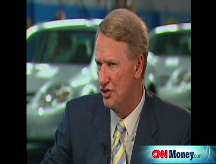
NEW YORK, New York -- Coverage of the "bailout" the Big Three US automakers are requesting has pivoted in recent days on the fact that the companies' CEOs took private jets to Washington. I have primarily watched CNN's reporting and can say that Anderson Cooper & Co. have emphatically reminded viewers at every turn that "these guys took private jets to Washington!"

I agree that Rick Wagoner and Bob Nardelli are probably morons. Not only are they unfit to run large corporations, they probably aren't even fit to attend a PTA conference: You'd have to be a social twit to fly your Learjet to DC when asking for a taxpayer handout, whether or not your corporate charter has provisions stipulating private airtravel for you for "safety reasons."

http://i2.cdn.turner.com/money/video/news/2008/08/22/news.velshi.wagoner.gm.cnnmoney.216x164.jpg
Mr Wagoner, does GM make a short bus for you?


Still, CNN's near-obsession with Bob Nardelli's preferred mode of transportation obscures a much more important point: millions of jobs, municipal and state budgets, dozens of industries connected in seemingly arcane ways to the automotive sector, and a nation's morale all hinge on the existence of the US auto industry.

What happens to the industry is unclear. In order to be long-term competitive, union contracts will have to be ripped up, and bankruptcy is as good a way as any to welch on your contracts. But if the automakers go into Chapter 11 protection, they'll need to get new financing to restructure after getting rid of the union agreements that are crippling them. Their ability to find financing at this particularly lousy moment is ... not so hot. The government would save the country a lot of pain -- and probably more than $25bn in long-term unemployment checks, Medicaid/Medicare expenses and lost tax revenue -- if it would guarantee to bail out any automaker that goes into bankruptcy, provided they meet certain demands (rewrite your labor contracts, fire your incompetent CEOs, start making your European fuel-efficient models here now). But the government's coy little patty-cake game is stupid. Grilling the automakers and refusing to definitively say to what fate you'll sentence them creates uncertainty and drags down the markets. And after Lehman Brothers' demise, I doubt many people have faith the government will always step in when it should.

In light of that, harping on the aloof, Asberger's tendencies of auto CEOs does little more than push the public -- and therefore lawmakers, who seem unable to buck what they think will be popular anger against unpopular decisions -- against any bailout for reasons that have nothing to do with the soundness of the bailout itself. That's hella dumb.

Before turning the country against this proposal, Silver Fox Cooper and his ilk should consider not whether the CEOs of these companies took private jets or whether they have fancy suits (most CEOs of the world's top companies do, after all, and you can't expect to convince JPMorgan to lend you money when you fly coach and wear Skidz), but whether the bailout has merits of its own.

http://maremare1225.files.wordpress.com/2008/03/anderson-cooper.jpg
Clowns to Cooper: Get us back on the Gold Standard!

I don't know if it will lead to a depression, but allowing a major company like GM to fall apart now certainly won't help us avoid one. At this point, we should probably not take any chances in doing everything possible to move away from that outcome, and we shouldn't flirt with depression because of the fact that a few inept CEOs are too obtuse to fly JetBlue. Judging their stupidity should not be substituted for judging the merits of this country having an auto industry and the harm its collapse would bring to the US economy and people's confidence in the economy or themselves.

Friday, October 31, 2008

Would You Like a Vice President With that 72-Year-Old Shake?

NEW YORK, NY -- Two Republican Party elders voiced support for Barack Obama today, part of a torrent of Republicans jumping ship.

Ken Duberstein, Reagan's chief of staff, endorsed Obama today, saying the following:

"I think it has very much undermined the whole question of John McCain’s judgment. You know what most Americans I think realized is that you don’t offer a job, let alone the vice presidency, to a person after one job interview. Even at McDonald’s, you’re interviewed three times before you get a job."


And Lawrence Eagleburger, secretary of state under Bush Sr. and a man whose support McCain has often touted, brought further pain today on NPR, where he said Alaska Gov. Sarah Palin was "of course" not ready to be vice president.

It seems unprecedented that so many grandees from one party should voice support for the other party's nominee. If McCain wins, it won't just be a rejection of Obama or the Democrats, but even of thinking Republicans including writers and party elders. It will be the true ascendancy of the idiocracy.

UPDATE:
House Minority Leader John Boehner. What a boner.

From the Miami University (Ohio) Miami Student newspaper: "Now, listen, I've voted 'present' two or three times in my entire 25-year political career, where there might have been a conflict of interest and I didn't feel like I should vote," Boehner said.

"In Congress, we have a red button, a green button and a yellow button, alright. Green means 'yes,' red means 'no,' and yellow means you're a chicken shit. And the last thing we need in the White House, in the oval office, behind that big desk, is some chicken who wants to push this yellow button."

Is this the first sign of the idiocracy?

Tuesday, October 28, 2008

People Who Should Have Been Fired, But Haven't: Tucker Bounds

BOULDER, Colorado -- I had not seen this bobble-headed nitwit in weeks, so I had just assumed that McCain spokesman Tucker Bounds had been cut loose by the campaign. But he is still around, defending untrue robocalls and Reaganomics and repeating the Animal Farm-like argument that a vote for Obama is the equivalent to a "double down" on George W. Bush's economic and fiscal policies.

At least he said today that you probably should not vote for Ted Stevens (the same 200-year-old, massively corrupt senator who had endorsed Sarah Palin in the Alaska governor's race).

Ugh, I cannot wait for this election to be over so that I can get back to writing about bad journalism in Russia. It is not quite so depressing when the terrible, incompetent journalism isn't coming from your own country and doesn't have an impact on the most monumental election of a generation. But my friend gave me a few words of solace: "But I'll find the strength, and the darnkess shall not comprehend it."

In the meantime, go and cast your vote for Osama bin Lohan.