Showing posts with label New York. Show all posts

Wednesday, September 2, 2009

Baseball Skies

BROOKLYN, New York -- This has been a summer of transitions for me - moving to a new city (Brooklyn will now be my more or less permanent dateline), coping with life after graduate school, and looking for work in a tough economy. But there has been one constant throughout the summer: baseball.

I crisscrossed the nation between New York and Colorado three times this year, and on every trip, I made sure to stop at some of the hallowed sites of America's pastime - not the gleaming corporate cathedrals of the monopolistic MLB, but the minor league parks of America's small cities and the sites where baseball history was made.

Unlike most other popular American sports, baseball is played almost exclusively outside (and with the impending demise of Minnesota's Metrodome and Tampa's Tropicana Field, there will be no more indoor baseball in the major leagues) and during the most beautiful time of year. So, here I would like to share some of my pictures from the summer and the beautiful skies of America's ballparks.


Here were some of the other highlights of my travels:

Louisville Slugger Museum and Factory, Louisville, KY: In addition to being home to the world's largest bat, the Louisville Slugger museum will teach you such interesting facts as how the two-tone bat was invented (it was a spare bat that we being used to stir paint) or how many bats a major leaguers uses in a season (over 100). One of the coolest things about the museum is that they have a batting cage where you can hit with a wide selection of wooden bats fresh off the factory floor.

Bob Feller Museum, Van Meter, IA: When Babe Ruth walked onto the field at Yankee Stadium for the last time on June 13, 1948, two months before throat cancer would take his life, he held a bat at his side to steady his ravaged body. That day the Cleveland Indians were in town, and the bat he grabbed off the rack belonged to future hall of famer Bob Feller. Today you can see that bat, signed by Ruth and Feller, on display in the pitcher's hometown museum.

Nemo's Kitchen, Detroit, MI: Located in the shadow of the now-demolished Tiger Stadium, Nemo's is as much a Tigers institution as Ty Cobb and gothic lettering. With the stadium gone, they have adapted to the times - where you could once walk down Michigan Avenue to a Tigers game, the bar now has a fleet of buses to shuttle patrons to games for a modest $3 (and parking around back is free). Anyone contemplating a trip to a Tigers game should make this a mandatory stop.

Collegiate Summer Baseball: When the college baseball season ends, players need a place to hone their skills and keep the scouts' attention - that's where the summer collegiate leagues come in. In small towns across America, players play for room and board, usually boarding with local families, and in the evenings they ply their trade for the crowds. It's not quite the big leagues, but the spectators treat the players like their adopted sons.

For future summer trips, I have put together a short wish list of baseball shrines I would like to visit:

Koshien High School Baseball Tournament, Japan: Though a bit far for a weekend road trip, the annual Koshien tournament is one of the most popular sporting events in Japan, eclipsing even the country's major leagues. 4,000 teams compete for the right to play in the tournament at historic Koshien Stadium in Nishinomiya, where more than a million fans show up to cheer on their hometown squads while millions more tune in at home. Japanese and American culture are very different, yet I find it remarkable that we both love such an idiosyncratic and arcane game as baseball; Koshien is one of those institutions that gets at the heart of the game - kids playing, not for money, but honor and glory. (The PBS program POV ran an excellent documentary on the tournament, a trailer is here.)

Esquina Caliente, Havana, Cuba - "The Hot Corner": Cuba is not known for its freedom of speech, but at this spot in Havana's Parque Central, people gather for heated debates - about baseball. Recently featured in the documentary about Red Sox pitcher Luis Tiant's return to the island after 46 years of exile, The Lost Son of Havana, the Hot Corner is a sort of Speakers' Corner that American baseball fans should envy.

Baseball Hall of Fame, Cooperstown, NY: Now just a few hours drive from my front door, the Hall of Fame is near the top of my to do list.

Little League World Series, Williamsport, PA: As Kenny Mayne said, "The best entertainment, and the true spirit of any sport, can be found at any children's game." As an unmarried man with no children of my own, people give me strange looks when I show up at a random little league game, but the LLWS offers enough public spectacle that I could show up on my own to watch kids play without anyone calling the cops on me. Congratulations, by the way, to Chula Vista, California, who defeated Taoyuan, Taiwan 6-3 in Sunday's final.

Fenway Park, Boston, MA: Most people who know me are aghast when I tell them that I, a lifelong rabid Red Sox fan, have never been to a game at Fenway Park. I have traveled as far as Detroit and Baltimore just to see the Sox, but never to their home ballpark. Hopefully this fall I will get the chance to walk down Yawkey Way with a playoff ticket in hand.

Thursday, June 18, 2009

Wednesday Links: Recession Solutions

BROOKLYN, New York -- Everyone is trying to cope with economic hardships. The Russian government is giving people free lumber. New Yorkers can no longer steal paper plates from their local Whole Foods. And Oprah just wants you to read The Secret and think positively to solve all of your financial, emotional, and medical problems.

Wall Street Journal: Let the forest be your stimulus.
Despite having the third-largest hard currency reserves in the world, Russia still can't spend its way out of economic oblivion. So instead, the government is letting ordinary citizens fell timber, prospect for gold and plant potatoes for free in hopes of stimulating the economy.

New York Times: Russia's defense minister is a "stool salesman." Russia's military has long been plagued by a bloated officer corps, but in its current economic dire straits, the country can hardly afford to gently show these officers the door. They just roughly kick them to the curb.

Architects' Journal: We will build Europe's largest ... er ... parking lot.
The Russia Tower was slated to become Europe's tallest building, but financial mismanagement has brought the project to a halt, and little has been built since the cornerstone was laid two years ago. So much for Norman "The Apologist" Foster's wet dream of a building.

Geography of Jobs: Americans are equally screwed everywhere. That's not entirely true, but almost no major cities have been free from job losses. This map comes from consulting firm TIP Strategies and displays the change in the number of jobs for the 100 largest metropolitan areas since 2004.

WNYC: Forget NYSC, I'm joining the YMCA. Like the two-dollar bill story reported earlier, WNYC is asking listeners to submit their own uncommon indicators of the recession. The result is a fascinating interactive map of New York City.

Newsweek: Oprah wants you to inject things into your vagina.
Oprah got thoroughly skewered by Weston Kosova and Pat Wingert in this Newsweek cover story, where they portrayed her as an uncritical, weak-minded ninny who unflinchingly endorses crackpots and cranks. The results are hilarious.

Toronto Star: Foreigners don't like hockey. Canada has been lauded for its open and fair immigration policies. Now if they could only get the new arrivals to take up hockey.

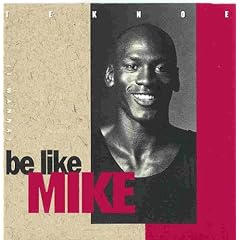
ESPN: I wanna be like Barry. If you want to get close to Obama, join in on some hoops. This borders a bit on a cult of personality, but luckily basketball is already very popular in the US, so we don't risk facing a situation like Russia, where niche sports like tennis, judo and skiing saw their popularity skyrocket simply because the president (Yeltsin in the first case, Putin in the latter two) played them.

Metropolis Magazine: Meet America's stupidest mayor.
We have leveled our own broadsides against illiterate Boston mayor Tom Menino; now he may be facing a challenge to his authoritarian rule.

Tor Project: Help stop the Iranian thugocracy. Speaking of authoritarian rule, the Iranian government has become quite adept at thwarting journalists and would be protesters from gaining access to the Internet to get information about the unrest out of the country. This piece of software prevents the authorities from easily tracking them and cutting off their access, or worse, finding out their identity and personally targeting them. It can also be quite useful to bloggers and journalists in any part of the world.

Wednesday, April 15, 2009

Wednesday Links: Happy Tax Day

BOULDER, Colorado -- Today we are going to ignore all of the teabagging that is going on across the nation, because those people are nuts and ignorant. Instead, we bring you news about race in America (the two stories may be linked, however), as well as stories about the dastardly deeds of the unhirable fools from the Bush administration and some urban ruins of bygone eras.

Colorado Matters: Come fly the racist skies.
Until 1963, there were no black commercial airline pilots in the United States. Carriers actively discriminated against black pilots, claiming that racist passengers would refuse to fly with them if they hired blacks, or that they would not be able to put them up in hotels during layovers in segregated southern cities. Then Marlon Dewitt Green took his case all the way to the Supreme Court, which ruled in Green v. Continental Air Lines that the practice was unconstitutional.

Hartford Courant: Do-over! In more recent race-and-hiring-practices news, my hometown could be approaching a landmark Supreme Court case. A group of 15 New Haven firefighters have taken the city to court over its hiring practices. The men all took a test to determine promotions, and they received the top 15 scores - unfortunately, 14 were white, and one was Hispanic, and there were only 15 promotion spots available. Because there were no black candidates who scored in the top spots, the city decided to hire nobody. The Court will hear oral arguments in the case, Ricci v. Destefano, later this month.

NASHI: All deposed presidents of former Soviet republics may now begin boarding.
Everyone's favorite government puppet right-wing youth movement, Nashi, demonstrated earlier this week at the Georgian embassy in Moscow to show their "solidarity" with the Georgian people who are clamoring for President Saakashvili to resign. They've even bought Mikhael a ticket to DC, where everyone (especially John McCain) loves him. It's worth noting that these are the same people who were baying for the blood of every last Georgian during last summer's war over South Ossetia.

The New Yorker: Mr. Feith, there are some men here to see you. They have a warrant.
At looks like at least six members of the Bush administration can look forward to a life like Henry Kissinger - that is, they can never leave the country, and probably can't travel to some US states, for fear of being arrested. British attorney Philippe Sands first identified the "Bush Six" in his book Torture Team, and Spanish Judge Baltasar Garzon has upheld the indictments of the former officials on charges of torture.

Strange Maps: The Rochester Subway. From 1927 to 1956, Rochester, NY, once one of America's most successful boomtowns, had its very own subway. The system consisted of a single line that was placed in the former bed of the Erie Canal, which had been diverted around the downtown. Today, all that remains are a few concrete trenches and overpasses.

New York Times: Keep smallpox alive.
One of New York Cities oft-forgotten islands is the quaint Roosevelt Island, located in the East River between Manhattan and Queens. Perhaps it's forgotten because for most of its history it has been home to prisoners, mental patients, and people suffering from wildly-infectious diseases. Now the city is trying to keep part of that history alive by restoring the ruins of the island's famous smallpox hospital.

Thursday, March 12, 2009

Wednesday Links: A Trip to the Islands

BOULDER, Colorado -- We are a little New York City-heavy this week with links, but I am preparing for a trip there next week, and I have just spent the past several days pouring over historical maps and reading about the various unvisited islands of the lower Hudson archipelago - places like Shooters Island, which was at one time a major shipyard, or Hoffman Island, a bit of landfill plopped into the lower harbor to protect the city from invasion. I can't wait to slip my canoe into the teeming waters of the East River and get a view of the city that few do.

Bring me your poor, your prisoners, your dead babies, your missiles. The Hart Island Project is an organization that is trying to document the history and ongoing story of one of New York's most fascinating yet invisible landmarks. The island is the city's Potters Field, a mass grave for the indigent, the unclaimed, and the stillborn, and over 850,000 New Yorkers are interred there. It is completely closed to the public and is owned by the city's bureau of prisons. People are still buried there, their graves dug by inmates from Riker's Island to the southwest. The founder of this project, Malinda Hunt, has made a documentary about the island which you can watch on the site, and she has been compiling a list of names of the forgotten thousands buried there.

Wired New York: An apartment in the Hudson River. This article was originally written in 2004 by Jim Rasenberger and posted on Wired New York, but Itchy just recently pointed it out to me. It's about some of the fantastical proposed projects for New York City that were never built, like Gustav Lindenthal's futurist masterpiece - a suspension bridge over the Hudson who's towers were massive apartment blocks - or Harvey Wiley Corbett's plan to turn Midtown into a three-dimensional grid of raised sidewalks. As Itchy just posted, it is still important to think big.

WSJ: Your tax dollars at work. Three of the most expensive sports stadiums ever built are set to open this year, and they all received huge subsidies from taxpayers who are rapidly slipping into poverty. Too bad they will never be able to afford a ticket to see a game in the new Texas Stadium, the new Yankee Stadium, or the Mets' Citi Park, soon to be renamed Zombie Bank Park, or perhaps after the Chinese conglomerate that swoops in to feats on the remains of the toppled behemoth. Perhaps as an homage to the bandbox stadiums of old, the new park in the Bronx will have obstructed-view seats; the view from the $5 bleachers will be blocked by a giant glass-encased luxury bar. Fuck you, working people! Watch the game on the jumbotron if you can't see.

Take a look around. Take the Handle Daily columnist Chris Walters is apparently trying to walk down every single street and alley in New York City; he's got his work cut out for him, but the effort is commendable, and the results are worth reading. His weekly column, Corner by Corner, is his effort to learn as much as he can about the fascinating city that surrounds him. I think we should all take a lesson from that no matter where we live.

Our language isn't dead, it's just sleeping. The Living Tounges Institute for Endangered Languages works all over the world to try and at least bear witness to the disappearance of indigenous languages and knowledge. Their website is packed with information they have collected on endangered languages from southern Siberia to West Africa to the Pacific Northwest, including audio recordings, online dictionaries, and academic papers.

[Photo credit: Claire Yaffa, Hart Island Project]

Generation Next: Federally Subsidized Pepsi

NEW YORK, New York -- You can't beat the real thing, New Yorkers. Unless, of course, the real thing is using federal stimulus money to subsidize soda purchases.

NY Governor David Paterson announced today that rather than raise taxes on soda and junk food to help close a gaping budget gap, stimulus money would be used to patch up the state's fiscal irresponsibilities, the New York Times reported.

With an estimated $14 billion in deficits, the state had planned to raise taxes on sugar water and junk food to raise over $1 billion. This plan, put forward by the state's health commission and Paterson, would have the additional effect of discouraging unhealthy eating -- one of the main causes of the obesity epidemic currently swelling waistbands across the state and country ... and increasingly making itself felt in obesity-related hospital bills and Medicare/Medicaid costs.

Despite cries that the tax was unfair to overweight individuals (who apparently need soda more than everybody else), I thought it was a pretty sensible idea. While the Legionnaire very fairly compared the NY State Legislature to King George III in its creation of absurdo levies, I think the idea is pretty palatable. Given the huge government deficits, taxes will inevitably be raised (even on Obama's middle class). The fairest, most efficient way to do this would be sales and consumption taxes, rather than piling ever more income taxes on people who grow more and more likely to seek out Swissmen named Bernard with deep vaults the more you tax them. And if you can achieve fairly reasonable policy objectives, like public health, in doing so, all the better.

Enter Sheldon Silver -- New York State Assembly Speaker, Dr. No, the High Priest of the Backroom Deal, and a likely Carnival of Corruption -- a man whose uniquely turbid power in Albany has quashed thousands of rational, good ideas in the past.

Paterson announced the kiboshing of the soda tax at a joint press conference with Silver, and my feline instincts tell me old Shelly was behind it.

The result is that $1.3 billion of tax increases composed of the soda tax as well as a tax on clothes over $100 will be eliminated. The Times reports that the remaining "flexible stimulus funds" will be $4 billion. So 25% of the discretionary stimulus funding (of $25 billion total in state stimulus aid) will go toward effectively subsidizing soda and Gucci blouses.

So much for completing the 2nd Avenue Subway, the various cash-strapped transit hubs, a rail link to LaGuardia, or building Moynihan Station. It's all about doing the Dew. Unless, of course, you're doing the Kate Spade.

It somehow smacks of 9/11 -- instead of being asked to join in shared sacrifice and buckle down to rein in deficits blowing open like saloon doors, we get to ... suck back a Mr. Pip. Sheldon Silver, let me just say: I like the Sprite in you.

Friday, March 6, 2009

Penal Geography: America's Internal Exile System

BOULDER, Colorado -- It is well known that the United States has the proud distinction of having the world's largest prison population, which currently stands at 2.29 million (as of 2007, according to the US Bureau of Justice Statistics). The US also leads the world in the proportion of the population in prison - 738 out of every 100,000 people are incarcerated, outstripping the nearest competitors Rwanda (691) and Russia (611). If all people under the supervision of the corrections authorities are included (people on parole or probation), the total population swells 7.3 million, or one in every 31 adults.

America's penchant for incarcerating its citizens (and non-citizens) is well documented, but what is less well understood is the exile component of the prison system. "Transportation" has long been a part of criminal justice, when inmates were sent to serve their term in a distant land, like British prisoners sent to Australia. In Russia, criminals were exiled to the remote reaches of the country long before the Soviets turned internal exile into a grotesque science. Whereas Great Britain eventually abandoned exile, the Soviets continued to use it as a means of making criminals and political opponents disappear, sending them off to vast areas of exclusion like the Kolyma Valley and the northern Ural Mountains. The group Memorial, which was founded to document the crimes of the Soviet state, has a great interactive map of the whole gulag system.

At least American prisoners aren't like Russian political prisoner Mikhail Khodorkovsky, who is imprisoned 3,774 miles from Mosocw; his co-defendant, Platon Lebedev, is a bit luckier, sent 1,193 miles to a prison above the Arctic Circle.

We like to think that we are above this barbaric practice, but America's geography of incarceration bears some small, though troubling, similarities to the "Gulag Archipelago." This analogy is not limited to usual spaces of exclusion, like Guantanamo Bay and CIA secret prisons, but can be found throughout the state and federal penal systems.

Imprisonment serves three basic purposes for society: incapacitation, retribution, and rehabilitation. The first of these is the simplest - the offender is removed from society for a period of time because they are perceived to be a threat to commit future crimes. The latter two are less straightforward. Society obviously demands that people pay for their crimes, but calculating the "just deserts" for every offender and offense is an inexact science. Rehabilitation was the primary motivation behind the establishment of the penitentiary system (before prisons appeared in the early 19th century, the state's options for punishment were limited to fines, torture, and execution), but it has since become a much lesser priority, though the terms "corrections" and "penitentiary" (as in, to be penitent for your crimes) persist. Rehabilitation was also found to be arbitary and unfair, as prisoners were subject to indeterminate sentences, and unaccountable parole boards determined whether or not a prisoner was "reformed" and therefore eligible for release.

Okay, being sent to Attica is probably still better than this.

We accept that inmates should be removed from society, but we also know that the vast majority of them will need to be reintegrated back into that same society. Therefore, they need to maintain bonds with the outside world, but there are many structural features of the prison system that prevent them from doing so, the most obvious being the location of corrections facilities. When sent hundreds of miles from home, prisoners lose all links with their former lives, and family and friends are unable to visit them. According to a study by the BJS, 60% of state inmates with children reported being incarcerated more than 100 miles from their last place of residence. In the federal system, prisoners are transported all over the country, far from their last residence or the place in which they committed their crime. But even in state systems, prisoners are sent to remote corners, far from the bonds of home. Beyond the unpleasantness of it all, there are consequences to society for isolating prisoners - several studies have linked long distances from inmates' homes to higher rates of recidivism.

New York offers one of the most glaring examples of this exile system. According to the state's department of corrections, 52% of inmates come from New York City, yet only 25% of the prison population is housed within 100 miles of the city. The vast majority of the state's prisons are located in the northern and western parts of the state, and of the total prison population of 62,599 in 2008, 44.6% of were housed in prisons in rural counties, outside of any metropolitan area, be that New York City, Buffalo, Rochester, or Albany. Prisoners are sent off to areas that are not only remote and rural, but also overwhelmingly white. The result is a system in which a predominantly white guard staff supervises a prison population that is 76% black or Hispanic, marooned hundreds of miles away from their homes and families with no reasonable expectation of regular visits.

There is a reason why it's called the Empire State.

California has a similar gulag archipelago, though the statistics are not as stark as in New York. The state is second in the nation (
behind Texas, obviously) with 172,000 inmates; 16% of them are held in prisons in rural counties (though the counties in California are much, much larger, as is the state, meaning some additional prisons may be just as remote as in New York). If ever there was a symbol of exile, it would be the state's super maximum security prison, Pelican Bay (pictured below), located in the northwestern-most corner of the state in Crescent City, 350 miles from San Francisco. Granted, the prison houses some of the state's worst criminals, but only about 5% of them are serving terms of life without parole, meaning the remaining 95% will return to society at some point in their lives.

It would appear as if being incarcerated in a small state would be an advantage, as you could not be transported too far away from your home and family, but that is not the case. There is an increasing trend of states contracting with privately-owned facilities in other states to house their inmates. California currently has 6,538 prisoners housed out of state (about 4% of the total) to deal with its massive overcrowding, even though this practice was ruled illegal by a state court. Vermont, which has only 2,130 inmates in total, sent 529 of them to a facility in Kentucky run by the Corrections Corporation of America. Hawaii sends about a third of its inmates to private prisons in Arizona, Oklahoma, Mississippi and Kentucky. This usually does result in cost savings for the sending state, but there can be problems for the receiving state. Virginia last year reversed its policy of accepting out-of-state transfers; its state prison beds were being filled with them, while Virginia inmates were serving terms in overcrowded city and county jails not designed to house long-term prisoners. The New York Times documented the phenomenon of out-of-state transfers in 2007, and they published this map of the prison network.

Maybe America's not better - it is 4,450 miles from Honolulu to Wheelright, KY.

There are many, many other issues at work here that I did not mention, such as the politics of prison location, the growth of private prisons, and the inequities of the federal prison system. As I continue my research on this subject, I hope to post more about this in the future. But we have to keep in mind that prisoners, despite their crimes, remain members of our society who are entitled to basic rights. Very few of them have committed acts that anyone could argue caused them to ever forfeit those rights. They must pay their dues, but they will return to our society, so we must incarcerate them in a way that is humane and just so they can be reintegrated as productive members. Sending them to the far ends of the earth, cut off from the ties of home and family is not a good way to accomplish this goal.

Robert Guskind, Dogged Brooklyn Blooger, Dies

BOULDER, Colorado -- Robert Guskind, founder of the Brooklyn-based blog Gowanus Lounge and writer for the site Curbed.com, was found dead Wednesday evening. Our condolences go out to his family and friends; Brooklyn has lost one of its most tireless champions.

We at the Walter Duranty Report will remember him most fondly for his relentless coverage of the sad state of affairs along the Coney Island boardwalk, which is being turned into a row of blighted vacant lots by its tyrannical landlords, Thor Equities. The company has dreams of turning the boardwalk into a stip of hotels and luxury condos (I guess they don't realize how far Coney Island is from Manhattan), but in the meantime, they are satisfied to jack up rents to drive off tenants and sell off the iconic attractions of Astroland to the highest bidder in Dubai or Pakistan. These same jokers have real estate interests in Russia; what a surprise.

But, it is probably best to leave the tributes and remembrances of Mr. Guskind to those who really knew him.

[Curbed: Robert Guskind, R.I.P.]

[New York Shitty: Dedicated To a Good Friend]

[Only the Blog Knows Brooklyn: Robert Guskind 1958 - 2009: Founder of Gowanus Lounge Dies]

[Brownstoner: Robert Guskind, Founder of Gowanus Lounge, Dies]

Unfortunately, Gowanus Lounge still remains down, but you can still peruse the archives of the blog's predecessor on blogger.com.

UPDATE: Gowanus Lounge is back up!

[Photo courtesy Pablo Jonesy via Curbed]

Monday, March 2, 2009

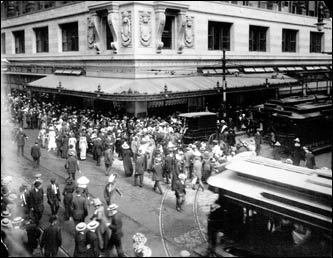
Nike vs. Goodyear: The Battle for Broadway

NEW YORK, New York -- After New York Mayor Michael Bloomberg decided to close portions of Broadway to car traffic as part of an experiment in pedestrian-friendliness, Newsweek is picking up on traffic-network theories that say fewer roads mean less congestion, not more (we spoke about it previously).


It's an interesting thought, and I'd like to think it's true. The people over at Streetsblog sure believe it. But a few cautionary tales have been reported recently that may give NYC-wannabes pause. Significantly, Boston's faltering Downtown Crossing area is considering inviting the cars back after 30+ years as a pedestrian-only zone. Turns out that when a city aims for that "St. Mark's Square" feel, it sometimes gets "Downtown Detroit After Dark" instead, as consumers find new shopping areas that are car-accessible and, over time, retailers move out.


That Downtown Crossing was right next to a neighborhood called the "Combat Zone" probably didn't help, though neither do the fact that Downtown Crossing's big draws for decades, homegrown New England department stores Jordan Marsh and Filene's, no longer exist (the "today" shot above shows the reconstruction of Filene's into a financially troubled skyscraper development). That, at least, is more indicative of the much broader economic trends dating back 30 years than it is of pedestrian vs. car traffic.

More generally, though, a potential factor in the success of ped-only zones is how well serviced a city's pedestrian-only area is by public transport and, crucially, how many people in a city take public transport. Downtown Crossing, for instance, does have a major subway stop right underneath it, but Boston's urban population is small and poverty-stricken. Many of the shoppers coming into town drive in from the suburbs. New York, on the other hand, has a critical mass, and then some, of affluent residents who predominantly use the subway, plus Jersey, Westchester, CT and Long Island suburbanites often come in by train. Not to mention the many thousands of tourists staying in Midtown.

Regardless, we'll be ready with firsthand reports once Broadway gets pedestized (sounds pretty creepy, huh?). For urbanists everywhere, we'll be hoping it goes over well. I guess for the sake of our beleaguered friends in Detroit we'll have to hope it doesn't spell the (19th) beginning of the end.

Monday, February 16, 2009

Florida and the Atlantic

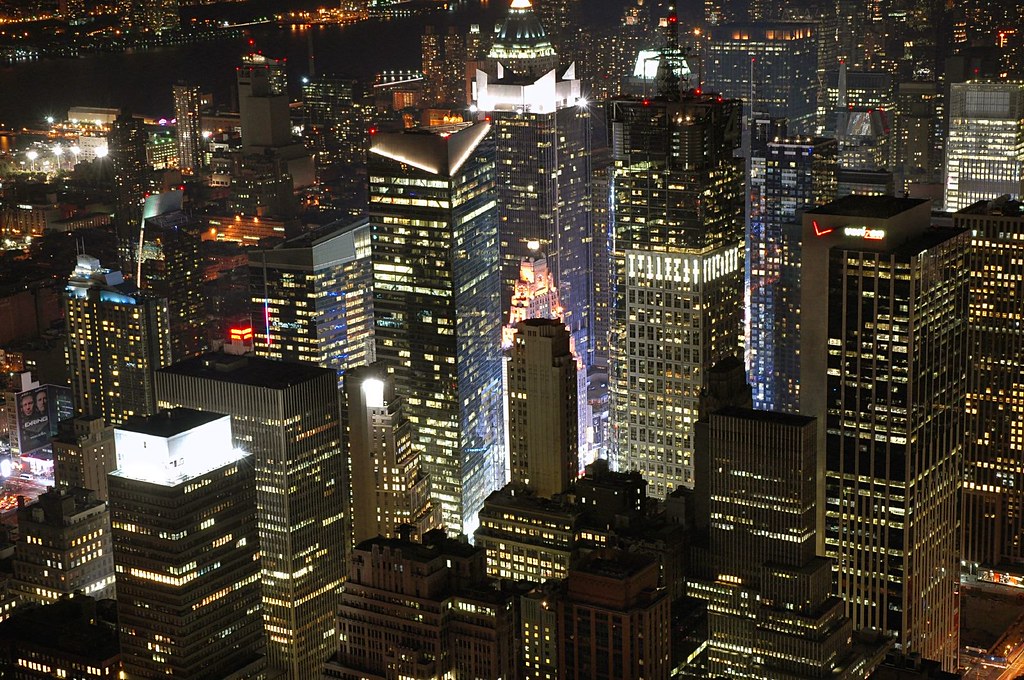
NEW YORK, New York -- Unfortunately, this isn't about a Hemingway short story, as the title may imply. It's about Richard Florida, author and urban theorist; and The Atlantic magazine.

Florida's piece "How the Crash Will Reshape America" in this month's Atlantic is well worth reading for two reasons. But before that, it's worth pointing out the flaws both of this piece and of The Atlantic as a whole, of which they are indicative.

The article, like so many The Atlantic now publishes, takes a huge theme and offers it up for some mind-onanism/voodoo thought exercises. Like many of these Atlantic pieces, it takes a trend and projects many, many years into the future to tell us how this trend will permanently make an imprint on history. In Rome, they called this Bitingoffus Moreus Thanus YouCanChewus.

A classic example is the May 2001 cover story "Russia Is Finished." It explained in the broad detail expected of a child using sidewalk chalk why Russia was totally irrelevant and doomed to eternal penurity. As anyone who has read a newspaper in recent years knows, stories about the "resurgent Russia" have flooded the presses since, well, June 2001. (Tayler is now writing for The Atlantic about the resurgence of Russian professional hockey, of all things -- another dubious claim.)

For his part, Florida makes lots of ridiculous generalizations about why he *feels* that New York will benefit from the crisis and Detroit will become a "ghost town." Most of this is based on his definining argument, outlined in his book The Rise of the Creative Class, that "knowledge economy" types are the way of the future -- scientists, singer-songwriters, novelists, and Farrah Fawcett. The dots are connected by the claim that New York has lots of these creative types, while Detroit has few. As Florida tells it, "New York is more of a mecca for fashion designers, musicians, film directors, artists, and -- yes -- psychiatrists than for financial professionals."

Has this man been to New York? The 3,000 hipsters in Williamsburg are neither a large part of New York's population nor of its economy. The economy is based on finance -- every one of New York's 200,000 finance jobs supports 3 other jobs, according to the city's comptroller. And those jobs pay 33% of income in the city. The population, meanwhile, is largely individuals of minimal education and income. Despite the many Wall Street jobs paying on average nearly $400,000, income in New York City is below the national median. And poverty levels are 150% that of the national level. Not to sound like John Rocker, but most of the teenage mothers of 3 I share a subway with every morning are neither stylish, hip, nor especially "creative" as far as I can tell. Florida's "evidence" for his statement is that New York "is home to high-tech companies like Bloomberg, and boasts a thriving Google outpost in its Chelsea neighborhood." Calling Bloomberg, a financial information provider, a high-tech company along the lines of Apple or Dell is absurd. And the Google floor of office space employs about 100 people and is similar to other outposts in Boston and elsewhere. The truth is, New York has very, very few life sciences, engineering, high-tech manufacturing or even non-financial management jobs per capita when compared with San Francisco, Boston, North Carolina, Seattle, Chicago or even Austin or Minneapolis.

The "creative class," titans of commerce, descend on Bedford Ave.

Moreover, Florida's underlying assumption -- that production jobs are dead and the future economy is in film directors and grunge rockbands, and that this is a good and viable thing -- makes me think he's on crack. A typical statement would be this: "Jobs in the 'tangible' sector -- that is, production, construction, extraction and transport -- declined by nearly 1.8 million between December 2007 and November 2008, while those in the intangible sector -- what I canll the 'creative class' of scientists, engineers, managers, and professionals -- increased by more than 500,000."

Yeah, those 500,000 fairy-dust "intangible" jobs make up for the loss of 1.8 million lesser, "tangible" jobs. I guess "tangible" jobs only get 3/5 of a vote. So Florida's claims are delusional and counterproductive. Let's count the problems: Not everyone can be in the "creative class" because scientists and executives are culled from the highest ranks of graduates; the "creative class" exists largely because of capital generated by years of production that is now migrating away as quick as possible (goodbye, career in YouTube filmmaking; hello, RiteAid job!); and if manufacturing is in China, you can be sure management and R&D will be there soon for logistical as well as cost reasons.

More reliable and profitable than the Hipster Sapiens

Because of the fundamental idiocy of Florida's argument and of so much of what The Atlantic prints in its quest for that evasive Best Reporting in Futurology and Speculation Pulitzer, I am skeptical of the parts of his article that make sense and have begun doubting myself and pulling at my hair.

Nonetheless there are two valuable points that make this article worth reading:

1. The spatial economy: Florida raises an interesting point about the relationship between our spatial/geographic existence and economic trends. Before the Long Depression of 1873, the US economy was based on an agricultural-cottage industry model wherein most people lived in rural areas and small mill towns like Lowell, MA, were the centers of industrial production. Afterward, and until the Great Depression, large industrial concerns gained predominance, with mass migration to man factories in cities where people rented space in tenements. But after the Depression and war, the creation of Fannie Mae and use of tax deductions on mortgage payments, which effectively subsidizes home ownership over renting, saw home ownership rise from 44% to 62% between 1940 and 1960 as people fled to the suburbs and affordable homes.

Owning a home, with the government's prodding, came to be a symbol of freedom and end in itself. Moving from dirty cities made sense for residents as well as businesses that could buy land cheaply in the suburbs. And the automobile and Interstate Highway system meant people could easily get to work from any suburban location. And in recent years, President Bush's "ownership society" and homeownership drives by both parties in Congress led to homeownership rates of 70%. It also became the greatest source of both equity and debt for people -- and was directly to blame in building a debt-laden, consumer-based economic order that has proved to be disastrous.

This all seems like an accurate telling of history, and clearly leaves us wondering what, if anything, comes next. Florida argues there will have to be a return to cities to allow for the cross-pollination that fuels the "creative class." I think he's partly right -- cities will increase in importance in part because of young people wanting to be hip and to be among other hip people. Of course, the "creative class"'s engineers aren't the heppest cats out there, and I wonder if anyone's ever told Florida that they really don't feel a need to be near a Nobu. And if there is to be any viable economy, manufacturing will have to return in some form or other to make the products the "creators" dream up, or else there'll just be more capital flight along with RiteAid clerks taking out loans based on their future rent payments or what-have-you in order to buy the imported products the "creators" dreamt up.

The next great spatial/geographic/economic step?

2. Make cities more attractive to power a new economy: Given the crisis in the prevailing model of life/geography/economy that we've adopted since WWII, the other interesting point Florida makes is that government now needs to act to make cities relatively attractive just as at different key moments it acted to make various geographies and spatial arrangements attractive to people. Subsidies for homeownership, he argues, deprive more important programs like alternative energy or medical or research spending from funding. Moreover, the cult of homeownership has left the population less flexible -- a smaller portion of Americans moved last year than at any time since 1940. With economic uncertainty and companies folding and (hopefully) opening at a quickened pace, restoring that mobility will be very crucial.

Moreover, with the popping of the credit bubble, people simply won't be able to afford homes. And with the popping of the home equity lines of credit bubble, they won't be able to fill McMansions with baubles. With the threat of gasoline price volatility affecting people's ability ot commute from one suburb to another, smaller, denser, rented homes will by necessity gain in prominence.
Florida is convinced that an ever-smaller number of mega-cities in the US (and world) will have larger and larger shares of output. I think that's a lot of speculation. But he's right to note that the US has succeeded so well in part because it has traditionally been farsighted enough to invest in new means of transportation that open new sectors of the economy and new geographies to exploit them: from canals that allowed fur and timber from the Old Northwest to reach the Atlantic; to railroads that shipped agricultural products, minerals and manufactured goods West; to the sewers that gave rise to cities; to the Interstate Highway that brought us suburbia -- we have always been progressive in transportation. Until recently.

Obama will have to pick up the ball that he dropped in his attempt to "bipartisanate" with the Republicans. New realities have developed in the environment, society and the economy. While production is a necessary part of a healthy economy, new modes of production will have to come about. And yes, the "creative class" will remain important -- as it always has been. While it'd be nice to think every American will be a researcher, that's not going to happen. But that doesn't mean Florida's focus on cities is wrong -- building links between colleges, hospitals, consumers and business is key; so is living more sustainable, affordable lives. The city will need to shave a few points off the exurban model for this to happen. There will have to be spending, and change. Mortgage subsidies need to end (no, that won't encourage people to buy more of the many homes going unsold now -- but they shouldn't be encouraged to buy them anyway; government needs to plow down the 1.5 million surplus "zombie" homes that were idiotically built in the Sunbelt if there isn't any demand for them). Zoning codes will need to be changed to allow denser, taller development, with mixed-use neighborhoods (i.e., a mix of retail, institutions and homes, as opposed to the cul-de-sac developments of tract housing miles from any retail or services). Transit-oriented hubs (housing development around mass-transit stations). Trains to go between cities. Subways to go within them. And light rail and commuter trains to move from suburb to city or, importantly, suburb to suburb. Key to it all is a variable gas tax to discourage wasteful driving and ensure gas-price stability once the price of a barrel of oil shoots up again, which it will as soon as the economy returns to health. On these points, Florida is dead on.

Monday, December 8, 2008

Mapping Sounds

BOULDER, Colorado -- The blog Making Maps: DIY Cartography is an excellent resource for cartographers or anyone interested in making maps. Cartography is a little-understood art, even among people who make maps regularly (the same could be said of many other graphic arts, like typography, which is a critical aspect of cartography). The blog is produced by J.B. Krygier, a professor in the Department of Geology and Geography at Ohio Wesleyan University, and he recently posted an article he wrote in 1994 about mapping sounds titled "Sound and Geographic Visualization."

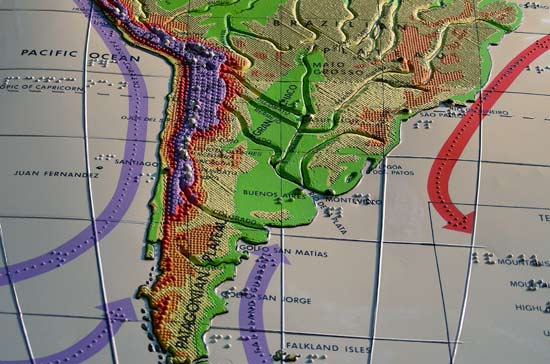
The interface between sound and maps raises a few different possibilities. Are you trying to display sounds with visual symbols (like in the graphic on the left), display visual features with sounds, or incorporate actual sounds to represent themselves in the map? Or can we use sound to include additional data and expand the range of information that is displayed to the reader, through the use of tools like audio narrations? Data is not always static, and sound can be an especially important tool for displaying temporal information.

In the case of people with visual impairments, using sound to represent spatial information can greatly expand the accessibility of maps. Sound, as well as other sensory information, may help mapmakers move beyond the tactile map, which is for many blind people the only cartographic resource available to them. In most cases, people require a great deal of training or assistance from a sighted person to properly orient these types of maps. They are essentially flat paper maps with the features turned into raised lines, and without any meaningful representation of the many other inputs that blind people (and sighted people) use to navigate the world. Finding a way to map these inputs may help people develop what the geographer Dan Jacobson refers to as a Personal Guidance System to enable them to move more freely in their environment (for a brief bibliography on this topic, see the end of this post.)

I was inspired to write about this because I have come across a few things of late that make intriguing use of sound in maps. My girlfriend also teaches elementary schoolchildren with visual impairments, so I have been trying to read up on the subject. She teaches them about the history and geography of New York City, so she is always looking for new ways to display geographic features and improve their spatial cognition.

The first item I will point to is a map produced for the Lower East Side Tenement Museum in New York City. The project is called Folk Songs for the Five Points, and the map links locations to sounds recorded at the particular site. The sounds are also categorized into four different types - field recordings, spoken word, music, and folk songs - and the visitor can mix them to create their own song that captures the cacophony of the Lower East Side.


The second was an episode of This American Life that aired earlier this year that explored mapping with different senses. The second act considered hearing, and the contributor attempted to isolate all the ambient sounds of his environment, and then figure out what mood they conveyed when in harmonic combination. The first segment of this program features the work of geographer Denis Wood, who co-authored with Krygier the book Making Maps: A Visual Guide to Map Design for GIS. The project that is mentioned in the piece can be seen here.

Most of these intriguing developments in mapmaking and visualization require the use of digital resources, so the possibilities for online multi-sensory cartography are immense. People encounter maps most often in the news media, and increasingly they get their news online. So let's hope that the massive layoffs that are sweeping through the press won't hamper these fascinating new possibilities in mapmaking, or the cartographic profession in general - you know things are bad when even National Geographic is laying off cartographers.

Bibliography

Dransch, Doris (2000). "The Use of Different Data in Visualizing Spatial Data." Computers and Geosciences 26(1): 5-9.

Jacobson, R. Dan (1994). "Navigation for the Visually Handicapped: Going Beyond Tactile Cartography." Swansea Geographer 31(1): 78-85.

Krygier, J.B. (1994). "Sound and Geographic Visualization." In Taylor, D. and A. MacEachren, eds. Visualization in Modern Cartography. New York: Pergammon.