Sunday, April 5, 2009

Oliver's Army Is On Their Way

BOULDER, Colorado -- Thirty years ago, Elvis Costello released one of my favorite songs. "Oliver's Army" chronicles the many opportunities on offer for the British working class to see the world on the margins of the country's dwindling empire. In faraway Hong Kong or nearby Belfast, the unemployed from dying industrial towns like Newcastle and Manchester could find themselves a professional career patrolling the world's hot spots.

The song is a laconic account of the decline of imperial power, and it remains especially poignant in today's America. Where once the army struggled to meet its recruitment goals, enlisting convicted felons and the illiterate to fight in Iraq and Afghanistan, the recession has driven many people from the unemployment lines to the recruiting office.


The song offers a little guided tour of the death throes of the British Empire. In celebration of the 30th anniversary of the record's release, here I offer some interesting details on the locales Costello mentions:

Checkpoint Charlie: Until the reunification of Germany and the withdrawal of foreign forces from Berlin, Britain had a garrison of 3,000 troops in the city. Once the very fault line between East and West, this central checkpoint between the two Berlins is now one of the city's most popular tourist attractions. The nearby Mauermuseum has exhibits on the various ways Berliners attempted to escape the communist East, and the many who died trying.

Murder Mile: Like Berlin, Belfast has long been a city of walls, dividing Catholic and Protestant neighborhoods. Some of the so-called "Peace Walls" have been removed since the warring sides signed a peace agreement in 1998, but the many that remain are adorned with murals chronicling the many heroes and victims of the protracted conflict. The Murder Mile refers to a particularly violent area around Crumlin Road that was the site of numerous sectarian killings. The famous Crumlin Road Gaol is located here, and it has since been converted into a museum. More than 4,000 people were killed during the Troubles in Northern Ireland, including 1,667 members of the British security services.

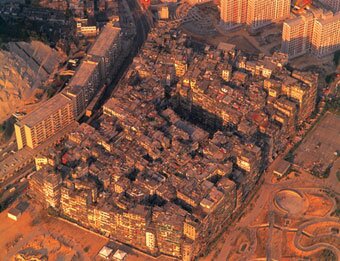
Hong Kong and the Chinese Line: During the more than 150 years of British rule in Hong Kong, the Chinese had always held a tiny toehold in the colony. The Walled City was an ancient fortress in Kowloon that stayed under Chinese control even after they ceded the surrounding territory to Britain in 1898. The area was completely neglected by China, and it grew into a center for criminal activity. By the 1980's, the population of the 0.01-square-mile area had swelled to 50,000, and the two countries agreed to evacuate and demolish the area, which had grown into one massive, tottering warren of makeshift buildings. Even though all of Hong Kong has reverted to Chinese control, the 20-mile-long border fence remains in place as the former colony is now a Special Administrative Region, and ordinary Chinese citizens need special permission even to visit. (For more on borders and security, check out the excellent blog Subtopia.)
Palestine: Palestine had been a British protectorate until 1948, when the UN partitioned the territory and the state of Israel was declared. During the period of the Mandate, British forces fought against a number of Jewish insurgent groups, including the Irgun and the famous Stern Gang. Seeking revenge for fallen comrades killed by the Zionists, a number of British soldiers left the army and began fighting alongside the Arabs in the bloody exchange of terrorist bombings that eventually escalated into the first Arab-Israeli War. (For more on this subject, see chapter four of Mike Davis' book Buda's Wagon: A Brief History of the Car Bomb.) Britain would return to the region in 1983 as part of the multinational peacekeeping force in the Lebanese Civil War.

Johannesburg: For the past several decades, civil conflict in Africa has provided ample opportunities for enterprising British and Afrikaner mercenaries. South Africa became independent in 1910, and by the 1970's, Britain's African empire was all but gone, with the exception of Southern Rhodesia. In 1965 the colony's white-dominated government declared independence, which the home country never recognized. This unilateral declaration and the imposition of apartheid-like rule sparked a long and bloody civil war, known as the Rhodesian Bush War. During this period, the Republic of Rhodesia, as the country was called, was only recognized by South Africa, who was fighting alongside the white government against black insurgent groups, and Britain successfully lobbied the UN to impose sanctions on the country. In 1979, the UK brokered the Lancaster House Agreement, which paved the way for elections the following year. As part of the agreement, the country reverted to British control between December 15, 1979 and April 18, 1980, when the elected government of Robert Mugabe took control.

Even long after the sun had set, so to speak, there were plenty of war zones and fence lines for Tommies to walk. The British Empire still technically exists, though it has been reduced to a scattered collection of islands and few rocky promontories. I have created a map showing the empire as it is today, and as it was in 1979, including the various places discussed above.


[Click on the image to enlarge]

Friday, April 3, 2009

Wednesday Links: Ramzan Kadyrov Will Find You and Kill You Wherever You Are

BOULDER, Colorado -- We have been slow to post things the past couple of weeks due to vacations and general malaise, so I have tried to include the most fascinating selections of news from the past three weeks. For this round we have more outrageous news from Russia involving political assassinations, economic nationalism, and the dumb Olympics, as well as the story of a nuclear dumping ground in my own back yard.

Newsru.com: Kill Ramzan Kadyrov. Okay, that's not what the story is about, it's just my own personal appeal to the world. The Chechen president has been sending assassins all over the world to kill his political opponents, most recently militia commander Sulim Yamadayev in Dubai. I guess he fancies himself as a regular Chechen Dick Cheney.

The Moscow Times: Screw Moody's.
The speaker of Russia's parliament, Boris Gryzlov, says he doesn't trust foreign rating agencies. Now, the credit raters really shit the bed on the mortgage-backed securities fiasco, and maybe they shouldn't be trusted, but I don't need an idiot like Gryzlov to tell me that.

New York Times: Salzburg 2014.
Some of Russia's biggest political attention whores have thrown their hats into the ring for the upcoming mayoral elections in Sochi, the presumptive site of the 2014 Winter Olympics. Some candidates have said they want to move the games to other sites in Russia that are more suitable; regardless of who wins, there's still a good chance that the IOC will decide to hold the Olympics elsewhere, because Sochi - and Russia - is such a basketcase.

High Country News: Don't eat the dirt, kids. Rocky Flats was one of the country's largest nuclear weapons manufacturing plants; now it's a wildlife refuge. The story of the contamination and clean up of the site does not inspire confidence.

Detroit News: Pets of Meat III. Pulitzer Prize-winning a-hole Charlie LeDuff "reports" on an urban raccoon hunter, and he serves up healthy portions of patronizing, patrician, and mildly racist commentary to go with the barbecued coon meat. And as Jossip reports, the whole story is totally plagiarized from a suspiciously similar story he wrote ten years ago about another raccoon hunter on Long Island.

Denver Post: Whole Foods is my religion.
The co-conspirator in the Oklahoma City bombing Terry Nichols is dissatisfied with his selection of menu items in the country's highest-security prison in Florence, Colorado. I don't think some fresh vegetables is too much to ask for when you spend 23 hours a day in a cell.

Washington Post: Barack Obama is making America so unsafe. In perhaps the least surprising story of the year, the Post reports that torturing people probably didn't yield any worthwhile intelligence and foiled no terrorist plots.

This American Life: Before it's too late.
The story of Bernie Epton, the Republican nominee in the 1983 Chicago mayoral race who lost to the city's first black mayor, Harold Washington, sheds some light on the ugly turn Sen. John McCain's campaign took this past fall (act four in the program).

BBC Four: The world's greatest time-waster. This documentary tells the fascinating story of Tetris, a game born on a whim in a Soviet computing center and transformed into one of the greatest video games ever created.

Wednesday, April 1, 2009

Parks of Miracles: Russia's Homegrown Amusement Parks

BOULDER, Colorado -- On Tuesday, the Moscow Times ran a piece (which appears to be more like a paid advertisement or press release than an article) about a new amusement park that just opened outside of Moscow. "Ethnic World" is meant to be a showcase of the world's cultural diversity, featuring reconstructions of traditional dwellings from cultures around the world, though they only seem to be bothering to build exhibits of ethnic groups found within Russia.

The park is still only partially completed, and the biggest attraction so far appears to be a giant model of a traditional Russian stove. This is not the first such effort to build a major amusement park in Moscow, and like past efforts, this one doesn't really look like a winner. So let's take a look back at the many abortive attempts to build a park Russia could truly call its own.

Most famous perhaps was the park billed as Russia's answer to Disneyland. "Park of Miracles" was meant to be a vast and opulent family attraction, but without the tawdry commercialism of Mickey's parks. The project was begun back in 1992, when the government awarded a parcel of land on an island in the Moscow River to a development company headed by the world's foremost public art terrorist, Zurab Tsereteli (more on him later). The land sat unused for more than a decade, during which time several different developers stepped forward with proposals for the site, including in 2002 a group which wanted to build a Bible-themed park. After that fell through, construction began in 2005 on an amusement park based on Russian fairy tales and folklore, designed by Tsereteli himself. From the outset the proposal was fraught with problems, including a lack of infrastructure in the area and unreliable access to the island, as well as the fact that much of the area was protected forest land. Within two years, the entire project had collapsed, the courts ordered the construction stopped, and the plan was scrapped.


Though his amusement park plans were foiled, Tsereteli has already firmly placed his mark on Moscow. An artist of negligible talent, he nonetheless has won nearly all of the city's most prominent public art commissions, largely as a result of his close personal relationship with Mayor Yuri Luzhkov, of whom he has done several sculptures extolling his virtues. While museums across Russia struggle to pay staff and complete renovations, Tsetereli has a gleaming four-story complex housing nothing but his own tasteless art. The centerpiece of his museum is his massive "Apple," a sculpture of the fall of Adam and Eve. Visitors can step inside the giant bronze fruit, where they are greeted by new age music and two naked figures. The interior walls of the apple are covered in small bronze plates featuring etchings of various sex acts, including countless forms of sodomy and bestiality, such as men copulating with deer.

Other cities have been smart enough to keep him out the public square, and several of his sculptures have been rejected after being completed. He had built a 350-foot statue of Christopher Columbus to commemorate the 500th anniversary of his famous voyage to the Americas, but it was rejected by no less than five US cities. Finally, the city of Catano, Puerto Rico accepted the sculptor's "gift" (which came with a $26 million price tag), but public outcry over the hideous project prevented it from ever being erected. It currently sits in 2,700 rusting bronze pieces on the proposed site overlooking San Juan harbor. Bayonne, New Jersey, however, did not escape his grasp, and it is now home to his monument "To the Struggle of Against World Terrorism." He had shopped the sculpture - also known as the "Tear of Grief" - to nearly every other city on New York harbor, all of whom rejected it. (Honestly, I can go on for hours about how awful this man is, but his work truly needs to be seen to be believed. Just thank the Lord that your fair city is not soiled by his tripe.)

But if the Russians can't have their own Disneyland, then they can at least build one near their vacation homes. In February, a group of Russian investors announced plans to build a Disney theme park in Cyprus. Russia has important economic ties with Cyprus, and in recent years the island has become their Cayman Islands of sorts, as it is major tax haven for Russian businesses. The Boema Group had originally considered building the park in Serbia, but they decided instead to locate it in the UN-patrolled buffer zone between Greek Cypriot-controlled Cyprus and the Turkish Republic of Northern Cyprus. I guess the Gaza Strip turned them down.


Where will Mickey Mouse feel more at home?

Russians should not worry so much about matching Disney or Six Flags - since 1938, Moscow has been home to one of the grandest public parks in the world, the Exposition of the Achievements of the National Economy, or VDNKh. This Stalinist project was built to showcase the country's economic growth and modernization, as well as the harmonious co-existence of the Soviet Union's many ethnic groups. The vast park is dotted with pavilions celebrating the many nations of the USSR and various aspects of the national economy, like mechanized agriculture, electrification, and space exploration.


Since the days of the commissars, however, VDNKh has lost a bit of its luster. It has since been renamed the All-Russian Exposition Center, and most of the exhibits in the pavilions have been replaced by stores selling cheap electronics and farmers markets. Perhaps the best attractions remaining at the park are its ferris wheel and a museum of gifts given by contestants to the host of Russia's version of Wheel of Fortune. Imagine if Epcot Center were suddenly abandoned, and the entire place was taken over by a flea market, and you will have some idea of what VDNKh looks like today (America's own VDNKh, the fairgrounds of the 1939 World's Fair in Flushing, Queens, recently celebrated its 70th anniversary, and WNYC did an interesting piece of the fair's opening).


Russia should not feel bad, however, that a major international attraction has not taken hold there. Disney's most recent addition to its global network of family fun centers in Hong Kong has fallen on hard times, laying off workers and putting expansion plans on hold.

Tuesday, March 24, 2009

CNN-sheviks Out to Destroy Capitalism?

NEW YORK, New York -- We all knew that Ted Turner was married to Hanoi Jane some years ago, but only now is it becoming clear how much of her former ideology he seems to have adopted.

The nation is in a massive recession, jobs are vanishing like hotcakes, we're crippled by unprecedented household debt, a deflationary environment is setting in, individual net worth is plummeting faster than any time since the Depression, structural deficits are looking at long-term unsustainability, the financial sector is broken. And those are only the most obvious things that immediately leap to mind.

So with all that on your plate -- plus an ominously rising China demanding an end to the dollar as the global reserve currency of choice and long-term economic competitiveness issues that continue to go unaddressed -- what does CNN want to focus the American people's attention on? Why, the fact that a few bankers took home a bonus, of course! That's right, CNN has a weird, 7th-grade-crush-style obsession with the fact that a number of AIG employees were given bonuses after the firm was bailed out (numerous times) by the US government.

A good time to manufacture populist rage against the wealthy, no?

We can all agree that AIG's decision to pay out bonuses at a most inopportune moment is pretty boneheaded, but let's take a look for a moment at how pointless this issue is. It is neither the cause of the recession and financial mess, nor is fixating on it the solution to getting us past our woes. Moreover, the $162 million dollars paid out in bonuses at a company of tens of thousands of people was less than 0.1% of the total aid that AIG received. And since money is fungible, it's impossible to say that those bonuses "came from" government aid any more than they "came from" AIG revenues collected from families with policies in Iowa -- or Japan, for that matter. What it is, however, is a populist rage-inducing story that gives the public an easy villain and a comprehensible plot. Never mind that it's irrelevant, distracting and counter-productive.

I've been increasingly repulsed in recent months by CNN's dumb-it-down tabloid journalism, the most recent exacerbation of which is undoubtedly the thoughtless Campbell Brown. But the channel's most recent decision to take a turn as the crusading populist mouthpiece of choice is truly disturbing. I luckily wasn't near a TV most of last week when the "AIG bonus story" broke, thank God. But the two hours of CNN coverage I saw tonight, a week and a half after the fact, was appalling.

For anyone who has the sense not to watch CNN, I should add that at tonight's presidential press conference that channel's correspondent asked an inane question about why Obama hasn't macheted all AIG employees because some workers there were given bonuses. You can see the question asked here. No less than CNN's own Bill Bennett, one of the most destructive and shameless political figures in late-20th-century America, harped on the non-issue in the chatter that followed the press conference, leaving idiots-in-chief Campbell Brown and Ed Henry to blather on (and on and on) about those nefarious bonuses. Fast-forward 6:20 in for a glimpse of the idiocy:


The evening's edition of "Anderson Cooper 360" continued to beat its breast over this non-issue, marveling at what a doozy that Ed Henry laid for the finance-loving (and therefore untrustworthy) President Obama. And CNN's web site -- itself as well-designed as an AOL forum circa 1997 -- made sure to give top billing to the fact that Obama gave its correspondent a "tough answer" in a typically half-witted, solipsistic article. (Like almost all CNN web articles, it generally serves to do little beyond publicize some "event" that occurred on a CNN television program.)

But here's what really bothers me. No successful capitalist society can exist without a robust financial system able to give businesses the capital they need to grow. What we need to do is revive the financial sector, not make its individual members say "Uncle" and flee to Abu Dhubaibi, or whatever half-witted Emirate is offering free housing and lap dances to any Westerners willing to defect these days. The Obama administration is fortunately toning down its rhetoric, paving a path to hopefully returning to normalcy, despite earlier missteps.

But restoring the health of the financial sector becomes a lot harder when the country's largest cable news network is engaged in a full-fledged witch hunt against bankers. Indeed, CNN's stab at nascent Bolshevism is reminiscent of 1930s Europe and is beginning to make me frightened. The incessant tirades against "greedy bankers" and "pigs" -- how much farther do we have to go before we begin to hear talk of "Zionist conspiracies"? Europe has dabbled in hatred of financiers throughout its history. There's no need for the US, prodded by CNN, to go down that path traveled, appropriately enough, by fascist and Bolshevik alike.

Luckily, most actual humans don't seem to be very interested in the media's latest false god. As Joe Klein notes in Time, "Most of the anger we see and hear comes from people who are paid to be angry, on cue, on cable television--as opposed to people with actual grievacnes. ... It is said that the bonuses are an aspect of the bust that the "public" can understand; in truth, the bonuses are an aspect of the bust that reporters can understand."

A glance at the "blog" that accompanies "Anderson Cooper 360" shows a preponderance of viewers who are sick and tired of CNN's crucible of bonus-boners.

"I think Ed Henry thought he was going to get the President on a “gotcha question” but the President really got him," as one viewer said. "The media is seeming more out of touch all the time. We’re over AIG–we’ve all got bigger things to worry about. If you’re not part of the solution you’re part of the problem!" added another.

I tried to add a comment four times but was filtered out each time. The comment said, "Can we please stop fixating on the bonuses? We need a healthy financial system to get the economy back on track, yet CNN seems bent on turning Americans against bankers. This is a frightening development, and we'd all be better off if the media turns its attention toward the more serious questions of where we'll find economic growth in the future given that the country's most successful sector has imploded and taken millions of high-paying jobs with it."

That comment was apparently too critical. CNN's comments guidelines state that topics not use foul language or be off topic ... yet the vast majority of comments that did make it onto the "blog" were along the lines of: "@ John King is a pity … you are a great “blogger”! I love when you are blogging with us" or "I really don’t want to know who on Earth would want Michael Jackson’s socks. That’s icky to infinity." Good thing CNN is ready to ask the hard questions, huh?

So CNN has developed the sensibilities of Soviet Russia in pushing its anti-bonus agenda and frittering out criticism by viewers. This is a rather sad development for the country. The problems are vast. But the opportunities are even bigger. The time is ripe to be asking the questions whose consideration will hopefully set the path toward longer-term growth. What industries will fuel growth in the future? How do we train people to work in them? How do we get those businesses financed? When will the economy turn around? Why are deficits (structural and current-account) so big? How do we reverse them? Do we need to have a manufacturing sector again? If so, how do we compete against China?

Those questions are clearly very dull, though. Obviously people would rather focus on hating their slightly wealthier neighbors than determining where their own future prosperity will come from, right? Well, possibly not. For those of us who have half a brain and need something a bit less demagogic than CNN, I can wholeheartedly recommend the program that ran against AC360 on PBS tonight: "Ten Trillion and Counting." It's a fascinating account of the structural debt that George W. Bush left us. Watch the program online and ask yourself how we can get out of that debt. After all, somebody has to start asking these questions while Anderson Cooper warbles on about the Zionist bankers' plot to destroy "Main Street."

From the Department of "Don't Start a Biotech in Texas"

NEW YORK, New York -- Texans, be ashamed.

Large swaths of American students may soon be deprived of a 19th-century science education because of Texas. Normally, in the 21st century it's a good thing to say, "I'm not getting a 19th-century science education."

But that's not so much the case when the education you're getting is an 18th-century one.

The state of Texas may soon adopt a new official science curriculum that forces teachers to cast doubt on evolution, as the Wall Street Journal reported yesterday. [We're a bit behind on this one (as we are on everything, due to a vacation last week), but this warrants a "better late than never" response.]


Why's that bad? Don't Texans already disdain science? They might, but the issue here is that textbook publishers can't afford to ignore as large a market as Texas'. So they'll have to include creationist babble to please the Texas school board head who thinks the Earth was created 10,000 years ago (yeah, like I said, this is 18th-century stuff) in their textbooks. And those textbooks will be standardized and sold nationally to keep costs in check.

Texas, you are going to fill the entire nation's children's heads with science-hating nonsense. Let's all join hands and get ready to jump back to an agricultural-subsistence economy. Thanks, er, "y'all."


Thursday, March 12, 2009

Wednesday Links: A Trip to the Islands

BOULDER, Colorado -- We are a little New York City-heavy this week with links, but I am preparing for a trip there next week, and I have just spent the past several days pouring over historical maps and reading about the various unvisited islands of the lower Hudson archipelago - places like Shooters Island, which was at one time a major shipyard, or Hoffman Island, a bit of landfill plopped into the lower harbor to protect the city from invasion. I can't wait to slip my canoe into the teeming waters of the East River and get a view of the city that few do.

Bring me your poor, your prisoners, your dead babies, your missiles. The Hart Island Project is an organization that is trying to document the history and ongoing story of one of New York's most fascinating yet invisible landmarks. The island is the city's Potters Field, a mass grave for the indigent, the unclaimed, and the stillborn, and over 850,000 New Yorkers are interred there. It is completely closed to the public and is owned by the city's bureau of prisons. People are still buried there, their graves dug by inmates from Riker's Island to the southwest. The founder of this project, Malinda Hunt, has made a documentary about the island which you can watch on the site, and she has been compiling a list of names of the forgotten thousands buried there.

Wired New York: An apartment in the Hudson River. This article was originally written in 2004 by Jim Rasenberger and posted on Wired New York, but Itchy just recently pointed it out to me. It's about some of the fantastical proposed projects for New York City that were never built, like Gustav Lindenthal's futurist masterpiece - a suspension bridge over the Hudson who's towers were massive apartment blocks - or Harvey Wiley Corbett's plan to turn Midtown into a three-dimensional grid of raised sidewalks. As Itchy just posted, it is still important to think big.

WSJ: Your tax dollars at work. Three of the most expensive sports stadiums ever built are set to open this year, and they all received huge subsidies from taxpayers who are rapidly slipping into poverty. Too bad they will never be able to afford a ticket to see a game in the new Texas Stadium, the new Yankee Stadium, or the Mets' Citi Park, soon to be renamed Zombie Bank Park, or perhaps after the Chinese conglomerate that swoops in to feats on the remains of the toppled behemoth. Perhaps as an homage to the bandbox stadiums of old, the new park in the Bronx will have obstructed-view seats; the view from the $5 bleachers will be blocked by a giant glass-encased luxury bar. Fuck you, working people! Watch the game on the jumbotron if you can't see.

Take a look around. Take the Handle Daily columnist Chris Walters is apparently trying to walk down every single street and alley in New York City; he's got his work cut out for him, but the effort is commendable, and the results are worth reading. His weekly column, Corner by Corner, is his effort to learn as much as he can about the fascinating city that surrounds him. I think we should all take a lesson from that no matter where we live.

Our language isn't dead, it's just sleeping. The Living Tounges Institute for Endangered Languages works all over the world to try and at least bear witness to the disappearance of indigenous languages and knowledge. Their website is packed with information they have collected on endangered languages from southern Siberia to West Africa to the Pacific Northwest, including audio recordings, online dictionaries, and academic papers.

[Photo credit: Claire Yaffa, Hart Island Project]

Awesome Site: Popular Mechanics' Infastructure EXTRAVAGANZA

NEW YORK, New York -- Do you lie awake at night thinking about a "new New Deal"? Does the idea of a massive Obama Bridge for high-speed trains across the Mississippi get you all hot and bothered? Ever excused yourself from polite company after hearing one too many seductive words about the "smart grid"?


If so, get ready for Popular Mechanics to blow your freaking mind with their web orgy of infrastructure reporting:

Click here for the dream-quest.

The site has been up (and aggregating relevant articles written since its inception) for almost a year, but I just caught sight of it. It's pretty cool.

Generation Next: Federally Subsidized Pepsi

NEW YORK, New York -- You can't beat the real thing, New Yorkers. Unless, of course, the real thing is using federal stimulus money to subsidize soda purchases.

NY Governor David Paterson announced today that rather than raise taxes on soda and junk food to help close a gaping budget gap, stimulus money would be used to patch up the state's fiscal irresponsibilities, the New York Times reported.

With an estimated $14 billion in deficits, the state had planned to raise taxes on sugar water and junk food to raise over $1 billion. This plan, put forward by the state's health commission and Paterson, would have the additional effect of discouraging unhealthy eating -- one of the main causes of the obesity epidemic currently swelling waistbands across the state and country ... and increasingly making itself felt in obesity-related hospital bills and Medicare/Medicaid costs.

Despite cries that the tax was unfair to overweight individuals (who apparently need soda more than everybody else), I thought it was a pretty sensible idea. While the Legionnaire very fairly compared the NY State Legislature to King George III in its creation of absurdo levies, I think the idea is pretty palatable. Given the huge government deficits, taxes will inevitably be raised (even on Obama's middle class). The fairest, most efficient way to do this would be sales and consumption taxes, rather than piling ever more income taxes on people who grow more and more likely to seek out Swissmen named Bernard with deep vaults the more you tax them. And if you can achieve fairly reasonable policy objectives, like public health, in doing so, all the better.

Enter Sheldon Silver -- New York State Assembly Speaker, Dr. No, the High Priest of the Backroom Deal, and a likely Carnival of Corruption -- a man whose uniquely turbid power in Albany has quashed thousands of rational, good ideas in the past.

Paterson announced the kiboshing of the soda tax at a joint press conference with Silver, and my feline instincts tell me old Shelly was behind it.

The result is that $1.3 billion of tax increases composed of the soda tax as well as a tax on clothes over $100 will be eliminated. The Times reports that the remaining "flexible stimulus funds" will be $4 billion. So 25% of the discretionary stimulus funding (of $25 billion total in state stimulus aid) will go toward effectively subsidizing soda and Gucci blouses.

So much for completing the 2nd Avenue Subway, the various cash-strapped transit hubs, a rail link to LaGuardia, or building Moynihan Station. It's all about doing the Dew. Unless, of course, you're doing the Kate Spade.

It somehow smacks of 9/11 -- instead of being asked to join in shared sacrifice and buckle down to rein in deficits blowing open like saloon doors, we get to ... suck back a Mr. Pip. Sheldon Silver, let me just say: I like the Sprite in you.

The War on Drugs Is a Failure, Quoth the Economist

NEW YORK, New York -- The "war on drugs" is a failure, the Economist writes this week in a series of well-composed (as always -- it is the Economist) articles that go from the Mexican drug wars to Spanish ports to US schools.

We at the Walter Duranty Report couldn't agree more and welcome these just criticisms of the colossal money pit that is the war on drugs. We're happy to recommend the reports on America's dirty little habit:

On the Trail of the Traffickers in Mexico

Sniffy Customers Popping Up in Europe

A Toker's Guide
to Countries Liberalizing Drug Laws

In America, Lessons Learned
on Combating Teen Drug Use

Wednesday, March 11, 2009

NYT Gets It From Horse's Mouth in Soviet Battleground

NEW YORK, New York -- The New York Times reported last weekend that Georgia's separatist enclave of South Ossetia was struggling to rebuild after the Russo-Georgian war that ostensibly centered around it this summer.

To listen to Times reporter Ellen Barry tell it, such are the wacky and crazy growing pains of an incipient nation.

Barry speaks of the "embarrassment" of residents of the South Ossetian capital, Tskhinvali, who are without basic plumbing -- for a newly sovereign state, running water should be a prerequisite, Barry and her interviewees seem to conclude. The report suggests that it's unclear what, exactly, has led to the shortages of water, construction supplies, and other basics, but, as Barry notes, "Whatever the reasons, progress has been slow."

Just like any other fledgling nation-state

Citing the head of a Russian organization, she writes: “They are asking, ‘What has actually changed as a result of our independence?’ There was, in fact, a real euphoria after the war, a strong one. But now it’s passing.”

Reading Barry's report, one would hardly realize that South Ossetia is a region in the nation of Georgia, and that only two countries in the world have recognized its claims to independence -- its primary enabler, Russia, and the bizarre leftist dictatorship of Nicaragua. Nor would one be cognizant that the country was the centerpiece of a war not of independence but mutual provocation by a then petrodollar-fattened Russia and a nascent Georgian state that Russia has long had designs of subduing and which Russia alleged was trying to bring about a genocide before that argument fell down like a prom dress.

Indeed, as Barry tells us: "When Georgia began an assault on the separatist capital on Aug. 7, Russia sent columns of armor to protect its allies."

Never mind the fact that, while it is extremely unclear under what circumstances the war between two consistently duplicitous and murky countries began, the current evidence seems to suggest Russian troops entered South Ossetia simultaneously with the Georgians. Never mind in addition that South Ossetia is less an "ally" of Russia than a part of a Georgian state in whose affairs Russia has repeatedly meddled since the Soviet breakup.

In this case, Barry seems to be the latest in a long line of English-language reporters who can from time to time be deaf, dumb and blind in Russia. At almost all big US and UK papers, foreign reporting is often sloppy. And (post) Soviet reporting can be a disaster.

This is nothing new -- Walter Duranty himself was the proudest purveyor of this particular trend -- but nor is it a good thing. While it's never pleasant or nice to dig into correspondents, who are often trying like anyone else to do their best at a difficult job, personality is uniquely important for foreign newspaper correspondents. Given that a Moscow reporter's editors are a world away and almost totally ignorant about what's going on in the (former) Soviet Union, the foreign corespondent's own impressions and ability to grasp his surroundings take on unique import in conveying to millions of Americans what is happening in a place utterly alien to them.

Judging by The Google, Barry's own background seems to be as a reporter in Boston and the US South before moving in 2007 to the New York Times. After a time reporting on the New York metro area, she vanished for 9 months (presumably for Russian language instruction) before re-appearing in Moscow in August 2008.

I have often been fairly impressed with her work, in part because of the inherent systemic difficulties of finding qualified foreign correspondents. First of all, it's probably very difficult for the Times' editors to determine who should be reporting for them in Russia or any foreign country. Do you hire natives who might have little or no training in high-quality journalism, or even share the Times' general weltanschauung and interests? Expats who have been in a place for a while -- but may be burnt-out lifers? Or do you send your own reporters?

The Times seems to combine the latter two approaches, which makes sense. But sending to Moscow a reporter who knows Brooklyn well doesn't guarantee that any less-than-totally-straightforward political stories (e.g., articles that aren't cut-and-dry stories on missile reduction or NATO expansion) will be handled well. Other Moscow reporters have been sent from New York (after winning a Pulitzer, in some cases). But their stories have sometimes been a mix of murmurings of the most basic facts of Moscow life ("Wow! They turn hot water off here in the summer!") and out-of-date features.

Barry seemed immediately capable, and I don't doubt that she is a good reporter, but this particular story is really pretty galling. When Western reporters go to Russia's "hot spots" -- places like Chechnya, Dagestan, distant oilfields on Sakhalin, or the breakaway republics Russia is trying to wrest from its neighbors -- their trips are often planned to a T by Russian authorities, sometimes with little time to wander off or interview people freely. For her part, Barry's sojourn to South Ossetia seems to have been part of a trip organized by the South Ossetian separatist government or its Russian sponsors: She mentions that she, as part of a "group of foreign journalists," met with the rebel leader, Eduard Kokoity, a sign that a Russian or Ossetian ministry may have been calling the shots on the trip.

Interviews with locals follow a typical tack for these sorts of trips: Residents of Tskhinvali mentioned in the piece are generally patriotic (though I doubt that many of the <70,000 people remaining in South Ossetia aren't patriotic at this point, given that ethnic Georgians and those opposed to the breakaway regime have been chased out). And when asked about the clusterfuck that is South Ossetia, they blame unnamed "underlings" of the rebel leader, rather than point any fingers at the top dog himself.

Sounding like any Chinese peasant standing around with a few teeth knocked out after a round of rioting, one South Ossetian tells Barry: "She 'didn’t get a thing' [in terms of monetary support], though it had not affected her opinion of Mr. Kokoity. 'We love him, we respect him,' she said. 'But he has many bad subordinates.'"

Kokoity is the head of a breakaway state alleged (in the Times' pages) to be involved in counterfeiting; arms, human and drugs trafficking; and that has helped smuggle nuclear material, but Barry's piece gives no indication of this. Instead, we're assured by Kokoity that "dishonest subcontractors" are to blame for any problems. Later, in case anyone didn't get the point, Kokoity is again quoted as fingering the nefarious "unscrupulous subcontractors" as being to blame for the fact that South Ossetia isn't exactly Candyland.

The fact that it's a war-ravaged breakaway state run, as Russian journalist Yulia Latynina has reported, by embezzlers and propped up and used as a political token in Russia's strategery games is apparently not central to these problems.

Indeed, the Russo-Georgian war is depicted not as a struggle between a rash, corrupt Georgian state and an ill-tempered, power-hungry Russian giant trying to regain control of its strategically located Caucasus neighbors and former subjects, but as a drive for independence among a people yearning to breathe free: "There are reminders of the euphoria that swept this valley last summer, when Russia acknowledged South Ossetia’s 18-year separatist struggle by recognizing it as a sovereign nation. Graffiti proclaims 'Ossetia thanks its defenders' and 'Great Russia,' and citizens say they are extraordinarily grateful to be free of Georgian rule."

Probably not so grateful

Yet, to anyone outside the Kremlin (or to those in the Kremlin and possessing common sense), South Ossetia remains firmly within Georgia's territory.

The thousands of ethnic Georgians whose ancestral villages are interspersed across South Ossetia, and who were chased from their homes, are not mentioned here. Neither are the Georgians living outside South Ossetia who were displaced when Russian tanks threatened to take Tbilisi, the Georgian capital, after invading South Ossetia.

The NYT is one hell of an organization. There is no parallel in US media. Unfortunately, as well-meaning as its Russian correspondents probably are, they and the Moscow correspondents for all English-language (especially UK) media sometimes don't speak strong Russian or command a great amount of knowledge about the region -- relying instead on a small army of translators, "fixers" who arrange interviews, researchers and drivers. In this case, the briar patch that is South Ossetia was smoothed over to the point that it was treated as a sovereign nation. In fact, a deeply flawed South Ossetia is still part of a deeply flawed Georgia at bitter odds with a deeply flawed Russia. But the result of this reporting-by-committee is unfortunately a too-often ill-informed American public, and, in this case, traces of unjustified deference to an opaque separatist state.