 BOULDER, Colorado -- Thirty years ago, Elvis Costello released one of my favorite songs. "Oliver's Army" chronicles the many opportunities on offer for the British working class to see the world on the margins of the country's dwindling empire. In faraway Hong Kong or nearby Belfast, the unemployed from dying industrial towns like Newcastle and Manchester could find themselves a professional career patrolling the world's hot spots.
The song is a laconic account of the decline of imperial power, and it remains especially poignant in today's America. Where once the army struggled to meet its recruitment goals, enlisting convicted felons and the illiterate to fight in Iraq and Afghanistan, the recession has driven many people from the unemployment lines to the recruiting office.
The song offers a little guided tour of the death throes of the British Empire. In celebration of the 30th anniversary of the record's release, here I offer some interesting details on the locales Costello mentions:

Checkpoint Charlie: Until the reunification of Germany and the withdrawal of foreign forces from Berlin, Britain had a garrison of 3,000 troops in the city. Once the very fault line between East and West, this central checkpoint between the two Berlins is now one of the city's most popular tourist attractions. The nearby Mauermuseum has exhibits on the various ways Berliners attempted to escape the communist East, and the many who died trying.
Murder Mile: Like Berlin, Belfast has long been a city of walls, dividing Catholic and Protestant neighborhoods. Some of the so-called "Peace Walls" have been removed since the warring sides signed a peace
 agreement in 1998, but the many that remain are adorned with murals chronicling the many heroes and victims of the protracted conflict. The Murder Mile refers to a particularly violent area around Crumlin Road that was the site of numerous sectarian killings. The famous Crumlin Road Gaol is located here, and it has since been converted into a museum. More than 4,000 people were killed during the Troubles in Northern Ireland, including 1,667 members of the British security services.
Hong Kong and the Chinese Line: During the more than 150 years of British rule in Hong Kong, the
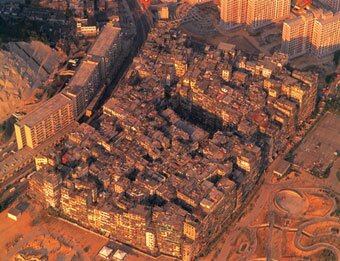 Chinese had always held a tiny toehold in the colony. The Walled City was an ancient fortress in Kowloon that stayed under Chinese control even after they ceded the surrounding territory to Britain in 1898. The area was completely neglected by China, and it grew into a center for criminal activity. By the 1980's, the population of the 0.01-square-mile area had swelled to 50,000, and the two countries agreed to evacuate and demolish the area, which had grown into one massive, tottering warren of makeshift buildings. Even though all of Hong Kong has reverted to Chinese control, the 20-mile-long border fence remains in place as the former colony is now a Special Administrative Region, and ordinary Chinese citizens need special permission even to visit. (For more on borders and security, check out the excellent blog Subtopia.)
Palestine: Palestine had been a British protectorate until 1948, when the UN partitioned the territory and the state of Israel was declared. During the period of the Mandate, British forces fought against a number of Jewish insurgent groups, including the Irgun and the famous Stern Gang. Seeking revenge for fallen comrades killed by the Zionists, a number of British soldiers left the army and began fighting alongside the Arabs in the bloody exchange of terrorist bombings that eventually escalated into the first Arab-Israeli War. (For more on this subject, see chapter four of Mike Davis' book Buda's Wagon: A Brief History of the Car Bomb.) Britain would return to the region in 1983 as part of the multinational peacekeeping force in the Lebanese Civil War.
 Johannesburg: For the past several decades, civil conflict in Africa has provided ample opportunities for enterprising British and Afrikaner mercenaries. South Africa became independent in 1910, and by the 1970's, Britain's African empire was all but gone, with the exception of Southern Rhodesia. In 1965 the colony's white-dominated government declared independence, which the home country never recognized. This unilateral declaration and the imposition of apartheid-like rule sparked a long and bloody civil war, known as the Rhodesian Bush War. During this period, the Republic of Rhodesia, as the country was called, was only recognized by South Africa, who was fighting alongside the white government against black insurgent groups, and Britain successfully lobbied the UN to impose sanctions on the country. In 1979, the UK brokered the Lancaster House Agreement, which paved the way for elections the following year. As part of the agreement, the country reverted to British control between December 15, 1979 and April 18, 1980, when the elected government of Robert Mugabe took control.
Even long after the sun had set, so to speak, there were plenty of war zones and fence lines for Tommies to walk. The British Empire still technically exists, though it has been reduced to a scattered collection of islands and few rocky promontories. I have created a map showing the empire as it is today, and as it was in 1979, including the various places discussed above.

[Click on the image to enlarge]


 Posts


