Showing posts with label Stimulus. Show all posts

Thursday, June 18, 2009

Wednesday Links: Recession Solutions

BROOKLYN, New York -- Everyone is trying to cope with economic hardships. The Russian government is giving people free lumber. New Yorkers can no longer steal paper plates from their local Whole Foods. And Oprah just wants you to read The Secret and think positively to solve all of your financial, emotional, and medical problems.

Wall Street Journal: Let the forest be your stimulus.
Despite having the third-largest hard currency reserves in the world, Russia still can't spend its way out of economic oblivion. So instead, the government is letting ordinary citizens fell timber, prospect for gold and plant potatoes for free in hopes of stimulating the economy.

New York Times: Russia's defense minister is a "stool salesman." Russia's military has long been plagued by a bloated officer corps, but in its current economic dire straits, the country can hardly afford to gently show these officers the door. They just roughly kick them to the curb.

Architects' Journal: We will build Europe's largest ... er ... parking lot.
The Russia Tower was slated to become Europe's tallest building, but financial mismanagement has brought the project to a halt, and little has been built since the cornerstone was laid two years ago. So much for Norman "The Apologist" Foster's wet dream of a building.

Geography of Jobs: Americans are equally screwed everywhere. That's not entirely true, but almost no major cities have been free from job losses. This map comes from consulting firm TIP Strategies and displays the change in the number of jobs for the 100 largest metropolitan areas since 2004.

WNYC: Forget NYSC, I'm joining the YMCA. Like the two-dollar bill story reported earlier, WNYC is asking listeners to submit their own uncommon indicators of the recession. The result is a fascinating interactive map of New York City.

Newsweek: Oprah wants you to inject things into your vagina.
Oprah got thoroughly skewered by Weston Kosova and Pat Wingert in this Newsweek cover story, where they portrayed her as an uncritical, weak-minded ninny who unflinchingly endorses crackpots and cranks. The results are hilarious.

Toronto Star: Foreigners don't like hockey. Canada has been lauded for its open and fair immigration policies. Now if they could only get the new arrivals to take up hockey.

ESPN: I wanna be like Barry. If you want to get close to Obama, join in on some hoops. This borders a bit on a cult of personality, but luckily basketball is already very popular in the US, so we don't risk facing a situation like Russia, where niche sports like tennis, judo and skiing saw their popularity skyrocket simply because the president (Yeltsin in the first case, Putin in the latter two) played them.

Metropolis Magazine: Meet America's stupidest mayor.
We have leveled our own broadsides against illiterate Boston mayor Tom Menino; now he may be facing a challenge to his authoritarian rule.

Tor Project: Help stop the Iranian thugocracy. Speaking of authoritarian rule, the Iranian government has become quite adept at thwarting journalists and would be protesters from gaining access to the Internet to get information about the unrest out of the country. This piece of software prevents the authorities from easily tracking them and cutting off their access, or worse, finding out their identity and personally targeting them. It can also be quite useful to bloggers and journalists in any part of the world.

Thursday, March 12, 2009

Generation Next: Federally Subsidized Pepsi

NEW YORK, New York -- You can't beat the real thing, New Yorkers. Unless, of course, the real thing is using federal stimulus money to subsidize soda purchases.

NY Governor David Paterson announced today that rather than raise taxes on soda and junk food to help close a gaping budget gap, stimulus money would be used to patch up the state's fiscal irresponsibilities, the New York Times reported.

With an estimated $14 billion in deficits, the state had planned to raise taxes on sugar water and junk food to raise over $1 billion. This plan, put forward by the state's health commission and Paterson, would have the additional effect of discouraging unhealthy eating -- one of the main causes of the obesity epidemic currently swelling waistbands across the state and country ... and increasingly making itself felt in obesity-related hospital bills and Medicare/Medicaid costs.

Despite cries that the tax was unfair to overweight individuals (who apparently need soda more than everybody else), I thought it was a pretty sensible idea. While the Legionnaire very fairly compared the NY State Legislature to King George III in its creation of absurdo levies, I think the idea is pretty palatable. Given the huge government deficits, taxes will inevitably be raised (even on Obama's middle class). The fairest, most efficient way to do this would be sales and consumption taxes, rather than piling ever more income taxes on people who grow more and more likely to seek out Swissmen named Bernard with deep vaults the more you tax them. And if you can achieve fairly reasonable policy objectives, like public health, in doing so, all the better.

Enter Sheldon Silver -- New York State Assembly Speaker, Dr. No, the High Priest of the Backroom Deal, and a likely Carnival of Corruption -- a man whose uniquely turbid power in Albany has quashed thousands of rational, good ideas in the past.

Paterson announced the kiboshing of the soda tax at a joint press conference with Silver, and my feline instincts tell me old Shelly was behind it.

The result is that $1.3 billion of tax increases composed of the soda tax as well as a tax on clothes over $100 will be eliminated. The Times reports that the remaining "flexible stimulus funds" will be $4 billion. So 25% of the discretionary stimulus funding (of $25 billion total in state stimulus aid) will go toward effectively subsidizing soda and Gucci blouses.

So much for completing the 2nd Avenue Subway, the various cash-strapped transit hubs, a rail link to LaGuardia, or building Moynihan Station. It's all about doing the Dew. Unless, of course, you're doing the Kate Spade.

It somehow smacks of 9/11 -- instead of being asked to join in shared sacrifice and buckle down to rein in deficits blowing open like saloon doors, we get to ... suck back a Mr. Pip. Sheldon Silver, let me just say: I like the Sprite in you.

Tuesday, February 24, 2009

State of the "Obamanation"

NEW YORK, New York -- Obama's speech was pretty good, but it could've and should've been better.

A more basic, fundamental, FDR-style explanation of why banks are important -- and why, if necessary, nationalization should not be held up for ideological reasons -- would've been nice.

And all this crap about how people need to get new mortgages and banks need to be forced to lend ... uh, terrible idea. This mess came about because banks were giving too many people too much money. Real disposable income was stagnant for the last 9 years while credit and mortgage lending exploded.

The answer is not to keep giving any schmuck a mortgage to prop up house prices that are still artificially high (remember: during the prime boom years, house prices were rising at nearly 20% nationally while median incomes actually decreased; dangerously easy credit and huge inflows of Chinese Central Bank investment made this possible, not any increase in income). House prices, unfortunately, need to keep falling until demand catches up with supply. The other alternative is to bulldoze the massive housing surplus.

Here're the ingredients in the witch's brew:
-A vacant homes for sale inventory at 2.6 million homes -- versus a historical average of 1.3 million
-A net change in households at approximately 700,000 in 2008
-Historical home ownership rates of 65% (it's closer to 68% now, down from 70% a few years ago, and it will probably fall to the sustainable historical average)

If we assume housing starts stop tomorrow (and they won't, unfortunately -- they're still actually outpacing housing sales!), then we have excess supply of 1.3 million homes, and a net change in home-owning households of about 500,000 per year. That means it'll take 2.6 years -- with no new houses built -- to work out the excess supply.

Obama and Congress need to stop incentivizing builders to construct new homes, and they need to stop giving huge tax breaks on mortgages (encouraging people to buy homes rather than rent, even if they don't have the money for a down payment or have a long-term stable job justifying mooring oneself to a home). The huge pustule of housing inventory needs to be burst either by destroying excess homes, or by slowly letting the people who can actually afford them buy them. Insofar as the second option leads to wrenching, gradual declines in house prices, the first is far preferable.

Instead, Obama seems to want to re-grease the credit wheels. That may mean buyers will burn off the supply a bit quicker, but it'll also encourage irresponsible developers to keep building (bad), and it will result in lots more people who can't afford homes buying them (really bad).

Similarly, Obama's comments that "I intend to hold these banks fully accountable for the assistance they receive, and this time they will have to clearly demonstrate how taxpayer dollars result in more lending for the American taxpayer" are a horrible, horrible move. I hope it's populist, political posturing. Banks have lent way, way too much. Debt-service ratios are at record highs versus real personal disposable income.

What's needed is to increase income and get bank leverage (the amount of debt a bank has versus its capital) to normal levels. The first can be done only by creating good, high-paying jobs. And Obama's smart enough to realize that investment in education, healthcare and energy is what'll do that. I'd add immigration reform and infrastructure investment to that list, along with a number of smaller policies, but his Big Three sure kick the crap out of their Detroit counterparts.

And nationalization of banks in order to clean out their debts via asset sales, including to a money-printing Treasury, is needed to get them out of the bad situation they're in -- which was caused by a government that encouraged increased mortgages and lending to people (see a pattern?). Obama needs to bite that bullet and, while I know Taro Aso was in the White House today and Japan's a pretty cool place, stop mimicking Japan on playing coy with bank losses. Clean them up by nationalization sooner rather than later.

The "pretty good" grade I'd give Obama comes from the fact most of his speech excellently pointed out the need for long-overdue in energy, healthcare and education -- the fundamental elements of an equally long-overdue US competitiveness strategy. But the banks, oh, the banks. Stop playing dumb, Barack, and put the silver bullet of nationalization in the heart of the insolvent zombie banks.

Wednesday, February 11, 2009

Boner of the Day

NEW YORK, New York -- No, this isn't anything that John Boner, House minority leader, did -- at least not directly. The day's boner move is the compromise reached between the competing House of Representatives stimulus bill and that put together by the Senate.

Here's the boner move, as reported by the New York Times:

Despite intense lobbying by governors around the country, the final deal slashed $25 billion from a proposed state fiscal stabilization fund, eliminated a $16 billion line item for school construction and sharply curtailed spending to provide health insurance for the unemployed.

The final agreement retained a $70 billion tax break to spare millions of middle-income Americans from paying the alternative minimum tax in 2009. Some Democrats decried the provision as a costly addition that would not lift the economy and that Congress would have approved, regardless of the recession.

Why's this bad? As the Wall Street Journal -- the nation's most conservative big paper -- writes: "A dollar sent to a state government to prevent layoffs or cuts in services yields a $1.38 economic boost, according to models used by the White House and Congress to calculate economic benefit. By contrast, the bill's inclusion of a measure to slow the expansion of the AMT will yield only 50 cents of stimulus for every dollar of avoided tax, the models predict."

So at the insistence of the Three Most Powerful People In The World -- bench-crossing Republican Senators Arlen Specter, Susan Collins and Olympia Snowe -- stimulative funding was replaced with a measure that taxpayers lose half their investment on, and that measure would've probably been passed in another bill later on, as happens every year.

Here's the upshot: "To win Republican votes, the final stimulus package is considerably leaner than what many economists say is now needed to jolt the economy, given its grave condition."

The question now is, what timeframe do we replace "day" with in "Boner of the Day"?

Monday, February 9, 2009

Stimulating Outside the Box: The Future of Culture

NEW YORK, New York -- After the Senate basically replaced a quarter of the stimulus' spending with tax cuts, it seems the US Congress is determined to keep shoving America down the economic trail blazed by former President George W. Bush and like-minded Reaganomists in the House and Senate.

Given that one of the victims of the Senate's slash-and-burn approach to government spending (which the most recent winner of the Nobel Prize in Economics derides as setting the course to disaster) is the meager $50 million that was to go to the National Endowment for the Arts, it may seem a lost cause to consider whether government funding for the arts should be stepped up, either in the stimulus or more broadly speaking. But we at the Walter Duranty Report believe if a cause is lost by the likes of gopher lookalike Mitch McConnell, it's worth picking back up -- in this case by way of a Cub Scout story.

When at the exalted level of Wolf Scout, I was once forced with my den to sing "Kids, What's the Matter With Kids Today?" from the musical "Bye, Bye, Birdie." That sucked a bushy tail.

I thought it was an annoying song, but I also got the sense there was an element of our parents complaining about us, their (degenerate) children. Ironically, the song was first written when they were children and teenagers. Although 1960's "Bye, Bye, Birdie" was satirical, it betrayed a fear of deteriorating cultural mores that the "Greatest Generation" saw in Elvis, rock'n'roll and Marlon Brando. Yet 1950s pop music and cinema is now seen as one of the greatest cultural contributions of America. The moral here is: Every generation seems to think it is on the brink of unprecedented cultural decay.

I'm sure many think that about today; and they have as strong a case as ever to make. Baltimore's XX-year-old Opera went belly up X months ago. In Los Angeles, the Museum of Contemporary Art, considered one of the country's top contemporary arts museums, was on the brink of closing in December. And to the horror of many, Brandeis University announced last week that it would shut down its art museum, a leading collection of postwar US art, and sell off the pieces in this, the worst market for art in decades, rather than cut operating costs throughout the university.

Not surprisingly, arts institutions (including the visual and performing arts and literature) are following the lead of nearly every other sector of business and society and hoping for salvation via the stimulus bill. But should there be increased funding for the arts, stimulus or no? Is this a good idea economically, artistically, or from the point of view of the kind of republican democracy the United States tries to be?

As a matter of pure economics in a recession, there's certainly a case to be made. As Michael Kaiser, head of one of the country's art heavyweights (Washington DC's Kennedy Center for the Performing Arts), recently told National Public Radio, the arts employ nearly 6 million Americans -- about 3% of the entire workforce.

According to arts industry insiders who spoke to the New York Times, that amounts to nearly $200 billion in economic contribution each year. As many note, jobs for artists are as high-paying and no less intrinsically worthy than plumbers', welders' or policemen's. But for reasons that aren't entirely clear -- maybe it's our latent fun-hating Puritan instincts -- we tend to think of any artist as a fag-o queer who needs to grow up and get a "real job."

Yet, in addition to the very real money that artists do make, there are deeper reasons for valuing the arts. Art gives us pleasure but also forces us to as hard questions about politics and the way we live our lives. Art improves our quality of life by allowing us to express ourselves and simply be among "nice things" (you'd be surprised what an impact that fluffy feeling can have on house prices or a place's ability to attract high-spending tourists). And art is the medium in which American culture exists and manifests itself. When that manifestation occurs, it is our No. 1 export and greatest source of international goodwill and softpower.

While arts organizations see endowments plummet and spectator numbers down as we all tighten our spending habits, the recent federal program the Big Read offers an easily-appropriated model for what government might do to help out, as a Guardian op-ed argued last month. That program, implemented after polls showed Americans were reading less and less, funded local reading groups, contests and programs, often through schools, and reading rates apparently improved. Today, there could be a Big Play or a Big Paint to use federal funds to underwrite locally organized theater performances at town festivals or in schools. Similarly, public works programs could be organized to hire young artists to paint murals on dreary government buildings or the increasing number of foreclosed and abandoned homes.

One of the most pressing questions, though, is whether to bail out large organizations on the brink of insolvency. No hands have been forced here yet (although arts groups scarily foresee up to 10,000 organizations disappearing this year), but it would seem reasonable for the federal government to provide funding for state and city governments to close budget caps and prevent further economic deterioration. That level of government is probably best suited to determine what cultural institutions should be kept from going under for economic or cultural reasons. Unfortunately, the Senate Repulicans and their Democratic enablers think people should be given money to stupidly invest their money in tract homes rather than prevent massive budget holes and service cuts at the state level.

"Lost Causer" McConnell 1, Duranty 0.

The longer-term role of government in the arts presents another difficult question.

It always strikes me as odd that the US, in giving so little government money to the arts either directly or in the form of commissioning murals or artistic flourishes for government buildings or infrastructure as it did until WWII, seems to care so little about the arts. Countries like France and Germany offer arts organizations nearly 20 times as much per capita in national, state and municipal funding. What confuses me is how any congressman can walk by Rockefeller Center, with its incredible Depression-era murals, statues and other public art, and not want to re-create that in the public works he votes to fund?

For the first time in the post-Mapplethorpe era, the current US president has made it clear that the arts are important to the nation's well-being. This perceived open window has caused some to call for the establishment of a Cabinet-level secretary of the arts to streamline and centralize government-backed arts programs. Yet concerns of centralizing "culture" in one person or agency (as in this ham-fisted and generally bone-headed WSJ op-ed) can't be dismissed -- would an agency have too monolithic an effect on a currently vibrant and diverse arts scene? Could it not pick political favorites? (I can see a Bush arts secretary funding Creed heavily and asking Jars of Clay to perform at the Kennedy Center.)

Moreover, there is the question of Republican angst. Members of that party call art "pork," not realizing that art and pork, like defense spending and pork or "homeland" security and transportation funding, are not mutually dependent and can actually both be good for regional economies. Indeed, the ranking Republican members of the House committees overseeing the NEA today oddly seem to want it starved to death.

Perhaps, then, a longer-term solution would be not to create a Department of the Arts at the Cabinet level but instead to increase funding and cut confusion and bureaucratic red tape more simply. A reasonable recent proposal by Lincoln Center's general counsel would simplify the huge amounts of red tape created by the fractured hodgepodge of agencies that govern the finances of arts organizations, as well as create dedicated revenue streams of federal aid to the arts at no cost to taxpayers. The government could offer tax incentives to Americans who increase charitable donations year on year; tax breaks for artists who donate works to charity auctions; or a federal counterpart to the vanity plates states like California use to generate revenue for the arts (stamps, e.g., or a tax opt-in).

Even more powerful may be the high-placed friend the arts may be gaining in Barack Obama. Jed Perl wrote last month on the value of symbolic gestures Obama can provide to the arts, recalling JFK's invitation to Pablo Casals to play Schumann in the White House not only inspired Americans to buy a classical music record or see a concert but reminded the nation that a Spaniard playing a German's composition was indeed American art.

The Economist's More Intelligent Life reported last month that high culture is actually growing in popularity, and perhaps it's time to finally stop wondering, "What's the matter with kids today." There may yet be hope arts institutions will live, even if they're facing financial hardship today.

McConnell is still up, over the WDR. Here's hoping Obama's magic dust, if there's still much left after the Daschle fiasco, rubs off on the smarting arts organizations across the country, either via funding, bureaucratic overhaul, or sheer symbolic value.

Wednesday, February 4, 2009

Of Human Idiocy

NEW YORK, New York -- Bad news loves company, eh? While the Republitards keep up their thuggery to get all of the spending -- i.e., the stuff that works -- cut out of the stimulus, they wield a knife in one hand and spoon on horrible additions with the other.

The Times reports tonight that the Republitards hope to "address the recession" by throwing $15K at anyone dumb enough to buy a home now. It's like the opposite of survival of the fittest -- encourage people to do the dumbest thing they could right now. It makes me hope that Washington, DC, will flood not only with unemployed graduates looking to join Obama's administration but also with some goons looking to push Mitch McConnell into the Capitol's choicest puddle.

McConnell and the Republicans continue to meddle with a stimulus package that Americans support 2 to 1, and the Democrats seem to roll over like the Obama's dog-in-waiting. Congress needs to get it into its collective head: encouraging people to take on more assets they can't afford is NOT a solution. The solution is creating work so they actually have some income. Ok, so we now encourage people who can't afford to buy homes to buy homes because they get $15,000 in subsidies. That's maybe 5-10% off the sticker price. If you can't afford a mortgage on $250,000, you probably can't afford $235,000.

One of the big problems now is that there are too many homes -- there's a 13-month inventory. If you can't get that down to 7 months, the problem won't go away. Government should start paying construction firms NOT to build homes and start demolishing them, not encouraging people to buy them.

Moreover, contrary to both Dem and Republican conventional wisdom, home ownership is not in itself an innate good. Especially in times of recession, distorting markets to force more people than is natural to buy homes is a shit idea: It means the labor market is much less flexible as people are tied to their home. In a poor economy, you want to give people maximum flexibility so they can head to the jobs they're qualified for, wherever they may be. Don't encourage people to stay in Cleveland or LA for that matter if the jobs are in Phoenix (or Flint for all I know). Idiotsidiotsidiots. Is there an enlightened nation (Lilliput? Laputa? Eldorado? Canada?) that can pleaseprettyplease invade the US South?

P.S. When someone gorges themself on Mal-o-mars, do you pay them to eat more? That's probably the aptest analogy I can think of with trying to reinflate the housing bubble. There are too many houses, and there's no underlying demand for them in a normal credit environment. Propping them up seems akin to Japan Syndrome -- there is no plan to create a "bad bank" or nationalize the banks to cough up the poison they've got, nor is there a willingness to let house prices hit a bottom the market supports. Until we recognize the losses, it'll be a long, hard climb to move on. Obama and the Democrats were elected to take action, and they seemed to want to do that. Instead, they seem to be mucking about and overly willing to bring themselves down to the level of John Boner. They need to return to Earth.

Tuesday, February 3, 2009

Why Highways and Cities Never Get Along (Pt. 4 of 4)

BOULDER, Colorado -- To conclude our series on infrastructure spending and the federal stimulus plan, I will provide a little historical perspective on these sorts of vast national projects, specifically the largest such effort ever undertaken by this country, the construction of the Interstate Highway System.

America's cities have never gotten along well with its network of highways in large part because nobody put very much thought into how the two would interact. Historian Lewis Mumford denounced the project in the 1950's, noting, "When the American people, through their Congress, voted a little while ago for a $26 billion highway program, the most charitable thing to assume about this action is that they hadn’t the faintest notion of what they were doing.”

The federal government had never paid very much attention to building roads, leaving much of the responsibility for it up to the states. It was not until 1912 that a nationwide road-building program was introduced, but this was limited to rural areas only. Cities were expected to cover the costs of their own infrastructure, and this bias of Washington in favor of funding rural projects was reiterated in appropriations bills in 1919, 1921, 1928, and throughout the New Deal programs. The purpose of building roads was to "bring the farmers out of the mud."

Then came the great day for the country's roads: the passage of the Federal Aid Highway Act in 1956, which established what we now know as the Eisenhower Interstate Highway System. This network of multi-lane, limited-access, high-speed roadways would link the country together more closely, facilitate commerce, allow for settlement of suburban and rural areas, and aid the national defense. According the president's highway committes, the particular design of the highways was chosen for four main reasons: (1) it could carry more vehicles at higher speeds than existing types of roads; (2) limited-access highways have fewer accidents per vehicle-mile; (3) they are cheaper to build then other types of roads of similar size; (4) they preserve “natural roadside beauty, prevent roadside blight, open up new territory for industrial commercial, and residential development, and can serve as buffers between different types of land development.”

Many planners did not anticipate the rapid outward migration from the central cities that the highways created, but the US military did, and they actively encouraged it. They felt that lower density with dispersed population centers and industry would make the country less susceptible to nuclear attack by providing the Soviets with fewer high-value targets. The spoke and wheel configuration of most cities' highways would also facilitate evacuation in the event of a strike. Nuclear armageddon is no laughing matter, but perhaps this was not the best use of resources.

While these purposes seemed appropriate for the nation as a whole at the time, the system was utterly devoid of any attention to how highways would serve cities. There was no means for coordinating between federal planners and city administrators, and roadbeds were laid without consideration of the urban environments they cut through. The disruption from highway construction fell disproportionately on cities' low-income residents, and there were no federal appropriations for resettling displaced people. Rather than being arteries for the city, highways became barriers and outward conduits, drawing the population, commerce and life of the city out to the suburbs. Chicago's Skyway, Boston's central artery, and countless others are glaring examples of the bifurcating effect of elevated highways. But Boston especially illustrates how difficult these problems are to rectify; the Big Dig cost $22 billion just to recover 25 acres of land from the downtown's impenetrable maze.

As I often do, I will now turn to my hometown of New Haven for an instructive example about the damaging effect of highways on urban environments. Construction of the Oak Street Connector, a spur off of the interchange between I-91 and I-95 that cut right into the downtown, was tied directly to a "slum removal" program. Most of the highway was never built, but the neighborhood was still razed, leaving a swath of still unoccupied land where a neighborhood used to be.

It is worth noting that until very recently, pedestrians, cyclists, and buses were not given much thought when planning highways. New Haven's downtown is now crossed with broad one-way streets, designed to facilitate access to the interstate on-ramps. But the traffic patterns allow cars to travel too quickly through the central business district, which does not encourage commerce and makes the streets dangerous for people not in automobiles. As part of the effort to slow traffic and develop more walkable urban spaces, the city is installing bike lanes and new transit options, like streetcars. Eventually, they may even turn the one-way thoroughfares back into tight, two-way streets with curbside parking, all of which encourage people to slow and see what the city has to offer. It may be difficult to admit, but if we want to reconstruct the dense urban environments with walkable neighborhoods and reliable mass transit, we may have to sacrifice some of the speed of travel that we have become accustomed to.

'

If the feds won't build it, bring your own bike lane.

How does this all relate the the stimulus bill that the Senate is currently slicing and dicing? Well, when it comes to highways, we still do not really know what we are doing. Highway construction is attractive because of its "shovel-readiness" (a totally made up and fatuous notion), but it is still wrought with problems, especially for cities. Building roads and bridges for the sake of building provides few economic benefits, and simply makes the environment less livable, as Japan learned in the 1990's. Meanwhile, important mass transit services are being slashed just when ridership is increasing, and they have little hope of being rescued by federal cash.

We do have innovate transportation alternatives that are deserving of funding, like light rail systems, dedicated bus lanes, and congestion pricing. This is a better use of money, and will be better for the nation's cities, than road widening and re-paving, which may only exacerbate existing transit problems.

Monday, February 2, 2009

What the Stimulus Could Do for Our Built Environment (Part 3 of 4)

NEW YORK, New York -- Now that we've made the case for a) why Congress and the Obama administration should focus on public spending, rather than tax cuts, in the stimulus bill; and b) why infrastructure spending should look past the conventional wisdom of throwing money at tar to repave roads and toward mass-transit spending, the next two posts will take up the question of what it might actually look like -- what aesthetic principles, (in this post) in infrastructure or (in the following post) in our lives in general, we would do well to embrace.

Let's start by putting things in a near-term historical perspective. It may be appropriate to characterize the recent boom years, fueled as they were by real estate development, by the architecture that came to dominate them: Sparked by Frank Gehry's Guggenheim Bilbao, the age was defined by massive (and massively expensive) museums and other showpiece buildings warped into alternate-reality computer-generated shapes as well as legions of "signature" skyscrapers across the world's third- and fourth-tier cities. In other words, unreality and excess.

And with the boom times gone, so are the Bilbao days, with Boston Globe architecture critic Robert Campbell swinging the reaper for the days of cartoonish show architecture.

With the election of the first "metropolitan" (i.e., not rural or exurban) president since Teddy Roosevelt, combined with his emphasis on rebuilding the bonds of community and on urban policy, there are great hopes for what may emerge from under the Obama administration. Congress, the states, and the president himself would do well to understand a few general trends and, er, hopes:

1. Urban: As Blair Kamin of the Chicago Tribune writes, conversations about urban planning are taking place that are a level of magnitude more ambitious than anything that ever happened during the Bush years. At the same time, architects are scrambling toward urban planning and public projects and away from the Bilbao era's "icon" architecture.

Amid that, there is a sense the city -- and urban planning -- are mounting a "return," with the inauguration festivities and the huge crowds they attracted onto Pierre L'Enfant's as evidence. That may or may not be very accurate reasoning (it sounds like excessive Obamamania-inspired exuberance, though the inauguration did make for one hell of a mob scene), but architects and planners are nonetheless alternately holding their breath and jockeying for funds to make cities vital and sustainable as never before.

There are calls for creating grand urban spaces that only central planning can do, like New York's grid or DC's Mall -- both of which were successful, but that sort of central planning has a sketchy record. Three simpler ways to advance urban planning are to focus construction of new buildings funded by the stimulus (schools, hospitals, government buildings) on dense urban areas; on urban infill (i.e., building on empty lots, like parking asphalts); and on brownfield development (renewing existing, unused buildings, rather than building anew). And new buildings outside of cities should be built as part of transit-oriented developments -- accessible by mass transit and embracing the urban principles of density and mixed-use.

2. Grand:
Campbell of the Boston Globe fired an eloquent and perspective-filled volley across the new administration's bow last month when he called on any new public works programs to recall the days when America was still an up-and-coming power with a chip on its shoulder, as opposed to the more arrogant creature it's become on a governmental and collective level.

Before WWII, government at all levels in the United States built monumental, lasting structures that exuded a sense of pride and faith in classical democratic ideals. Afterward, government buildings became pared-down temples to the ordinary, as if embarrassed by their very existence. Think of any 1970s post office or school -- it's probably not only a depressing eyesore but falling apart. The 1990s saw a return of grand federal courthouses, but under George W. Bush (fittingly) government building projects were de-urbanized and moved to vanilla suburban sites deemed safer from terrorists; cookie-cutter and stripped-down Bauhaus designs were churned out; and the result was strip mall-esque structures like the new US Embassy in Berlin (left), which ignited much of Germany in anger against Washington for building such a hideous structure next to the Brandenburg Gate.

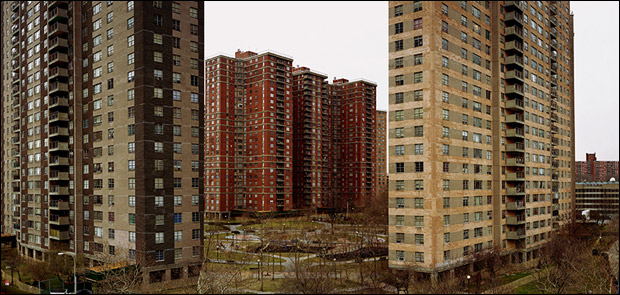
Campbell's words probably convey a warning as much as hope. Amid a general expectation that public works and other stimulus-propelled government spending will be the engine driving construction over the next few years, nobody knows what that new era of architecture will actually look like. Will it be grand, like the lasting bridges and buildings of the New Deal? Or will it be "value-engineered" to be as post-Gropius cheap as possible, similar to what characterized the last wave of government spending on buildings that stretched from 1946 with subsidized apartment projects for returning veterans to the 1970s and the Co-op City-style housing projects built across America's cities?

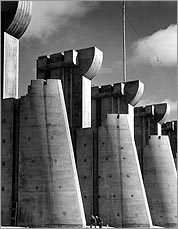
Our Canadian friends, also expecting infrastructure spending to head off deepening recession, remind us that infrastructure isn't merely functional, as it was treated in the postwar 20th century. As North Americans on either side of the US-Canada border rediscover cities and urbanization, it makes sense to again embrace public works. Sewage facilities, water-treatment plants, electrical stations (or turbines) can all be made into elements of beautification and pleasure. They are powerful enough to either chase away existing residents and result in deadzones; or, if built with the timelessness and sturdiness as a WPA dam, they can lead to the creation of new, hip neighborhoods, spurring development and construction at a time when house prices desperately need a pick-me-up. What Bob Corker may call a "boondoggle" could be a great stimulus for the housing markets of Nashville or Memphis.

Co-op City: Bob Corker, you do NOT want to wish this upon Ebeneezer Brezhnev himself

On the depressing topic of the Bob Corkers of the world, though, there are vocal critics in Congress of any spending that doesn't benefit their own district (they're generally called Republicans), which may mean our cities and landscapes will be scarred with more dollar-bin "tower-in-the-park" Bauhaus atrocities and housing projects. That may save a few billion dollars, but it arguably costs that many times over in damage done to quality of life and the built environment.

3. Traditional:
If schools, government buildings and public works are going to be built, one of the most efficient -- temporally, environmentally and fiscally -- ways of doing so is to quit the Modernist cigarettes the world has been smoking since WWII and re-adopt traditional building techniques.

Locally sourced natural materials like brick, wood and stone; windows that actually open; courtyards; densely built streets. All of those traditional practices are cheaper and less energy-intensive than the modernism that has come to define most institutional buildings for the past half century. And, since the institutional buildings are often designed by committee and picked by committee, it may be no surprise that most people who use them don't really care for them. Research suggests more traditional proportions (e.g., a building that isn't a dark rectangular slab 2 blocks wide and 21 stories tall) have fractal patterns found in human features that are inherently pleasant to our eyes and minds; that may help explain why Americans overwhelmingly prefer older buildings to newer ones (amenities aside) and choose to live in faux Colonial houses.

But that shouldn't prevent tomorrow's WPA architects from creating their own aesthetic: Just as FDR's administration channeled money into a contemporary style with a solidly traditional basis (Art Deco), so might we see a new style emerge that picks up where Art Deco left off, allowing us to move beyond the fake Cape Cod houses but staying safely away from Zaha Hadid's latest mothership.

4. Coordinated: Finally, if billions of dollars is going to be dropped on infrastructure, it would pay to think about what it looks like and how it interplays with the people who use it, transportation systems, and other infrastructure before it's built.

When transportation systems are built or upgraded, they should be connected across different modes of transport and done so in a way that attracts people rather than repels them. James Russell of Bloomberg uses Riverside Park in Manhattan as a case in point: The New Deal park continues to draw millions of New Yorkers who seek recreation there for its grand, commanding stone walls, monumental stairs and views of the Hudson and the cliffs that hem it in. But within, under and among the running and biking paths, baseball diamonds and picknicking areas, commuter rail and Amtrak trains carry millions to work; and a cleverly disguised highway runs through its center.

Sadly, as Russell argues, we can't even consider something like that today, so debased are our capabilities, expectations and (among Republican congresspeople) ability to plan for the long term. But if we're going to be building new schools, hospitals or government buildings, building them so in densely built neighborhoods and connecting them to the communities they're in via dedicated bus lanes or bike lanes planted with local vegetation could allow "mini Riverside Parks" to come about. What's clear is that the focus on costly, quality-of-life-killing highways and the dependence on elected officials in choosing projects are not going to help.

A little sense in coordinating the various functions of a community when building public works goes a long way: Would Phoenix or Las Vegas be built today, starved as they are of any sustainable water source? Should money be thrown at draining the Colorado River to quench Vegas' thirst? (New motto: "What's drunk in Vegas, probably didn't come from Vegas.") Should stimulus money be used to rebuild a place like Galveston, TX, which will only be knocked down again in a matter of time, or flood-prone areas? Good coordination focuses on successful ideas and communities rather than throwing money at the poorly performing ones.

Perhaps by focusing on those broad principles we can overcome our terrible postwar track record. After all, if they could build Riverside Park when that was prime shanty-town real estate, what's preventing us from attempting something similar in other shanty-towns?

Sunday, February 1, 2009

How to Make Infrastructure Investments Smart: Trends in Urban Planning (Pt. 2 of 4)

NEW YORK, New York -- Tonight brought the surprisingly-good-but-still-far-from-a-sealed-deal news that Republican Senators are looking to modify the stimulus bill and a re-worked plan may increase infrastructure spending in the stimulus bill by as much as $20 billion to $30 billion.

As we argued in Part 1 of this mini-series on stimulus spending, with a bill so large and unprecedented (as a Washington Post op-ed notes, it reverses a long trend of Congress shirking from any spending to increase US economic competitiveness), money should be spent wisely and in a way that improves the country's long-term economic prospects.

Infrastructure spending sounds like a good idea for reasons we already discussed. But once Congress decides to put money toward infrastructure, there of course is a wide range of choices that await. "Infrastructure" means anything from the electrical grid to telecoms to transportation infrastructure like ports, airports, roads and rail.

Since transportation infrastructure appears to be the area of stimulus infrastructure that attracts the largest amount of debate in Congress and would have the greatest effect on the economy, we'll focus on that. As the Brookings Institute notes, the sophistication and quality of a country's transport infrastructure play (and will increasingly play) an important role in its economic competitiveness -- and the US, while its postwar investments continue to pay dividends, has been coasting for the dangerously long period of 40 years and now needs $2.2 trillion in investment, according to the American Society of Civil Engineers. Since we've underinvested for so long, it's worth asking what's the best way to undertake a major capital renovation and rebuilding (or kapremont, as I would say if I was redoing my Soviet apartment) of America's infrastructure.

Most of the discussion of infrastructure spending seems to assume a) that most money should be given to "shovel-ready" projects that can be started quickly; and b) that these projects are exclusively road and bridge repairs. But while the logic of funding projects that can be quickly implemented (and quickly put people to work) is sound, the assumption that only re-tarring roads meets this description folds like me playing poker (f$%# you, poker). As the Legionnaire pointed out last week, there are dozens of major mass-transit infrastructure projects in New York City alone that are "shovel-ready," and not only do other cities have similar numbers of ready-to-go mass-transit projects, but dozens of major public transportation systems are facing budget shortfalls that will lead to service cuts.

The justification, then, of putting the vast brunt of stimulus money toward road and bridge repairs because no other "shovel-ready" projects can be found is chimerical and largely based on legislative desire to appease testy rural voters, on hopes to gain kickbacks from the mobsters who have a monopoly on road-repair industries, or on the misplaced priorities of state legislatures that oversee most infrastructure spending. But do road and bridge repairs stand on their own merits as worthy expenditures, or are other areas of transportation spending (mass transit, rail projects, ports or airports) a better investment?

As the Wall Street Journal reported last week, the "shovel-ready" roads-and-bridges spending as currently construed would be used mainly for repairs to existing roads. A large part of this is that state and municipal governments are cutting back new road, bridge and other infrastructure projects because of budget shortfalls and declining revenues from gasoline taxes as that commodity's price (and the taxes that are pegged to it) falls. The WSJ writes that these cut-backs are so large that the stimulus money would only partially offset them -- meaning that it would be used to repair (i.e., put some tar on) existing roads, not create new ones.

Beyond that, given what we now know about environmental concerns, economic efficiencies and even emerging demographic patterns, building a new network of roads would be, like, so 1950s.

As a large number of Americans (fueled in part by empty-nester Baby Boomers looking both to downsize their suburban homes and reinvigorate their lives as well as by 20-somethings who grew up on Seinfeld and Friends and are opting to live in cities) move to cities from suburbs, light rail and other transit schemes that link the various anodes of economic and cultural activity of a metro area would be more in tune with sustainable development trends than building more highways. There's a fairly widespread recognition of that, including by David Brooks here.

Perhaps even more intriguingly, Scientific American writes that building roads actually hurts efficiencies not only for the empty-nesters who think moving to New York and taking the subway turns them into Lou Reed but also for ... drivers themselves. Recent studies show that removing streets actually makes traffic flows more efficient. That's because drivers, when given fewer choices, don't strive as much to maximize their own efficiency, which paradoxically allows both them and other drivers to get to their destination faster. The science behind this is based on Game Theory's Nash Equilibrium (named after Russell Crowe, before he got fat and started hitting people) and a mathematical theorem called Braess's Paradox that applies to networks.


These theorems are reflected in driving activity, as shown in studies that Scientific American cites. For anyone living in San Francisco (see video above) or Boston, you may know that the removal of 10-lane megahighways from city centers does not result in increased congestion. And cities in the US are following European patterns in converting city streets into pedestrian plazas -- and finding that gridlock is little affected.

Instead of paying for roads or even traffic lights or signs (which Scientific American notes also lead to traffic inefficiencies), Congress would be smart to invest in municipal transportation planning offices, which don't exist in many cities and states, or in innovative new open-source software that lets city planners use data collected by crowdsourcing and analysis of movement patterns to create more efficient public transit systems. Similarly, rather than repave a parking lot, doing away with on-street parking spaces altogether increases efficiencies by encouraging people to take public transit, bike, or walk. Of course, Rush Limbaugh will call a dime spent on any of this a boondoggle. But listening to him when allotting infrastructure funding is as smart as asking a Tennessee Senator for help studying for a biology exam (oh, wait, that friend of William Jennings Bryan actually went to Harvard Medical School -- note to self: Harvard Medical School must be a mess).

Other ways to put stimulus infrastructure spending to intelligent use could include
  • Addressing the in-the-works mass-transit and other non-road-and-bridge infrastructure projects in New York and elsewhere, and funding the public-transit systems forced to cut service
  • Setting up a national infrastructure bank to oversee long-term spending to coordinate ports, airports, rail of all types and roads
  • Upgrades to ports and the air-traffic control system
  • New runways and even airports in the most congested areas that cause flight delays across the US and world (Step One would be to convert the existing New York-area Stewart Airport into a commercial hub and constructing a high-speed train to allow easy access to it)
  • Light-rail to connect otherwise unconnected points of metro areas (e.g., suburb-to-suburb routes)
  • High-speed train corridors that are close to shovel-ready including the Northeast Corridor's Acela route and California's rail corridor
  • Incentives for transit-oriented development around new commuter- or light- or subway-rail hubs (as the West Coast is already doing)
  • Spending on grand new rail stations would create a powerful, immediate stimulus and recapture some of the glory and inspiration we once saw as desirable (and if we no longer care about creating monumental spaces, we can at least justify it economically by knowing that tourists sure like seeing them)
  • Simple additions of bike lanes; plazas and sidewalk space in place of traffic lanes; and dedicated bus lanes on streets would make cities more walkable, satisfying the nearly 80% of Americans who surveys say would like to see more walkable cities realized via increased public-transit investment
  • Upgrades to the existing freight rail network to save hundreds of billions of dollars in enery costs and transportation efficiencies, as Washington Monthly writes this month
  • And investments in IT to coordinate on a city level both parking for cars as well as traffic flows via stoplights and other mechanisms, electronic toll systems, congestion fees, and (on a somewhat-unrelated note) emergency-responder coordination software -- IBM is pioneering this space
"Shovel-ready" projects could be found in any of those areas, and they'd be a good first step toward the later introduction of a substantive gasoline tax, creation of a National Infrastructure Bank and coordinated investment in ports, airports and ... you get the picture.

But that doesn't mean we should forget about the interstate highway system, which is still an engineering marvel and connects population centers in the US better than any other country does. However, we do need to think about it more ambitiously than as a roadway that billions ought to be spent to repave -- after all, its primary use (as a conduit for getting goods from the shopping mall) is going the way of the dodo as malls lose their lustre. As Metropolis Magazine argues, using highway median strips for new high-speed or commuter train routes is both an efficient and natural move, and is already happening. Additionally, a nationwide smart grid that allows wind power from North Dakota or solar power from Arizona to reach the East Coast could also be built under or along the interstates. Connect the dots and you see that if highways become transit and energy corridors, perhaps the Roy Rogerses and acres of parking lots at rest stops could actually give way to densely built transit-oriented developments. It sure as hell wouldn't take much arm-twisting to convince the Legionnaire and me to move into a Dairy Queen.

Saturday, January 31, 2009

Why Public Spending, Not Tax Cuts, Is Needed for the Stimulus (Pt. 1 of 4)

NEW YORK, New York -- As the stimulus bill makes its way to the Senate this week, Republican politicians and pundits are increasing calls to strip it of spending and add tax cuts.

The New York Times' David Brooks has denounced the "permanent Democratic agenda" of healthcare spending, alternative energy investment and ... Pell Grants, calling instead for cuts to the payroll tax that funds Social Security. Meanwhile, noted prescription drug abuser and all-around lardass Rush Limbaugh (whose power over Republican lawmakers is reportedly growing) wants to use the stimulus as an "experiment" to "prove" how well corporate tax cuts work.

It's not just enough to say, "Are you f&$%ing kidding me, you Oxy-Contin-addicted swine?!" because millions of Americans (and probably no more than a dozen people in any other country) take these things seriously.

In this post we'll sketch out a quick (because it's almost 1 a.m.) defense of public spending as an economic stimulus; and in the following three posts, we'll argue for ways that money could be spent to improve quality of life by showing how urban planning principles are currently changing; how infrastructure spending can take advantage of that; and why putting some of the money toward the arts would be a good idea.

So why do we think public-works spending will be a more effective stimulus than Rush Limbaugh and John Boner's tax cuts?

The quickest explanation is that the reason many consumers seem to be cutting back their spending -- and thereby sending the economy into a tailspin -- is that people are afraid for their income rather than their wealth. This is a point raised in a slightly different context by James Surowiecki in the New Yorker last week; the short of it is that we're buying fewer Wiis, Chevys and expensive meals not because we are flat-out broke (i.e., lacking in wealth) and, if given $20 or $500, we'd be purchasing like a panhandling wino who gets a tenner, but because we're worried about having a solid income in a year's time. Unemployment could hit double digits this quarter, and consumer confidence is in the doldrums. If most of us who aren't dirt-poor get a $500 tax break (an addition to our wealth, not a permanent increase in our income), we'll stash it away for the rainy day we fear is ahead, rather than take our stimulative duties seriously and buy 20 lbs. of steel, put in a few orders for some durable goods, and grab ourselves a 42" TV.

What's needed to rev up consumer confidence is jobs confidence. When employment expands, the broader economy jumps, and we all start breathing a sigh of relief that we will indeed still have an income in half a year -- freeing us to re-max out our credit cards today and kick the economy back into debt-driven gear.

But if we're going to max out our national credit card with China, we need to do more than just create jobs. John Maynard Keynes might have famously said that a government could stimulate an economy by paying people to dig holes and fill them up (see the dudes to the right), but even if that pulls us out of recession a tad faster, a policy of utterly wasteful spending is not worth potentially indebting ourselves for decades to come.

The challenge, then, is to create jobs that do lasting good, something that President Obama and advisers like Rahm Emanuel are certainly aware of. But, as David Leonhardt, David Sanger and ... David Leonhardt have explored in the New York Times, determining how to successfully transform the economy into a 21st-century "star" that can quickly get back on the trail to strong long-term economic growth is no small feat.

As Leonhardt notes, America has fallen far from benchmarks it once set in research and development, transportation efficiencies, education, healthcare and even Internet access. If we are to thrive in the 21st century, we need to get back to work in re-establishing these areas and many others.

The rub, however, is that investing into these areas doesn't necessarily equal the short-term growth that can help snap the recession. Economist and former Federal Reserve member Alice Rivlin has argued to Congress that it should quickly adopt a scaled-down stimulus package intended to defibrillate the economy, then pass the legislation that puts us on firm footing for the longer term. The question becomes: What sort of targeted spending can put us in good stead to grow over the long run while also attack the recession?

Tax cuts, if confined to the poorest Americans, would be fast-acting. But because their return is terrible (30 to 40 cents on the dollar), and because of the need for income stability rather than wealth that we described above, tax cuts may provide a short-term kick but will clearly need to give way to spending to create jobs and pull up the economy.

The greatest need -- and most glaring hole in the bill the House passed -- is infrastructure spending. As Leonhardt notes, the infrastructure spending the House lazily fell back on is unlikely to provide the transportation paradigm shifts needed to improve our decaying 20th-century infrastructure to make it the virtue in the 21st century as it was in the 20th:

In the current system, the federal government sends money to states without any real effort to evaluate whether it will pay for worthy projects. States rarely do serious analyses of their own. They build new roads before fixing old ones. They don’t consider whether those new roads will lead to faster traffic or simply more traffic. They spend millions of dollars on legislators’ pet projects and hulking new sports stadiums. In the world of infrastructure, cost-benefit analysis is still a science of the future.

So what should be done? As Leonhardt advocates, an infrastructure bank could be created (as Obama promised in the campaign) to oversee spending and make less pork-minded decisions than Congress does; new state cost-benefit-analysis offices could be created to make sure money is spent intelligently (which it isn't now); and rather than spending $30 billion to re-tar roads, money could be spent covering the budget shortfalls of 51 transit systems. As it stands, with service cuts and fare increases proposed, people will have a harder time getting to work -- or looking for it, as Leonhardt says. And only by investing in mass transit will we be following our own credos on building a green economy.

While Congress appears stubbornly set on infrastructure projects it calls "shovel-ready" (the meaning of this Orwellian phrase has apparently been set to mean: "tarring of highways and doing other things that the Mafia-affiliated construction companies that donate to my campaign tell me they like"), others are pushing for longer-term transformative projects.

The excitement of charts is ... off the chart! (Charts from the Brookings Institute)

Bloomberg is one of many media outlets pushing for public works, and the American Institute of Architects says infrastructure projects could create 1.6 million jobs. But the most salient voice in the debate may be the Brookings Institute. Noting that the US is the one country in the developed world that has no national infrastructure strategy; accounting for spending of infrastructure funds; or coordination of ports, highways, airports, freight rail, mass transit and passenger rail -- and hammering home how much of a disadvantage that puts us on compared to competitor nations -- the Brookings Institute released a laundry list of recommendations that should be developed immediately to increase efficiencies in the economy. These include smarter strategizing, investments in mass transit, and in particular the admonition that stimulus spending should be concentrated on the 100 largest metropolitan areas that generate 75% of GDP. That sounds good to me. Leave the big-time health and education stuff for later, perhaps, but get a big, targeted infrastructure bill passed ASAP to create jobs and restore income and consumer confidence. Oh, and let's embrace innovative infrastructure thinking (as every other country on Earth has), rather than Don Guido and his $50,000 donation to our campaign war chests.

UPDATE: Ok, it's after 2 a.m. I'm tired. The Walter Duranty Report will get back to you with parts 2 through 4 tomorrow. G'night.

Thursday, January 29, 2009

More Stimulus-ball: Why Doesn't Jeff Immelt Want Uncle Sam to Buy American?

NEW YORK, New York -- The Washington Post reports tonight that many multinational firms angling to get a piece at the infrastructure spending in the stimulus package that is making its way through Congress are lobbying to strike a "Buy American" provision from the bill.

Following precedents from the New Deal and other federal public works programs, the provision would require materials used in infrastructure projects to be produced in the United States. Materials like steel and concrete would be especially large inputs, as would more advanced finished products. The objective, naturally, is to lift domestic output -- steel production is currently wilting at 43% of capacity, while without roughly 90% capacity, steel companies waste huge amounts of money keeping their furnaces and production lines running.

However, multinationals including General Electric, Caterpillar and aerospace companies are protesting that the measure amounts to protectionism and that foreign governments will in response make export of their products more difficult.

At first glance, GE & co. have no right to whine -- if the purpose of the stimulus is to create American jobs, it should actually attempt to do so; and if Washington is going to spend $1 trillion of taxpayer dollars, taxpayers have every right to demand they materially benefit from it. Few would disagree that taxpayers' interests, not those of GE (while also a taxpayer, its tax receipts pale in contrast to 200 million working Americans'), should take precedence.

On the other hand, the massive current-account deficits that have built up in the US (translation: we import way more than we export) will require a huge pick-up in exports down the road. To that end, the United States is right to pursue free-trade agreements with trading partners, and any sniff of American protectionism could well result in much more direct protectionism from other nations itching to bring up their own tariffs or spite American firms.

But if you look a little bit closer, that logic appears less solid.

A spokesman for Caterpillar provided the following rationale to the Post: "Any student of history will tell you that one of the most significant mistakes of the 1930s is when the US embraced protectionism. It had a cascading effect that ground world trade almost to a halt, and turned a one-year recession into the Great Depression."

They didn't call them "Hoovervilles" and not "New Deal-villes" for nothing

That's all technically true, but that protectionism came in the form of tariffs during the Hoover days, not the New Deal's "Buy American" provision. Stipulating that taxpayer-funded public works programs put taxpayers to work is a fairly routine practice in all local and federal public works projects. The most recent example I visited is the new Capitol Visitors' Center in Washington, D.C. As is standard practice, it used American-made materials. It may have come in in over budget and late, but that was the fault of security concerns, not materials suppliers, and nobody thinks it amounted to protectionism. Similarly, for security but also economic reasons, one of the largest areas of federal spending -- defense -- relies overwhelmingly on domestic production. That seems to sit fine with other countries.

Moreover, GE, Caterpillar and (presumably) Boeing may now be crying about stimulus provisions stipulating US-made products are used in road construction, but a potential reason for that is that they themselves will be at a disadvantage in procuring those contracts. GE and Boeing have spent years trying to move production from the US to China, seeing no reason at the time to invest in their historic home countries. But as the Economist notes, that lack of investment in US production, R&D and other capital projects was a major factor in the global financial collapse:
"After the dotcom bust, American firms turned cautious and investment spending was weak. That ruled out a natural home for foreign capital [in the US]. Faced with strong external demand for AAA-rated assets, the financial system got creative. Marginal home loans were packaged into supposedly safe securities. That supply of credit lifted house prices and spurred a boom in residential construction, which filled the gap in demand left by sluggish business investment."
In other words, if US companies had invested in American cap-ex, China's $2 trillion tidal wave of investment into bonds could've been put to more productive use than puffing up house prices and encouraging subprime mortgages and excessive consumerism. That China dumped money on consumers is as much the fault of US businesses that stopped investing in production as it is of the Chinese central government. And as the dollar remains a primary safehaven currency, capital inflows will only continue. Why allow GE, Boeing & co. to continue slicing investment in the US when inflows are looking for more productive investment than the credit-card debt derivatives they were able to find in the Outsourcing Age?

Perhaps, then, the "Buy American" provision is a cheeky way to show companies that while Washington doesn't demand they base production here to gain access to the domestic market (as China does) or grant WTO-violating subsidies in return for direct investment in facilities (ditto), there actually is a material benefit to investing in US-based facilities and employees in times like this.

In a word, the rush to move production to low-cost labor markets can hardly be said at this point to have been a smashing success in the United States. Any economist can tell you we spend too much and make too little. This crisis, and the stimulus, offer a decisive first step toward changing that.

Stepping back, crises are often the only times a people tends to reflect on the fundamentals of its economy, political system and society. So it is now in an America that had grown haughty and lazy in recent years. Even the Clinton-era lead negotiator who established Permanent Normalized Trade Relations with China now wonders whether that deal has actually helped the United States. At the time, it was thought PNTR would see a dramatic increase in both Chinese imports and US exports. Because of Chinese protectionism, exporter-subsidies, yuan policy and investment to keep the dollar weak, only half of that equation came true.

WWCD: Is Beijing's public spending likely to source from the US with its own workers losing jobs?

Perhaps GE and Boeing should do some reflecting of their own now: Rather than encourage the US government to plunge the polity into long-term debt buying Chinese construction materials and finished goods, is it not worth asking whether China, long hostile to imported goods (and now even more so), will actually grant access to its own public works program? Do not doubt that with Chinese factories closing, unemployment soaring and the yuan getting depreciated, any access GE gets to Chinese spending will be the direct result of agreement to build its goods in Chinese factories. China already doesn't allow US-made goods from DVDs to steel to banks to enter its market; Caterpillar or GE would only be able to tap the Chinese kitty if they do so with Chinese-made goods.

At the end of the day, it is frighteningly possible that Jeff Immelt's lobbying could be as disastrous as PNTR, resulting in a federally funded mass purchase of Chinese steel and electricity network equipment while GE nonetheless is shut out of China's public works program. To quote our Cold Warrior friend John McCain, "That's not change we can believe in."

Wednesday, January 28, 2009

City Governments Want to Cut Out the Middleman for Stimulus Cash

BOULDER, Colorado -- With billions of dollars for infrastructure, medical care and education about to be disbursed to the states as part of the federal stimulus bill, many cities are trying to bypass their respective state houses and receive the federal dollars directly for their favored projects.

Recently officials from three of Connecticut's largest cities - New Haven, Stamford, and Bridgeport - gathered to discuss how to approach the Washington beancounters without having to go begging to Hartford and Gov. Jodi Rell, the New Haven Independent reported.

The cities, along with Hartford and Waterbury, are part of a group known as Connecticut Elected Local Leaders Organized, or CELLO. Connecticut lacks any sort of regional planning or administration for its cities, meaning there is little coordination with suburban communities when it comes to things like infrastructure planning. Instead, plans are imposed on the state level, and impoverished cities are usually given less attention than more affluent suburbs.

The Connecticut cities are not alone in these sentiments. Chicago has already made an appeal to receive stimulus money directly, and many others will likely follow suit. Certainly New York City has an interest in bypassing Albany, since the state government has stymied a number of major projects in recent years, such as the West Side Rail Yards development and the city's congestion pricing scheme. As Itchy mentioned to me earlier today, the city also has a host of so-called "shovel-ready" projects that would benefit from federal dollars (some of them had their ground breaking in the 1970's and are still unfinished):
LIRR extension to Grand Central (tunnels currently being drilled under East River)
New Amtrak/NJ Transit tunnel under Hudson (under construction)
2nd Ave Subway (under construction)
No. 7 Subway Train extension (under construction)
Fulton St. Downtown Transit Hub (foundation built; out of money)
WTC Transit Hub (under construction, financing a mess)
Platforms over Midtown and Brooklyn Railyards (under construction, private financing coming undone)
Major new parks: Brooklyn Bridge Park, Governor's Island Park, Hudson Parks, East River Park (all under construction and stalled)

Ferry service (getting cut)
Subway service (getting cut)
Dedicated bus lanes (pilot programs already exist; money for new buses and lanes falling apart)
But of course, the federal government would rather spend their money on clean coal technology (currently $9 billion of stimulus money is budgeted for just that) than give any money for mass transit projects in a Northeastern liberal city.

This initiative is not without precedent in Connecticut. New Haven's most famous mayor, Richard C. Lee, was a master at directing federal funds to his city. During his 16 years in office from 1954 to 1970, Lee brought in millions of federal dollars for his urban renewal projects. His city planning offices, which were then known as "the Kremlin" due to secretive cabal of bureaucrats who ran them, had a direct pipeline of money from Washington. New Haven was dubbed "the Model City" during these years for its vast urban renewal and slum clearing projects, and it was the pilot site for a number of Lyndon Johnson's Great Society programs. Today, the city is still trying to undue much of the damage done by Lee's slash-and-burn projects which razed historic neighborhoods and replaced them with now-crumbling brutalist edifices (for more on these urban renewal projects, check out the New Haven Oral History Project and listen to interviews with city residents at the time).

The stimulus money would likely be better spent by struggling cities, but it can be squandered just as easily in city hall as in the state house. Having a president who actually understands city politics and the plight of the country's impoverished urban centers will hopefully put these important issues back on the national political agenda.