Showing posts with label Israel. Show all posts

Thursday, May 21, 2009

Wednesday Links: Screw you, GPS

BOULDER, Colorado -- This week we offer you new rights for Gurkha soldiers, stomach-turning photos of children dressed like adults, and Russia's war on GPS.

Urban Oyster: Brewed in Brooklyn.
After twelve months of researching, interviewing, and exploring the streets of Brooklyn, Urban Oyster, which offers unique, hands-on experiences in some of New York City’s most fascinating neighborhoods, is ready to launch. In two weeks their new tour on the history of brewing in Brooklyn will start, and they will be offering their bus tour of the Brooklyn Navy Yard. If you're in New York, this is definitely the way to see some of the city's out of the way places.

Gurkha Justice Campaign:
Jai Mahakali, Ayo Gorkhali! Nepalese Gurkhas have long served in the British army and are renowned for their courage and tenacity. Despite this, they have been denied the right to become British citizens or even reside in the UK. The campaign to win them this right won a huge victory today when the British Home Secretary announced that Gurkhas who have served four years in the armed services would be allowed to settle with their families in Britain.

Financial Times: Why interview anyone else? The rivalry that may play out between Russian President Dmitry Medvedev and Prime Minister Vladimir Putin over who will stand in the 2012 elections is interesting, by the FT's reporter may want to ask someone other than a longtime Kremlin stooge with close ties to the intelligence apparatus.

Baseball Analysts: The new Yankee Stadium is three times better than any other ballpark. And its premium seats are six times better, which is why they cost $1,250 (down from $2,500 on opening day) as compared to a league average of $203 for front-row seats.

Youtube: Get a three-course meal for a dollar.
Take a gleeful romp through the bodega economy of the Bronx, which has rendered it, and much of inner-city America, a food desert. Why eat fresh produce when you can get two honey buns and a forty for $2.50?


Jezebel: Which one is the tireless human rights campaigner?
In case you are confused, here is a rundown to help you distinguish between anti-death penalty advocate Sister Helen Prejean and beauty pageant loser Carrie Prejean.

Anna Skladmann Photography: Russia has pageants, too.
These aren't beauty pageant photos, but they possess the same creepy aesthetic of children's pageants in which these young Russian girls and boys are made to ape the poses, mannerisms and dress of Las Vegas strippers. The results are terrifying (as pictured above).

Zagolovki: GLONASS will dominate the heavens.
GLONASS, the Russian government's answer to America's GPS satellite navigation system, is having trouble catching on. Perhaps that is because it is unreliable, and they have yet to develop any sort of workable, hand-held consumer electronics that can interact with the system. But now the government is going to make people use it, by banning any foreign navigation devices that do not use the GLONASS frequency.

New York Times: One man's freedom fighter.
This article needs no introduction. I will just say that writing an imperialist travelogue of Israel does not help convince people that the New York Times is not part of a vast liberal Jewish media conspiracy.

Sunday, April 5, 2009

Oliver's Army Is On Their Way

BOULDER, Colorado -- Thirty years ago, Elvis Costello released one of my favorite songs. "Oliver's Army" chronicles the many opportunities on offer for the British working class to see the world on the margins of the country's dwindling empire. In faraway Hong Kong or nearby Belfast, the unemployed from dying industrial towns like Newcastle and Manchester could find themselves a professional career patrolling the world's hot spots.

The song is a laconic account of the decline of imperial power, and it remains especially poignant in today's America. Where once the army struggled to meet its recruitment goals, enlisting convicted felons and the illiterate to fight in Iraq and Afghanistan, the recession has driven many people from the unemployment lines to the recruiting office.


The song offers a little guided tour of the death throes of the British Empire. In celebration of the 30th anniversary of the record's release, here I offer some interesting details on the locales Costello mentions:

Checkpoint Charlie: Until the reunification of Germany and the withdrawal of foreign forces from Berlin, Britain had a garrison of 3,000 troops in the city. Once the very fault line between East and West, this central checkpoint between the two Berlins is now one of the city's most popular tourist attractions. The nearby Mauermuseum has exhibits on the various ways Berliners attempted to escape the communist East, and the many who died trying.

Murder Mile: Like Berlin, Belfast has long been a city of walls, dividing Catholic and Protestant neighborhoods. Some of the so-called "Peace Walls" have been removed since the warring sides signed a peace agreement in 1998, but the many that remain are adorned with murals chronicling the many heroes and victims of the protracted conflict. The Murder Mile refers to a particularly violent area around Crumlin Road that was the site of numerous sectarian killings. The famous Crumlin Road Gaol is located here, and it has since been converted into a museum. More than 4,000 people were killed during the Troubles in Northern Ireland, including 1,667 members of the British security services.

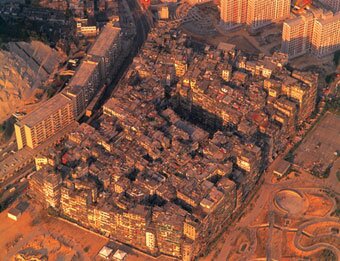
Hong Kong and the Chinese Line: During the more than 150 years of British rule in Hong Kong, the Chinese had always held a tiny toehold in the colony. The Walled City was an ancient fortress in Kowloon that stayed under Chinese control even after they ceded the surrounding territory to Britain in 1898. The area was completely neglected by China, and it grew into a center for criminal activity. By the 1980's, the population of the 0.01-square-mile area had swelled to 50,000, and the two countries agreed to evacuate and demolish the area, which had grown into one massive, tottering warren of makeshift buildings. Even though all of Hong Kong has reverted to Chinese control, the 20-mile-long border fence remains in place as the former colony is now a Special Administrative Region, and ordinary Chinese citizens need special permission even to visit. (For more on borders and security, check out the excellent blog Subtopia.)

Palestine: Palestine had been a British protectorate until 1948, when the UN partitioned the territory and the state of Israel was declared. During the period of the Mandate, British forces fought against a number of Jewish insurgent groups, including the Irgun and the famous Stern Gang. Seeking revenge for fallen comrades killed by the Zionists, a number of British soldiers left the army and began fighting alongside the Arabs in the bloody exchange of terrorist bombings that eventually escalated into the first Arab-Israeli War. (For more on this subject, see chapter four of Mike Davis' book Buda's Wagon: A Brief History of the Car Bomb.) Britain would return to the region in 1983 as part of the multinational peacekeeping force in the Lebanese Civil War.

Johannesburg: For the past several decades, civil conflict in Africa has provided ample opportunities for enterprising British and Afrikaner mercenaries. South Africa became independent in 1910, and by the 1970's, Britain's African empire was all but gone, with the exception of Southern Rhodesia. In 1965 the colony's white-dominated government declared independence, which the home country never recognized. This unilateral declaration and the imposition of apartheid-like rule sparked a long and bloody civil war, known as the Rhodesian Bush War. During this period, the Republic of Rhodesia, as the country was called, was only recognized by South Africa, who was fighting alongside the white government against black insurgent groups, and Britain successfully lobbied the UN to impose sanctions on the country. In 1979, the UK brokered the Lancaster House Agreement, which paved the way for elections the following year. As part of the agreement, the country reverted to British control between December 15, 1979 and April 18, 1980, when the elected government of Robert Mugabe took control.

Even long after the sun had set, so to speak, there were plenty of war zones and fence lines for Tommies to walk. The British Empire still technically exists, though it has been reduced to a scattered collection of islands and few rocky promontories. I have created a map showing the empire as it is today, and as it was in 1979, including the various places discussed above.


[Click on the image to enlarge]

Wednesday, January 28, 2009

War Tourism in the Gaza Strip

BOULDER, Colorado -- Did you ever wish that war was a spectator sport? Well, in Israel it can be. Danish television station TV-2 Nyhederne produced this report about spectators of the Israel assault on the Gaza Strip. Most of the segment is indecipherable to me, because it is in Danish, but the interviewees speak in English:


Because Israel is such a small country (it's about the size of New Jersey), it has not been hard to find a front row seat for the country's various wars over the years. However, it still remains rare for civilians to seek out the conflict zone to witness Israel's dazzling military strikes against one of the poorest and most destitute populations on earth. I was under the impression that everyone in Israel was cowering in their basement awaiting the next Hamas rocket to fall on them.

There are always accidental tourists in war zones - Israel's last war, this one in Lebanon, sparked huge evacuations by foreign government of their citizens from the war zone. Itchy and I were even mistaken for Russian refugees from Lebanon while on vacation in the Caucasus that summer (yeah, I didn't know what the hell the guy was talking about, either.)

So-called "war tourism" is a rare phenomenon - few people actually travel to active war zones for leisure, but venturing to more dangerous parts of the globe has gained some popularity. Filmmaker Robert Young Pelton has made a career out of traveling to such places, and he encourages others to do the same with his website ComeBackAlive.com, which also features the Dangerpedia, a wiki of adventure (and horror) stories from the world's political black holes. Personally, I would like to take my next vacation to Pakistan's tribal areas to pick up some homemade machine guns.

This sort of tourism could also fall under the classification of "dark tourism," which involves visiting sites of death or tragedy, like battlefields, cemeteries or prisons, but it is usually done after the dust has settled and the unexploded ordnance has mostly been cleared away. Britain's University of Central Lancashire hosts an online forum on the subject, replete with excellent resources for further research. If you would like to experience a war zone from the comfort of your own chair/couch/bed/toilet, you can take a virtual tour with visual artist Emanuel Licha. On his War Tourist website, you can travel the streets of Sarajevo during the siege, the crime-ridden alleys of Mexico City or a Parisian banlieu, or the tourist-filled grounds of contemporary Auschwitz.

But perhaps the most famous incident of "war tourism" was during the opening battle of the Civil War, when adventurous sightseers from Washington traveled out to nearby Manassas, Virginia to have a picnic and watch the federal troops rout the rebels at the first battle of Bull Run. Of course, the Union forces were driven from the field in what became known as "the great skedaddle," and the picnickers had to retreat in a panic along with the troops.

No such luck with this "little fascist," who continued to sip her latte undistrubed. Of course, if "Joe" the "Plumber" had his way, no one - not tourists, and certainly not journalists - would be allowed anywhere near war zones, just like the good ol' days of the horrific world wars: "I liked back in World War I and World War II, when you’d go to the theater and you’d see your troops on the screen and everyone would be real excited and happy for them."

Thanks to Adam for the link.