Showing posts with label GWOT. Show all posts

Thursday, June 11, 2009

Enter the CELL: Denver Museum Tells You When, Where and How Terrorists Will Kill You

BROOKLYN, New York -- I recently visited Denver's Center for Empowered Living and Learning, ominously referred to as "The CELL," to see their inaugural exhibit on international terrorism. The museum probably told me more about the politics of fear and the construction of threats than it did about actual terrorism, so I thought I would share some information and insights from my visit.

Titled "Anyone, Anytime, Anywhere: Understanding the Threat of Terrorism," the implied clause to follow the exhibit's name is "could be killed by terrorists," and they make every effort to convince you not only that terrorists are everywhere, but they all are part of a vast, sinister network who's only object is to kill innocent people. The museum was not as crazy as I had hoped, but it was as uninformed as I had feared.

The CELL opened last fall as part of Denver's Mizel Museum, which is dedicated to Jewish history and culture. The museum was founded by Larry Mizel, a real estate developer who is also the chairman of the Simon Wiesenthal Center in Los Angeles. The museum claims to be non-partisan, and despite Mizel's history as a major Republican contributor, I was quite surprised to see not a single image or even mention of President Bush anywhere in the museum. There was a lot of information on attacks in Israel, but considering the number of terrorist attacks that have been inflicted on that beseiged country, this was probably appropriate (it was not mentioned anywhere that the first terrorist groups in historic Palestine were in fact Jewish, though mention of this fact would be a lot to expect from any museum, regardless of its politics.) The museum's slant goes beyond partisanship - the rhetoric of terrorism and fear transcends party lines.

The museum strives to make the visitor identify with the victims of terrorism. When you purchase your ticket, they give you a card for their "Shattered Lives" exhibit. At three points in the museum, there are kiosks where you insert the card, and you are given information on a particular victim of terrorism, very similar to the approach used at the United States Holocaust Memorial Museum in Washington. At the first kiosk, you are told about the person's biography and background - my victim was Yanis Kanidis, a resident of Belsan, Russia. The second station tells you about the circumstances of their encounter with terrorism - there was a brief description of the attack on the Beslan school in 2004, and the terrible conditions the hostages were held in. Finally, like at the Holocaust Museum, you are told whether your person lived or died - Mr. Kanidis was killed by the terrorists while attempting to get other hostages out of the school, for which he posthumously received the medal for the Protection of Human Rights by the Russian government.

Encouraging visitors to identify with people who's lives have been affected by terrorism is a somewhat noble goal of the museum, but another exhibit tries to accomplish this in a far more heavy-handed fashion. Called "Hitting Home," when you enter the room halfway through the museum, you are surrounded by floor-to-ceiling screens depicting crowds of people mulling around Denver's Civic Center and 16th Street Mall. The screens are then filled with explosions and fireballs and the sounds of sirens and anguished cries (pregnant women are encouraged to avoid this portion of the museum). This is the type of thing one would expect from a Tom Tancredo campaign ad, not an educational museum.


The main problem with the museum is that their definition of terrorism is at once too broad and too narrow. The museum tries to draw links between all terrorist groups across the world, which is similar to the Cold War efforts to link all leftists to an international communist conspiracy. It is even more absurd than that, however, because terrorism is not an ideology, it is a tactic. It is employed by state and stateless actors, by the downtrodden and poor and by the rich and powerful, by the left and by the right. The CELL explains that there is no universally-accepted definition of terrorism, which they see as problematic. But will this make terrorism any less ambiguous? Is the firebombing of Tokyo and Dresden in World War II, or the shelling of Sarajevo, all of which specifically targeted civilians with the intent of inciting mass terror, much different that setting off a suicide bomb in a crowded Baghdad market? Many countries are labeled "terrorist states," but it is without dispute that the United States has provided both material and moral support to groups around the world that are unequivocally terrorists. Yet somehow we justify supporting the Contras in Nicaragua or insurgent groups in Iran. If these issues are black and white, and terrorism is morally wrong, then there can be no "freedom fighters" who set off bombs in shopping malls or use death squads to execute civilians.

America's struggle with terrorism has revealed that it is a complicated, messy business that makes it difficult at times to draw bright lines between good and evil in this so-called war. We have sacrificed many of our own moral principles in pursuit of the GWOT, and we are left with little to show for it. Despite our efforts to weaken terrorist organizations, people around the world, regardless of their ideology, are no less willing to murder and maim civilians to achieve their political goals. There are many valid question to be asked about the nature of terrorism and the use of violence to achieve political ends, but they remain largely unexplored in this museum. Saying that Timothy McVeigh, Hezbollah, and the Earth Liberation Front are all cut from the same cloth and should be treated the same obscures more than it illuminates.


Not Just Homeland, Hometown Security

I recently discovered another ad from Tom Tancredo's failed presidential bid, and it is even more crazy and racist, but it bears another similarity to the CELL. Tancredo says he wants to deport "those who don't belong," a wonderfully ambiguous phrase that is simply a code for racism and xenophobia. The CELL encourages visitors to be diligent in the fight against terrorism and offers tips and directions for the average citizen. These include looking out for people who "don't belong in the workplace, neighborhood, business establishment or anywhere else." You should also look out for people who might be rehearsing for committing an act of terrorism, or it could be for The Amazing Race, as Liz Lemon learned. Also look out for people who are conducting surveillance, which may include "use of cameras, note taking, drawing diagrams, annotating maps or using binoculars." Apparently, terrorism is an activity remarkably similar to birdwatching.


It would be far more useful if they included a poster like this one I saw at a zoo in Russia. It doesn't just tell you how to spot a terrorist, but what to do should you be held hostage. The most important thing is to avoid being killed by the police when they storm the building.


Making Terrorism Black and White


This effort to paint all terrorists with the same brush has led to a number of factual inaccuracies throughout the museum. Even the basic facts of terrorist attacks can often be disputed, but the CELL does not look at any accounts with a critical eye, choosing instead to give the visitor a clear-cut version of events. Two examples of this were particularly striking.
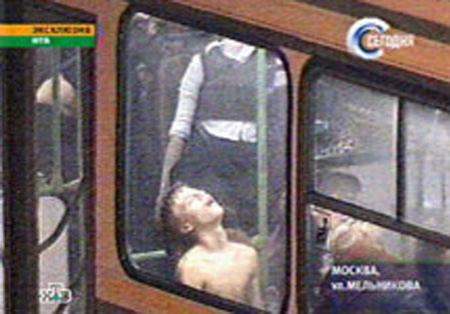
Throughout the first exhibit of the museum, there are television monitors that display information about various terrorist attacks that have taken place in recent years, including the location, the number of casualties, and the culprits. The segments are produced like news reports to give them an air of objectivity. One of the featured incidents was the hostage taking at a Moscow theater in 2002 by Chechen separatists. The attack resulted in the deaths of 129 hostages, though not a single one was killed by a terrorist - all of the hostages died as a result of a toxic nerve gas that Russian security services pumped into the building. The plan worked in rendering everyone inside unconscious, but there was not sufficient medical staff or equipment on hand to deal with the 700 affected people, and most of the victims died after being carried out of the building and left lying in buses and trucks, waiting to be revived at a hospital. It should also be noted that Russian special forces then summarily executed the 40 hostage takers while they lay unconscious inside the theater, when they could have easily been removed, arrested and tried for their crimes. None of this was mentioned in the CELL's report.

Mentioned in one of the exhibits was an event that took place on the eve of the Beijing Olympics last year, when reports came out of China of an attack by Uighur extremists on a police station in the western Chinese city of Kashgar. The official account stated that men armed with machetes and home-made explosives killed 16 officers, which is exactly how the event was recounted in the museum exhibit. However, pictures of the event taken by American tourists - and published in this article from the New York Times - show that the attack was far more complicated than insurgents attacking police. The attackers were dressed in police uniforms, and it is completely unclear who were the attackers and the targets in these photos. Clearly there are important details that the Chinese government either fabricated or left out, but the unambiguous official account is passed along to CELL visitors.

Saturday, May 23, 2009

New Hampshire: The Original Guantanamo Bay

BOULDER, Colorado -- The soon-to-be-closed prison camp at Guantanamo Bay was such an anathema to American democracy because it was expressly created to imprison people beyond the reach of American courts; or more specifically, to hold them beyond the reach of the most fundamental right of prisoners, that of habeas corpus. This right has been suspended only a handful of times in American history - Andrew Jackson did it after the capture of New Orleans in 1815, and Abraham Lincoln did it in Washington, DC at the outbreak of the Civil War - and never for the 7+ years that some detainees have been held at Guantanamo. Furthermore, none of these instances are looked upon fondly by history.

The framers of the Constitution had a healthy anxiety about the potential of the new federal government to violate the habeas corpus rights of citizens. Recently I read an article by Eric M. Freedman, "Federal Habeas Corpus in Capital Cases," published in an edited volume, "America's Experiment with Capital Punishment," and I came across this fascinating passage from the Constitutional Convention. A debate was raging about how to deal with habeas corpus rights in the Constitution (this is relevant to the article because even since the Guantanamo debacle, the most common use of petitions for review of habeas corpus come in death penalty cases). Could it be suspended? For how long? And under what circumstances? Luther Martin, a delegate from Maryland, offered this commentary:
And it was urged, that if we gave this power [to suspend habeas corpus] to the general government, it would be an engine of oppression in its hands, since whenever a state should oppose its views, however arbitrary and unconstitutional, and refuse submission to them, the general government would declare it to be an act of rebellion, and suspending the habeas corpus act, may seize upon the persons of those advocates of freedom, who have had virtue and resolution enough to excite the opposition, and may imprison them during its pleasure in the remotest part of the union, so that a citizen of Georgia might be bastiled in the furthest part of New-Hampshire - or a citizen of New-Hampshire in the furthest extreme of the south, cut off from their family, their friends, and their every connection.
So, just as our founding fathers feared, we have supplanted New Hampshire with Guantanamo Bay, or with the vast number of other black sites across the world. The Supreme Court has since ruled that the government cannot declare a blanket suspension of habeas corpus for so-called "enemy combatants," whether they be US citizens (Hamdi v. Rumsfeld) or not (Hamdan v. Rumsfeld).

Even so, the Global War on Terror has unleashed a new geography of detention and torture specifically designed to circumvent the rights of prisoners to contest their detention or be treated humanely. Scholars like Trevor Paglen have tried to unravel and decode these new networks, not by relying on government admissions and documents, but by finding evidence on the ground. For example, the Terminal Air Project, who's work was featured in Paglen's book "Torture Taxi," is a community of researchers and aviation enthusiasts who have meticulously recorded tail numbers of unregistered flights as they took off and landed at airports around the world. Many of these secret flights were part of the Extraordinary Rendition program, and the group's website offers interactive maps of flights from places like Smithfield, North Carolina, near the headquarters of Xe (formerly Blackwater Worldwide) and Symany, Poland, or Amman, Jordan.

You can read more about Paglen's work on Extraordinary Rendition in "An Atlas of Radical Cartography," which includes a map of the rendition flights. That map was also incidentally turned into a billboard on LA's Wilshire Boulevard in 2006 (pictured below). But this trend is not limited to fighting terrorism. In the past we have also mentioned efforts to detain migrants in isolated areas beyond national borders - sort of like Ellis Island on steroids.


The founding fathers were afraid that the remote corners of our own republic, separated by vast distances, could afford an ill-intentioned government an easy means of ferretting away undesirable opponents. They probably never could have imagined the government holding prisoners on a foreign naval base, or in a secret CIA prison, or even aboard an aircraft that didn't touch down, to circumvent the right of habeas corpus. Though they probably knew quite a bit about prison ships.

Thursday, May 21, 2009

Obama Sets Out Postition on Future of Guantanamo Detainees

BOULDER, Colorado -- President Barack Obama Thursday laid out his positions on closing the Guantanamo Bay prison camp, handling the remaining detainees, government transparency, and combating terrorism.

Obama reiterated his pledge to close down the facility, and in the same stroke dismissed fears about relocating detainees to American soil. He cited the ability of the federal prison system to safely hold these prisoners until a final resolution of their cases can be reached, adding that no one has ever escaped from a federal supermax prison, and that they already house hundreds of dangerous terrorists.

The president broke detainees down into five categories and explained how each will be handled:
  1. Detainees found to have committed criminal acts will be tried in federal courts.
  2. Detainees found to have violated the rules of war will be tried by military commissions, a position the White House articulated earlier this week. However, Obama pledged that he will stop some of the legal practices of the previous administration, including allowing in heresay evidence and evidence gathered as the result of torture.
  3. Detainees who have been ordered released by US courts will be released forthwith, though not into the United States, as some had inexplicably feared.
  4. Detainees who can be transferred safely to another country for detention, of which there are roughly 50.
  5. Detainees who cannot be prosecuted but can also not be released because they "pose a clear danger to the American people."

Obama discussed this last category at length, though he did not say specificially how they will be handled. He did state that, "We must have clear, defensible and lawful standards for those who fall into this category. We must have fair procedures, so that we don't make mistakes. We must have a thorough process of periodic review so that any prolonged detention is carefully evaluated and justified."

Obama stated that as many as 250 detainees could be safely moved to the United States, which suggests that the administration will not be seeking to pare down the numbers of detainees through swift prosecutions and relocations within the next year, which we had earlier said was a possibility. While the 50 or so who are eligible for relocation to another country will likely be transferred soon, as many as 100 could be facing long-term detention in the US without being charged, which is the number that Secretary of Defense Robert Gates cited last month.

Here is the entirety of President Obama's speech:


I support the president for saying unequivocally that the camp at Guantanamo must be closed, and closed soon, and that there is no reasonable argument against relocating them to prisons on US soil. It still remains to be seen if the system of military tribunals will be workable and fair, even under the new parameters. And the category of detainees that will not be released or charged poses a conundrum without any easy resolution, and while the president's candor was refreshing, the problem remains no less vexing. It appears that we will still have at least a few dozen detainees who are denied the right of habeas corpus for an unforeseen period in the future; at least we can take some comfort in the fact that they will no longer be imprisoned in a legal black hole.

Also on Thursday former Vice President Dicky Cheney, speaking at the American Enterprise Institute (where he is now a trustee), decided to take the opportunity to continue his campaign of fear-mongering and justify and rationalize his indefensible record of torture, Constitutional violations, and obfuscation.

Monday, May 18, 2009

Sending Guantanamo Detainees to the Phantom Zone

BOULDER, Colorado -- On Friday, the Obama administration announced that they would be revamping the system of military tribunals established in 2006 to try terrorism suspects held at the Guantanamo Bay prison camp. The announcement seemed to come as a reversal of pledges the president had made to try the detainees in federal courts or established courts-martial.

Apparently, the government is worried that the previous administration's systematic program of torture and denial of basic rights may hinder prosecution in normal American courts. But basically Obama is making the same argument that Bush officials did: the pesky Constitution keeps getting in the way of fighting the Global War on Terror. But the decision may also be linked to the problems the government is having in finding a suitable home for the remaining detainees once the prison at Guantanamo is closed in 2010. Military tribunals would allow for speedier prosecution of the remaining detainees, meaning fewer would have to be relocated when the camp is closed.

Last month Secretary of Defense Robert Gates told the US Senate that of the 240 remaining detainees, there could be as many 100 that would not be tried or could not be transferred to another country, which means they will likely have to be relocated to US soil. This has whipped many communities that host federal prisons into a panic, and members of Congress have been scrambling to try and prevent these prisoners from being transferred to their districts. Apparently, these people are so diabolical and terrifying, if transferred to the US, they will likely immediately escape and set up the new Caliphate, with its capital in Leavenworth, Kansas.

Let us not forget that the candidates for this transfer are those detainees that the government will not even bother to prosecute, meaning that they are probably poor Pakistani farmers that their home government does not want to take back, lest they hasten the toppling of the government. But they are being portrayed as if they are General Zod and his minions, people so dangerous that they had to be cast into the Phantom Zone for all eternity in Superman 2.


There are some very unseemly and dangerous characters who will be searching for a home when Camp Delta is mercifully shuttered, but the notion that they will escape is ludicrous. The Justice Department does not publish yearly statistics on prison escapes, but the numbers that are available are remarkably low. According to data compiled by Richard F. Culp and published in The Prison Journal in 2005, in 1998 (the last year for which data were available), there were 0.4 prison escapes for every 100 prisoners in America's state and federal prisons and jails. That year, there were 6,530 escapes, the vast majority of which were prisoners who had gone AWOL during an authorized leave or walked off of a minimum security work site. Nearly all were recaptured in short order, and this was out of a prison population of 1.8 million inmates.

In the federal system, the figures are even more encouraging. Though official data are unavailable, I did a Lexis-Nexis search of US newspapers, which revealed that in 2008, there were four escapes from federal prison. Three of the fugitives escaped from minimum-security facilities, while the fourth was in a medium-security prison. All but one of the escapees has since been apprehended - only Eddie Davidson, who walked off Colorado's Florence Prison Camp in July, evaded capture. Tragically, just a few days later, he was found dead, along with his wife and daughter, the result of a murder-suicide. In 1999, there was only one escape from federal prison, and that was the first in four years.

The other puzzling thing about this controversy is that the federal government has already constructed a facility tailor made for terrorists right here in the U.S. and A. The Communication Management Unit in Terre Haute, Indiana (dubbed "Little Guantanamo" and mentioned here before) already houses a couple dozen or so "terrorists," most of them of Middle Eastern descent, in a medium-security wing. If the CMU is good enough for John Walker Lindh or the Lackawanna 6, why not Khalid Sulaymanjaydh Al Habayshi? Granted, the facility would have to be enlarged, but no one is afraid that Terre Haute will be overrun by escaped terrorists.

But not every prison town in America turns into a bunch of NIMBYs when the feds try and move Islamic terrorists there. Hardin, Montana, has actually volunteered their brand new 460-bed prison for the Guantanamo refugees, which currently sits empty and deeply in debt. Montana's senators have tried to put the kybosh on the plan, but one town official said, "Somebody has to stand up and put [the Guantanamo prisoners] in their backyards. It's our patriotic duty." He added, sensibly, "You have hardened criminals in jail all around the state, you have sexual offenders. When they're in jail, they're not a whole lot different."

Well, perhaps the Guantanamo detainees are not all sex offenders, but the notion that they are too dangerous to ever set foot on American soil, or be allowed access to due process in America's courts, is ludicrous. To defend this move as shrewd or prudent gives the president too much credit. I am tired of politicking when it comes to civil liberties and basic Constitutional rights, and Obama has backtracked on what was, for me, a key promise in his campaign. So much for the kinder, gentler GWOT.