Wednesday, August 5, 2009

Facebookin' Health Care

NEW YORK, New York -- This might be a lame use of a blog.

This post follows from a facebook conversation about health care reform in the US, and I'd like to offer my thoughts below. This is entirely because facebook limits comments on links, etc., to a paragraph or so, and there no longer seems to be any way to create content on facebook by uploading a note from scratch, as opposed to pasting in a blog link. Hence, my use/abuse of the blog to continue an argument that would've remained on facebook, if Mark Zuckerberg didn't suck.

At any rate, the article that spurred the back-and-forth was this WSJ article about Democratic lobbying groups attacking party members who were "out of line" in criticizing the Party Leadership's (still not elucidated) stance.

I had commented on the article as follows:
Still unclear on why it's supposed to be wrong for businesses to want to make a
profit. I really don't know what worldview the majority of Democratic
congresspeople are supporting -- trashing an industry simply because it is
profitable?

There seems to be a need for some healthcare reform (or so I'm
told...), but allowing the motivation for it to be the fact that certain
companies are profitable is inane, vengeful, and economically backward.

A friend of mine responded:
Once again you have posted a link to an article along with a comment that
is almost unrelated. The article is about political infighting among democrats,
not the overall economic philosophy of the democratic party. Are you hoping no
one will bother to read the article, and we'll all just assume it substantiates
your point?

I'm sure that privately run fire departments would also be quite
profitable, if not for the public option... Not all things should be left to the
private sector.

Your "or so I'm told" bullshit suggests that you don't personally know
anyone who has suffered under our current health care system. I'm glad you and
your family have been so fortunate, but open your eyes. It is not working....

I am sick of you guys posting this shit. (Yes, G-Man, I'm talking to you
too.) So please answer the following question: What is the republican
health-care platform, other than opposing the democrats? No change to the status
quo?

My reply is this:

Guys, I'm glad you commented -- some debate is obviously a good thing when Congress and the administration want to radically alter something that affects our financial and physical well-being to the degree that healthcare does.

Firstly, though, I think your criticism was pretty off-base: the comment I made is in no way unrelated to that article. The article is about lobbying groups publicly attacking Democrats who have qualms about undertaking radical changes to 1/6+ of the economy without slowing the process down for debate. The POV of the attacks is that "profiting" is somehow wrong. To my mind, that is a dangerous, populist route to take.

In any economy, in any sector, you need to turn a profit to stay in business and, ergo, to employ people. People need jobs, but those jobs will only exist when an industry is profitable. Yet in a recession, when people feel financially hit, demagogues can appeal to populist anger at "rich bosses." As recent incidents in France (workers rigging bombs to factories) or China (workers beating executives to death) show, that populist rage can be an unpredictable, violent thing. Today far-left lobbying groups rail against "profiteering" in healthcare; but that same logic can apply to any other industry tomorrow: energy, agriculture, food processing, higher education, technology, finance. I find the line of attack these lobbies are taking to be fundamentally worrisome.

Moreover, let's look at the larger, overarching point of the article that you say I'm not addressing. The point is that lobbying groups are launching ad hominem attacks on politicians who don't want to go along with the government's plan. As I said, when you're talking about restructuring 18% of the economy, some debate is a good thing. The administration, however, wanted a bill to go through by early August -- after virtually no debate. Sure, Obama goes on YouTube and urges people to have "health care parties" where you can talk about how worried you are about health care; but there hasn't been any actual open debate in Congress or the administration about what changes would be best, either in an ideal world or in the current situation. Instead, as he has done elsewhere (the stimulus and energy legislation, e.g.), Obama puts out a few forceful advertisements or press conferences about how badly something needs to be done … and then he lets Nancy Pelosi worry about the details behind the closed doors of congressional committee rooms.

And those Democrats who have qualms about the closed manner in which the process has taken place are then vilified by lobbying groups that are apparently connected to the Democratic Party. Stifling debate is a dangerous, unhealthy thing to do in a democracy. That's especially true when a plurality of people are opposed to the initiatives that are coming together and feel that it will make their own health care worse.

As much as Obama portrays healthcare as a huge crisis, 80% of Americans are happy with their own coverage, and coverage rates have been more or less stable for about 20 years. There are problems, certainly -- most people feel that the system in general has problems even if they themselves are satisfied -- but people don't want a radical revamp. Doesn't that count for something? After all, isn't democracy about the will of the people? Can you force a new health system with a big government role on people, the constituents of the state, if most of them don't want it but because you think Congress and the president know better than people what's good for them?


But that sort of stifling is what those ads aim to do. Incidentally, by attacking people who post articles critical of this process, you are also stifling any attempts by people to create discourse.

Why is discourse important? It helps to know what the government is trying to pull when it comes to any policy. But in this case, there are some good ideas out there, and then there are some less-good ideas, many of which are arguably in the main congressional plans. A quick look at the only state to have introduced health care reform of the sort that seems likely to be pushed by Congress -- Massachusetts -- isn't much of a success story. Fewer uninsured have been covered than thought (though coverage rates are pretty good there), but more importantly costs have soared, the system is in debt, and growth-killing taxes are being introduced despite promises of no new taxes for the middle class to fund the program (sound familiar?). And that's in a state of 5 million people that is one of the wealthiest, healthiest, least-obese states in the country.

So what needs to be done? What else is out there? I don't know what the Republicans' plan is, to answer your question. They don't seem to have one, and it's a pretty big disappointment when the opposition is either irrelevant, has no idea what to say, or goes along with the ruling party. It was annoying when Democrats went along with Bush initiatives that were ill thought-out, and it's annoying now when the Republicans appear to have little to add. One-party rule is always a bad thing.

More proactively, there are probably three areas to look at here: quality, coverage and cost. As for quality, the quality of care in this country is pretty good. Granted, we pay 80% more as a % of GDP than France and Japan and don't have markedly better outcomes. But outcomes are still better than, e.g., in the UK. So quality is good, but, importantly, we don't get enough value.

That brings us to cost. Theoretically, rising costs aren't in and of themselves a problem. As an economy grows more sophisticated, people don't need to spend all their money on nondurables like food or clothing. That they spend more to advance technologies that let people live longer, healthier lives is a given. But cost is an issue when it becomes prohibitive -- or when health care is run by the government and those costs eat into other government expenditures or raise the public debt. So if you want to have real problems with cost, giving government greater responsibility for health care costs is a pretty good way of making cost a real problem -- which is what you have when that responibility eats into other spending, or worsens the debt load.

As for prohibitive costs, they play into coverage. People get hit hardest financially when they aren't insured or their insurer gives them poor coverage. Making sure more people are covered, and that that coverage is good, is important.

But the biggest driver of rising costs is the same factor that results in the US having outcomes no better than France while paying twice as much compared to GDP: Waste. The system is full of waste, with doctors ordering far more expensive tests and ineffective treatments than is needed. The reason behind that is that reimbursement for hospitals and doctors is based on the costs they run up, not on the quality of their outcomes. As a doctor or hospital, you get paid more by insurers or the government when you order more expensive tests, whether or not they're needed. The incentives are totally backward.

That's the biggest factor driving cost increases. It's a problem, but there are hospitals and health care systems that have tackled it: the Mayo Clinic in Minnesota, California's Kaiser Permanente system, the Cleveland Clinic. What they all do is pay doctors yearly salaries rather than commissions based on the costs they rack up, and have outcome-based systems of cooperation among different doctors to coordinate treatment and make sure unnecessary tests aren't given.

Revamping the system in that mold -- putting in place a system (Medicare incentives, e.g.) that moves reimbursement to a salary model and coordinates care to achieve better, more efficient outcomes -- would be the best step in the right direction. But the plans being hashed out by Congress don't do that. And prominent Democrats bucking the government's plans get steamrolled when they might have something good to say.

That change of incentives is agreed upon by academic health-policy experts, yet it has no place in the main plans. Other policies have achieved mainstream acceptance among health-policy experts (including Obama advisor David Cutler, whose book "Your Money or Your Life" goes over these issues really well; maybe if Obama came up with his own plan instead of leaving it to Congress, we'd see more of Cutler's good ideas…) include separating insurance from employment. Employers today get tax breaks for offering health insurance. That leads to an incentive structure where they can offer really, really expensive plans -- and write it off as taxes. The result is to push up costs and have more waste in the system -- all funded by the US government's tax system, and none of it reformed under Congress' proposals. Neither Democrats, influenced by unions that have the most generous and wasteful benefits, nor Republicans, influenced by the insurance companies that can benefit from this policy, want to touch this one, although every health-policy expert sees it as Public Enemy No. 1. You stop offering those tax incentives, and you can move away from employer-based coverage. Not only does that mean that US employers don't have to shoulder insurance burdens (making them more competitive globally), but it means people don't get screwed when they lose their job. That step toward portable insurance is key, although insurance under the competing congressional plans would only be portable if it's controlled by the government, while employers will continue to have the same bad set of incentives vis-a-vis private insurance.

Another reform: Individual mandates. This is a bit more controversial, but a large number of uninsured are younger, healthy people who can afford insurance but choose not to purchase it, preferring instead to have more spending cash. The result is that if you are, say, unemployed or a young adult and not yet working, it's expensive to buy insurance. That's because you aren't part of a group buying pool, and also because so many other young, healthy people don't buy insurance. The upshot being that insurance costs go up when it's only older or less-healthy people buying the insurance. When younger people with lower medical costs buy it, they bring costs down for everyone. Putting in place tax penalties for people who don't buy insurance could create individual mandates that bring down costs for all. Lots of Republicans are reasonably opposed to this as a violation of personal liberty, but it may not be the worst of ideas.

There are various other ideas, some supported by Democrats (more government spending on EMRs and other technology; a health "exchange" where people can go to get good, clear info on what plan would be cheapest/best for them), others by Republicans (tort reform; allowing insurers to operate across state lines, breaking up the local monopolies that exist). Then there are interesting ideas that both, or no, parties support: non-profit health cooperatives; prohibiting insurers to exclude based on pre-existing conditions; tying outcomes to value so that, e.g., people can use any clinic with their insurance but using more costly and less-efficient ones costs you more out of pocket; and, importantly, action to break up the local monopolies that insurance companies have become.

Look, at the end of the day, US health care is among the best in the world. I know it's not New York hipster-cool to say that (maybe Conor Oberst will be pissed at me), but it's true. There are big problems, but on the bright side there is a broadening consensus among health-policy experts about how to take care of them. Unfortunately, Congress' plans don't really take them into account. Instead, they try to ape European-style plans. Doing that doesn't mean we'll get European-style outcomes, and it may mean that, despite European-style taxes, outcomes here are affected negatively. Medicare, after all, is a politicized, wasteful mess (they still haven't figured out where funding for Part D is coming from...) and hardly the path you want to follow. The number of hospitals is about half of what it was in the 1970s. That's because hospital profits have been getting squeezed both by insurers and by Medicare for decades. The result is that there are fewer hospitals, pushing costs up and making care less accessible. If you have a government-run plan that artificially pushes down costs, unless you put hospitals under government control (that may work, but it's not exactly part of the plan now), they'll take more margin hits and more of them will go out of business … pushing costs up further at the existing, less-accessible ones.

Atul Gawande wrote an interesting article a few months ago about how different health care systems came about. It's pretty interesting, but he recommends the US stick to what it knows and improve that, expanding coverage, cutting costs and improving quality. As he notes, that would be done by embracing reforms like those above, rather than having a government insurance plan that doesn't cut costs or restructure the way doctors are paid; that retains a backward employer-based system necessitated by WWII-era worker shortages; that politicizes health decisions (meaning any cost cuts will be political death and that therefore costs will keep on rising); and that creates more debt and eats into other government expenses. Yeah, it's fashionable to focus on how the Republicans, who are pretty irrelevant here, have no plan, or about how ridiculous and hickish Max Baucus or Ron Wyden sounds. But it's just stupid to try to silence Baucus' or Wyden's voices when what they want is an examination of the largely closed way a handful of powerful congresspeople have cobbled together a populist but iffy plan.

Saturday, July 25, 2009

Gambling in Russia and the Rust Belt

BOULDER, Colorado -- Earlier this month, the Russian government implemented a ban on gambling, restricting casinos to four special zones scattered across the country. The Western press was all atwitter over this story, acting as if the Kremlin had declared over night that casinos be shuttered.

The deadline of July 1, 2009 to close or relocate all gambling establishments had actually been established two and half years ago, but due to a lack of planning by the government and the general arbitrariness of the law in Russia, few operators chose to close before the deadline, and none have yet moved to the new gaming zones.

The four tiny enclaves to which gambling is now restricted are located in the Kaliningrad Region along the Baltic Sea; in the Altai Region near the border with the Altai Republic in southern Siberia; near the Far Eastern city of Primorye; and along the border between the Krasnodar and Rostov regions along the Sea of Azov.

The regions have been described in the press as "remote," "far-flung," and "far from Moscow." It should be noted that the last casino zone listed above is not far from Sochi, the city that will host the 2014 Winter Olympics. Like the casino operators view of the ban, I have a similar attitude towards the Sochi Olympics - I'll believe it when I see it.

Says one resident of Siberia, "When do we get the showgirls?"

The Russian Ministry of Finance has plans to spend $31 billion of public and private money (roughly 80% from the private sector, the rest from the state) developing these gambling regions, but so far no one has stepped up to invest anything. Some operators have even chosen to move to the hermit kingdom of Belarus rather than open up shop in the Russian enclaves.

As this ban was taking force, I found myself driving across America's rust belt - though upstate New York, Pennsylvania, and Michigan - where casinos are popping up everywhere. Many of these dying post-industrial cities have decided to bet their chips on gambling to improve their fortunes.

Downtown Detroit is now dotted with massive new hotel casinos, built to compete with the establishments across the river in Windsor, Ontario, a city hit just as hard by the decline of the auto industry. Meanwhile, the landmarks of Detroit's city center remain dilapidated, the city remains as dysfunction and destitute as ever, and the crushing competition for gambling dollars has driven Windsor to become one of the worst cities in Canada.

Bethlehem, Pennsylvania, once one of America's colossal steel centers, has turned to the golden gambling goose to at least slow its breakneck decline. A massive steel crane that in a previous era may had carried iron ore to the blast furnaces is now adorned with a massive sign welcoming you the new Sands resort casino.

This is not a new trend, of course - the former steel town of Gary, Indiana opened its first casino over a decade ago, and a growing list of cities and states with nowhere left to turn to improve their economic plight fight and claw with one another to attract the next gleaming casino to their city.

Not only do casino operators squeeze the most desperate municipalities for tax breaks and financing, but they then turn around and squeeze their profits out of the most destitute members of the population. Anyone who thinks that casino revenues come from high-rollers, or from people who are making a reasoned, informed choice to gamble, has clearly never been to the casinos outside of Las Vegas or the Riviera. Bethlehem, Detroit and Gary will never become vacation destinations, meaning the casinos will sell their "entertainment" to the unemployed citizens of these impoverished cities.

This was the case in Russia as well. Yes, the law was poorly planned and badly executed, but gambling had become a serious social ill in the country. Roughly 400,000 people have lost their jobs as a result, a tough pill in Russia's faltering economy, but I have little sympathy for the operators who are mostly homegrown gangsters or foreign profiteers. I can say from personal experience that the expats working in Russia's gambling industry are some of the worst people in the world.

One of the most depressing sights I have ever seen was a man, drunk and likely homeless, pouring 1 ruble (roughly 3 cents) coins into slot machine outside a Moscow subway entrance. The machine was nothing more than a steel box with three digital clock-like displays that flashed random numbers. No bells, no pictures of fruit, and no waitresses plying him with free drinks. For millions of people, this is the so-called glamorous world of gaming.

Thursday, July 23, 2009

Bush and Nixon: The Men Who Would Be Baseball Commissioner

BOULDER, Colorado -- President Barack Obama recently enjoyed the privilege of throwing out the ceremonial first pitch at the Major League All-Star Game in St. Louis. The tradition is nearly as old as the game itself. The All-Star Game started in 1933, and every president since Franklin Roosevelt, who first pitched at the game in 1937 at Washington's Griffith Stadium, has made the ceremonial delivery.

This is just one of many connections between the presidency and the national pastime. While attending the Louisville Slugger Museum and Factory earlier this summer, I watched a documentary chronicling this relationship. Lincoln was lampooned in a political cartoon from 1860 for his love of the game its in infancy; ambidextrous Harry Truman and Gerald Ford each threw Opening Day first pitches with their left and right arms; and Ronald Reagan, when working as a Cubs radio announcer for a station in rural Illinois, would make up colorful descriptions of the action on the field for listeners, as all he had to rely on was a play-by-play ticker tape.


Two men who achieved the highest office in the land also nearly held the highest office in baseball. The dearly departed George W. Bush (well, he's just moved to Dallas) and the irrepressible racist Richard Nixon were both considered for the job of commissioner of Major League Baseball, though both chose instead to run for president.

How different would America - and the game of baseball - be today had both of these men become commissioner? They were arguably the two worst presidents ever to be elected to two terms, yet baseball could have kept them away from the presidency. The ball club owners could have done the nation a favor by keeping these men out of public office. Nixon's presidential ambitions were clear when he declined the offer in 1965, though Bush's were not when he was considered for the job 1992. In Nixon's case, the owners could have been acting much like when a country accepts to host some deposed Third World strongman to prevent them from causing any more trouble, like Saudi Arabia did with Idi Amin, or Boston University continues to do with many former African dictators.

(Above: Nixon making a proposal to add the expansion Saigon Senators to the National League)

Nixon did cause at least one owner a headache when he became president. In 1973, Commissioner Bowie Kuhn fined and suspended newly-minted Yankees owner George Steinbrenner for making illegal contributions to Nixon's re-election campaign, something Big Stein claimed he was forced to do under pressure from Nixon campaign officials.

As commissioner, what challenges would Nixon have faced in 1965? That era saw some big changes in baseball, including expansion into Canada, the playoff system, the players union, free agency, and the growth of night games. As the man who presided over much of this time period, Kuhn was a dynamic yet controversial commissioner, and he was hardly on the cutting edge of all of these changes, especially the new labor relationships that were taking shape between owners and players. Nixon was no friend to unions as president, but during the 1960's he had been considered to head up the nascent Baseball Players Association, and long after he had left the White House, he did successfully arbitrate a dispute between MLB and the umpires in 1986 to avert a strike. With this solid baseball resume, I think it is unlikely that Nixon would have left his office in disgrace aboard a chopper flying out of Dodger Stadium, waving the "V" for Victory.

Unlike Nixon, Bush had few political ambitions, at least that anyone was aware of, in 1992, and even when he assumed the presidency just eight years later, few foresaw that his campaign promises of modest foreign policy, limited federal spending, and education reform would turn into ... well, we all know what happened. Bush also has a baseball resume, but the crises that faced the game during his potential tenure were far more serious. While still the managing partner of the Texas Rangers, Bush was a candidate to replace Faye Vincent. Steroids would become the single most important issue over the next decade, and while he did employ at least one proven juicer (Rafael Palmeiro), it's hard to say whether he would have handled the situation any better or worse (which would be quite hard to do) than Bud Selig. One decision that Bush was surely on the wrong side of was to expand the playoffs to six teams and break the leagues into three divisions, which has been an unabashed success. Every owner voted in favor of the change in 1993, with one exception - the Rangers' George W. Bush.

Bush also understood the power of baseball as a national symbol, something that he mobilized for maximum propaganda effect after the attacks of September 11th, 2001. His theatrics at Yankee Stadium a few days later would make any die-hard nationalist proud. The Yankees, true to form, have continued this ceremony to the present day, forcing everyone to sing "God Bless America" at every seventh-inning stretch. And if you don't feel like singing, then you can get your ass to jail. USA! USA!


It is an interesting bit of counter-factual history, and if I had to choose, I would gladly pick both these men to be my baseball commissioner instead of my president. Bush may still have ambitions to become commissioner, though his rock-bottom popularity make him a risky choice to replace Selig when he retires, supposedly in 2012. I can say this without exception, though; in many cases, both the country and baseball have deserved far better leadership than they have gotten.

Despite his brief term, Bart Giamatti is considered by many to be the last great commissioner. He famously banned Pete Rose for life for betting on baseball, but more importantly, he was able to eloquently express his love and admiration for the game to the public, something that Selig appears utterly incapable of doing. Giamatti also served as president of Yale University, and immediately upon assuming this post in 1978, he issued this memo:
To the Members of the University Community:

In order to restore what Milton called the ruin of our grand parents, I wish to announce that henceforth, as a matter of University policy, evil is abolished and paradise is restored.

I trust all of us will do whatever possible to achieve this policy objective.
That's a platform I can get behind, whether it be from a university president, a baseball commissioner, or the president of the United States.

Thursday, June 18, 2009

Wednesday Links: Recession Solutions

BROOKLYN, New York -- Everyone is trying to cope with economic hardships. The Russian government is giving people free lumber. New Yorkers can no longer steal paper plates from their local Whole Foods. And Oprah just wants you to read The Secret and think positively to solve all of your financial, emotional, and medical problems.

Wall Street Journal: Let the forest be your stimulus.
Despite having the third-largest hard currency reserves in the world, Russia still can't spend its way out of economic oblivion. So instead, the government is letting ordinary citizens fell timber, prospect for gold and plant potatoes for free in hopes of stimulating the economy.

New York Times: Russia's defense minister is a "stool salesman." Russia's military has long been plagued by a bloated officer corps, but in its current economic dire straits, the country can hardly afford to gently show these officers the door. They just roughly kick them to the curb.

Architects' Journal: We will build Europe's largest ... er ... parking lot.
The Russia Tower was slated to become Europe's tallest building, but financial mismanagement has brought the project to a halt, and little has been built since the cornerstone was laid two years ago. So much for Norman "The Apologist" Foster's wet dream of a building.

Geography of Jobs: Americans are equally screwed everywhere. That's not entirely true, but almost no major cities have been free from job losses. This map comes from consulting firm TIP Strategies and displays the change in the number of jobs for the 100 largest metropolitan areas since 2004.

WNYC: Forget NYSC, I'm joining the YMCA. Like the two-dollar bill story reported earlier, WNYC is asking listeners to submit their own uncommon indicators of the recession. The result is a fascinating interactive map of New York City.

Newsweek: Oprah wants you to inject things into your vagina.
Oprah got thoroughly skewered by Weston Kosova and Pat Wingert in this Newsweek cover story, where they portrayed her as an uncritical, weak-minded ninny who unflinchingly endorses crackpots and cranks. The results are hilarious.

Toronto Star: Foreigners don't like hockey. Canada has been lauded for its open and fair immigration policies. Now if they could only get the new arrivals to take up hockey.

ESPN: I wanna be like Barry. If you want to get close to Obama, join in on some hoops. This borders a bit on a cult of personality, but luckily basketball is already very popular in the US, so we don't risk facing a situation like Russia, where niche sports like tennis, judo and skiing saw their popularity skyrocket simply because the president (Yeltsin in the first case, Putin in the latter two) played them.

Metropolis Magazine: Meet America's stupidest mayor.
We have leveled our own broadsides against illiterate Boston mayor Tom Menino; now he may be facing a challenge to his authoritarian rule.

Tor Project: Help stop the Iranian thugocracy. Speaking of authoritarian rule, the Iranian government has become quite adept at thwarting journalists and would be protesters from gaining access to the Internet to get information about the unrest out of the country. This piece of software prevents the authorities from easily tracking them and cutting off their access, or worse, finding out their identity and personally targeting them. It can also be quite useful to bloggers and journalists in any part of the world.

The Recession and $2 Bills

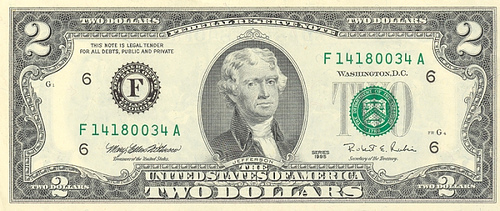
BROOKLYN, New York -- Recently a friend took a trip down to Baltimore for a family wedding. During that trip, something rather curious happened: on multiple occasions while making commercial transactions - usually with cab drivers - he received back in change the elusive two-dollar bill. He returned to New York with three of them in his wallet, totally befuddled as to why Thomas Jefferson's visage was in such regular circulation in Maryland.

Just last week, I took a trip back to my hometown of New Haven, and I retold this story to a mutual friend of ours at a local bar. We were both equally puzzled about this strange occurrence. I have never in my life been in possession of a two-dollar bill, and we both thought perhaps that Baltimore was such a backwards place that the bills had never fallen out of use. The bartender overheard us and said that he had two in his pocket that he had received from customers that week.

"It's the recession," he said simply. His theory was that when economic times are tough, people start dipping into any reserves of cash they might have on hand, whether those be collectible coins, loose change in the couch, or a stash of two-dollar bills.

The two-dollar bill has actually never been pulled from circulation. They currently make up roughly 1% of the money supply, and the Federal Reserve continues to print the bill. According to the Fed, "The $2 bill has not been removed from circulation and is still a circulating denomination of United States paper currency. The Federal Reserve System does not, however, request the printing of that denomination as often as the others. The Series 2003 $2 bill was the last printed and bears the names of former Secretary of the Treasury John W. Snow and Treasurer Rosario Marin. As of April 30, 2007 there were $1,549,052,714 worth of $2 bills in circulation worldwide."

Most of the bills, however, are not in regular circulation. Banks hold on to them and usually only distribute them to customers when they are specifically requested. Most of them end up, for example, stashed away in the pockets of bartenders instead of in the register to be given out in the normal course of transactions.

Perhaps the cab drivers of Baltimore are simply following the orders of the Federal Reserve to use the bills like you would any other currency, and our neighborhood bartender just happened to get lucky. I have not found any evidence or research about links between the resurfacing of two-dollar bills and recessions, but it seems to make logical sense.

For the past several years, the two-dollar bill has started to become more and more common. A Reuters story from 2006 reports increased orders for the bills from banks since 2001, though it is hard to say why. The piece cites the bills' popularity among strip clubs, as they mean double the tips for the dancers. It is possible that the combination of increased supply and less reluctance on the part of spenders to use them due to the recession has led to their increased visibility.

The bill has been linked to the current recession, but in a different way. Recently a story appeared in several news outlets about a pharmacy owner in Alabama who earlier this year gave his employees his own economic stimulus. Danny Cottrell gave each of his full-time employees bonuses of $700 and his part-time staff $300, with two conditions: they had to give 15% of the cash to charity, and the remainder had to be spent in local businesses. To track his employees' spending, he handed out the bonuses entirely in two-dollar bills, so that if they did as they were told, the local market would be flooded with the bills (A similar scheme was tried by the Geneva Steel Company in Utah in 1989 to show the economic importance of the company and its employees. The bills have subsequently been used to show the impacts of the plant's closing in 2001.) Interestingly, Mr. Cottrell also wrote an article in 2004 for VFW Magazine about a limited-time release of uncirculated two-dollar bills from the Federal Reserve. Perhaps that is how he managed to get ahold of $16,000 worth of the bills to dole out to his employees.

Is the two-dollar bill really an indicator of the recession? It is hard to tell. I think we will only know how bad things really are when people start paying for their beers and cab rides with their own gold teeth.

Friday, June 12, 2009

Western Dispatches: The Lone Survivor of Little Bighorn

BROOKLYN, New York -- This week I will be bringing you a few observations and highlights from my recent road trip from Boulder to Brooklyn, one I will be repeating in reverse in just a few weeks time. The trip included my first visit to South Dakota; I was expecting a slightly less populated Kansas - some spectacular views of the prairies, but worth getting across as quickly as possible - but I was in fact mesmerized, and I wish I could have spent more time there.

While driving past lonely exit 191, right smack in the middle of the state, I stopped in at "1880 Town," an Old West attraction that looked too campy to pass up. The place is actually a collection of historic buildings taken from towns around the state and plunked down alongside the highway. Like many roadside museums, this one is filled with a somewhat random collection of artifacts, from signed pictures of Red Sox great Bobby Doerr (who, as far as I can tell, has no connection to South Dakota) to props from the movie "Dances With Wolves."

One of the most interesting exhibits was the above photograph of a horse accompanied by this letter:
Headquarters, Fort Abraham Lincoln, Dakota Territory
April 10, 1878

General Orders No. 7

I. The horse known as "Comanche", being the only living representative of the bloody tragedy of the Little Big Horn, June 23, 1876, his kind treatment and comfort should be a matter of special pride and solicitude on the part of every member of the Seventh Cavalry to the end that his life be prolonged to the utmost limit. Wounded and scarred as he is, his very existence speaks in terms more eloquent than words of the desperate struggle against overwhelming numbers; of the hopeless conflict, and of the heroic manner in which all went down on that fatal day.

II. The commanding officer of Company "I" will see that a special and comfortable stall is fitted up for him, and he will not be ridden by any person whatever, under any circumstances nor will he be put to any kind of work.

III. Hereafter upon all occasions of mounted regimental formation "Comanche" saddled, bridled, draped in mourning, and led by a mounted trooper of Company "I", will be paraded with the regiment.

By command of Colonel Sturgis,
(Signed) E.A. Garlington
In reality, probably more like 100 American horses survived the Battle of the Little Bighorn, but the US Army heaped all of this praise on Comanche. He became a symbol of the battle, and the Army's resolve to fight the Indians to the last. The horse became so famous that he was even "interviewed" at Fort Abraham Lincoln by papers from across the country. For more on Comanche, go here for an article by Deanne Stillman, published in New West magazine.

When Comanche died in 1890, he became the first horse buried with full military honors - the only other horse so honored was Black Jack, who's only accomplishment was acting as the riderless horse at more than 1,000 military funerals. That hardly compares with being wounded in several battles and surviving seven bullets at the Little Bighorn. But Comanche was not laid to rest when he died; his remains were sent to the University of Kansas, where he was stuffed and put on display in the Natural History Museum, where he remains today.

Alongside Comanche's portrait were also those of the last surviving fighters from the battle (pictured below), who gathered in South Dakota in 1948 to commemorate the still-unfinished monument to Crazy Horse. These eight men have no monuments to their victory; one of the few Indian triumphs of the Indian Wars is instead remembered as a national tragedy. Had the outcome of the battle been the opposite, and the Sioux were slaughtered to the last man, this would likely be the marker left behind for these men.


On the western edge of the state, standing beneath the colossal outline of Crazy Horse's torso and horse, where 18 million tons of rock have been blasted from the Black Hills, and no less than 60 more years of blasting and carving remain to be done, I could not help but feel melancholy about the whole undertaking. Not just because the project seems Sisyphean, but because the monument to the Indians appears to be aping the nearby monument to the colonial occupiers. True, the Crazy Horse monument dwarfs Mt. Rushmore, but it will always appear as a copy, an effort to beat the white man at his own game, and a similar desecration of the sacred Black Hills. Of course, I am not an Indian, so I cannot say what is desecration and what is commemoration, but I could not feel comfortable about either place. If a reporter were to interview him today, I wonder what Comanche would have to say about all of this.

Thursday, June 11, 2009

Enter the CELL: Denver Museum Tells You When, Where and How Terrorists Will Kill You

BROOKLYN, New York -- I recently visited Denver's Center for Empowered Living and Learning, ominously referred to as "The CELL," to see their inaugural exhibit on international terrorism. The museum probably told me more about the politics of fear and the construction of threats than it did about actual terrorism, so I thought I would share some information and insights from my visit.

Titled "Anyone, Anytime, Anywhere: Understanding the Threat of Terrorism," the implied clause to follow the exhibit's name is "could be killed by terrorists," and they make every effort to convince you not only that terrorists are everywhere, but they all are part of a vast, sinister network who's only object is to kill innocent people. The museum was not as crazy as I had hoped, but it was as uninformed as I had feared.

The CELL opened last fall as part of Denver's Mizel Museum, which is dedicated to Jewish history and culture. The museum was founded by Larry Mizel, a real estate developer who is also the chairman of the Simon Wiesenthal Center in Los Angeles. The museum claims to be non-partisan, and despite Mizel's history as a major Republican contributor, I was quite surprised to see not a single image or even mention of President Bush anywhere in the museum. There was a lot of information on attacks in Israel, but considering the number of terrorist attacks that have been inflicted on that beseiged country, this was probably appropriate (it was not mentioned anywhere that the first terrorist groups in historic Palestine were in fact Jewish, though mention of this fact would be a lot to expect from any museum, regardless of its politics.) The museum's slant goes beyond partisanship - the rhetoric of terrorism and fear transcends party lines.

The museum strives to make the visitor identify with the victims of terrorism. When you purchase your ticket, they give you a card for their "Shattered Lives" exhibit. At three points in the museum, there are kiosks where you insert the card, and you are given information on a particular victim of terrorism, very similar to the approach used at the United States Holocaust Memorial Museum in Washington. At the first kiosk, you are told about the person's biography and background - my victim was Yanis Kanidis, a resident of Belsan, Russia. The second station tells you about the circumstances of their encounter with terrorism - there was a brief description of the attack on the Beslan school in 2004, and the terrible conditions the hostages were held in. Finally, like at the Holocaust Museum, you are told whether your person lived or died - Mr. Kanidis was killed by the terrorists while attempting to get other hostages out of the school, for which he posthumously received the medal for the Protection of Human Rights by the Russian government.

Encouraging visitors to identify with people who's lives have been affected by terrorism is a somewhat noble goal of the museum, but another exhibit tries to accomplish this in a far more heavy-handed fashion. Called "Hitting Home," when you enter the room halfway through the museum, you are surrounded by floor-to-ceiling screens depicting crowds of people mulling around Denver's Civic Center and 16th Street Mall. The screens are then filled with explosions and fireballs and the sounds of sirens and anguished cries (pregnant women are encouraged to avoid this portion of the museum). This is the type of thing one would expect from a Tom Tancredo campaign ad, not an educational museum.


The main problem with the museum is that their definition of terrorism is at once too broad and too narrow. The museum tries to draw links between all terrorist groups across the world, which is similar to the Cold War efforts to link all leftists to an international communist conspiracy. It is even more absurd than that, however, because terrorism is not an ideology, it is a tactic. It is employed by state and stateless actors, by the downtrodden and poor and by the rich and powerful, by the left and by the right. The CELL explains that there is no universally-accepted definition of terrorism, which they see as problematic. But will this make terrorism any less ambiguous? Is the firebombing of Tokyo and Dresden in World War II, or the shelling of Sarajevo, all of which specifically targeted civilians with the intent of inciting mass terror, much different that setting off a suicide bomb in a crowded Baghdad market? Many countries are labeled "terrorist states," but it is without dispute that the United States has provided both material and moral support to groups around the world that are unequivocally terrorists. Yet somehow we justify supporting the Contras in Nicaragua or insurgent groups in Iran. If these issues are black and white, and terrorism is morally wrong, then there can be no "freedom fighters" who set off bombs in shopping malls or use death squads to execute civilians.

America's struggle with terrorism has revealed that it is a complicated, messy business that makes it difficult at times to draw bright lines between good and evil in this so-called war. We have sacrificed many of our own moral principles in pursuit of the GWOT, and we are left with little to show for it. Despite our efforts to weaken terrorist organizations, people around the world, regardless of their ideology, are no less willing to murder and maim civilians to achieve their political goals. There are many valid question to be asked about the nature of terrorism and the use of violence to achieve political ends, but they remain largely unexplored in this museum. Saying that Timothy McVeigh, Hezbollah, and the Earth Liberation Front are all cut from the same cloth and should be treated the same obscures more than it illuminates.


Not Just Homeland, Hometown Security

I recently discovered another ad from Tom Tancredo's failed presidential bid, and it is even more crazy and racist, but it bears another similarity to the CELL. Tancredo says he wants to deport "those who don't belong," a wonderfully ambiguous phrase that is simply a code for racism and xenophobia. The CELL encourages visitors to be diligent in the fight against terrorism and offers tips and directions for the average citizen. These include looking out for people who "don't belong in the workplace, neighborhood, business establishment or anywhere else." You should also look out for people who might be rehearsing for committing an act of terrorism, or it could be for The Amazing Race, as Liz Lemon learned. Also look out for people who are conducting surveillance, which may include "use of cameras, note taking, drawing diagrams, annotating maps or using binoculars." Apparently, terrorism is an activity remarkably similar to birdwatching.


It would be far more useful if they included a poster like this one I saw at a zoo in Russia. It doesn't just tell you how to spot a terrorist, but what to do should you be held hostage. The most important thing is to avoid being killed by the police when they storm the building.


Making Terrorism Black and White


This effort to paint all terrorists with the same brush has led to a number of factual inaccuracies throughout the museum. Even the basic facts of terrorist attacks can often be disputed, but the CELL does not look at any accounts with a critical eye, choosing instead to give the visitor a clear-cut version of events. Two examples of this were particularly striking.

Throughout the first exhibit of the museum, there are television monitors that display information about various terrorist attacks that have taken place in recent years, including the location, the number of casualties, and the culprits. The segments are produced like news reports to give them an air of objectivity. One of the featured incidents was the hostage taking at a Moscow theater in 2002 by Chechen separatists. The attack resulted in the deaths of 129 hostages, though not a single one was killed by a terrorist - all of the hostages died as a result of a toxic nerve gas that Russian security services pumped into the building. The plan worked in rendering everyone inside unconscious, but there was not sufficient medical staff or equipment on hand to deal with the 700 affected people, and most of the victims died after being carried out of the building and left lying in buses and trucks, waiting to be revived at a hospital. It should also be noted that Russian special forces then summarily executed the 40 hostage takers while they lay unconscious inside the theater, when they could have easily been removed, arrested and tried for their crimes. None of this was mentioned in the CELL's report.

Mentioned in one of the exhibits was an event that took place on the eve of the Beijing Olympics last year, when reports came out of China of an attack by Uighur extremists on a police station in the western Chinese city of Kashgar. The official account stated that men armed with machetes and home-made explosives killed 16 officers, which is exactly how the event was recounted in the museum exhibit. However, pictures of the event taken by American tourists - and published in this article from the New York Times - show that the attack was far more complicated than insurgents attacking police. The attackers were dressed in police uniforms, and it is completely unclear who were the attackers and the targets in these photos. Clearly there are important details that the Chinese government either fabricated or left out, but the unambiguous official account is passed along to CELL visitors.

Thursday, June 4, 2009

Wednesday Links: Baseball, Batons, and Bankruptcy

BROOKLYN, New York -- I have spent the past week wending my way across the United States (and Canada), seeing as many roadside attractions and minor league baseball games as humanly possible. In the coming days I will be publishing dispatches from Sioux Falls, South Dakota, and Buffalo, New York, as well as some links on places worth visiting should you ever find yourself in northern Iowa or southwestern Ontario. Itchy has also promised to emerge from hiding and complete his series on America's immigration policies.

This was a week of landmarks - of bloody crackdowns, bloody pogroms, and bloody bankruptcies. My brief detour through Ontario yielded a number of interesting stories, courtesy of CBC radio, and some old demagogues have found their singing voices.

Guardian: The internet is for porn, not protest. This week China chose not to commemorate the 20th anniversary of what they refer to as the "June 4th Incident"; instead, they marked the occasion by shutting down all manner of websites. In protest, many websites shut down voluntarily, citing Thursday as "Internet Maintenance Day."

CBC: Why read books when you can burn them? This week also marked the 28th anniversary of the destruction of the Jaffna Library (pictured) in Sri Lanka by a Sinhalese mob. The library, which housed one of the largest collections of Tamil-language texts in the world, was burned as part of a pogrom against ethnic Tamils after two policemen were killed at a Tamil nationalist rally on May 31, 1981. The destruction was a key moment in the formation of the violent separatist Tamil movement, which has supposedly been "defeated" by the Sri Lankan military after a 25-year civil war. Dr. Rebecca Knutsen, a professor of library science at the University of Hawaii-Manoa, has written extensively on the topic of "biblioclasm" and "libricide," including on the Jaffna incident.

The Wall Street Journal: P.J. O'Rourke hates pointy-headed busybodies. After driving more than 2,000 miles across 10 states, one province, and countless dirt roads and wide-open highways in my V-8 pickup, I must say that I sympathize whith O'Rourke's frustration. Trains and bicycles and other greener forms have transport have their romance, but it is tough to compete with the automobile as a symbol of freedom and exploration. So the next time you fill up your tank, pour a little out for GM and Chrysler.

CIUT.FM: Al-Jazeera English is not propaganda.
Tony Burman, the former editor-in-chief of the CBC, is now the managing director of Al Jazeera English. In this talk aired on the University of Toronto's community radio station, he speaks about his new network's focus on coverage of the global south, accusations of bias, and their efforts the secure a license to broadcast in Canada. Listen to this talk, and you will definitely consider tuning in to Al Jazeera English if you haven't already.

New York Times: Maybe if they made Freedom Toast.
In more depressing idiotic American immigration policy news, a French couple who immigrated to this country to open a bakery in the struggling logging town of Colebrook, NH are denied visas by the State Department.

Financial Times: Here's that green-collar job you've been promised, America.
The green energy sector has long been touted as a savior of American manufacturing, but the experience in the solar cell industry has not been encouraging. Like so many other industries, despite government subsidies and the need for inputs of advanced technology, solar cell manufacturing is drifting away from the US, Germany and Japan to lower-cost locations like China.

Toronto Star: The SkyDome seems much older. Toronto's SkyDome, now dubbed the Rogers Centre, turned 20 this week. Once the paragon of modern sports stadiums, back when it appeared every baseball and football game was destined to be played on turf in climate-controlled domes, the SkyDome has fallen behind the times, as have its occupants, the struggling Blue Jays.

Livejournal: Prokhorov will punch your face.
Russian metals magnate Mikhail Prokhorov was quite upset about something somebody said about his sister in the press. So, in true billionaire fashion, he has threatened to punch the person responsible in the face if they don't apologize within the week. He made this threat on his personal blog.

Youtube Stand-off: Churchill vs. Hitler. Here we bring you two videos that have brought me endless pleasure. The first comes from the geniuses who created the Autotune the News videos (I challenge you to find a more satisfying sound than Katie Couric singing the news). They have also remixed some historic speeches (the autotuned version of Martin Luther King, Jr.'s "I have a dream" speech is sublime), including these words from Winston Churchill. In similarly inspired fashion, someone else has taken the wild gesticulations of Adolf Hitler and set them to the theme song from The Jeffersons. I guess by "east side," he means "Poland." You decide which is more awesome.


One final note ... Last week the Memorial Cup, Canada's premier tournament for major junior hockey, was won by the Windsor Spitfires of the Ontario Hockey League. Located just across the river from Detroit, Windsor has fallen on hard times as jobs in the auto industry evaporate. Winning the Memorial Cup was a real bright spot for the city, but it was especially meaningful because the victory was dedicated to Mickey Renaud. Renaud was the Spitfires captain who died in February 2008 of a rare heart condition at the age of 19. Congratulations, Windsor, and Mickey and his family are in our thoughts.

Saturday, May 23, 2009

New Hampshire: The Original Guantanamo Bay

BOULDER, Colorado -- The soon-to-be-closed prison camp at Guantanamo Bay was such an anathema to American democracy because it was expressly created to imprison people beyond the reach of American courts; or more specifically, to hold them beyond the reach of the most fundamental right of prisoners, that of habeas corpus. This right has been suspended only a handful of times in American history - Andrew Jackson did it after the capture of New Orleans in 1815, and Abraham Lincoln did it in Washington, DC at the outbreak of the Civil War - and never for the 7+ years that some detainees have been held at Guantanamo. Furthermore, none of these instances are looked upon fondly by history.

The framers of the Constitution had a healthy anxiety about the potential of the new federal government to violate the habeas corpus rights of citizens. Recently I read an article by Eric M. Freedman, "Federal Habeas Corpus in Capital Cases," published in an edited volume, "America's Experiment with Capital Punishment," and I came across this fascinating passage from the Constitutional Convention. A debate was raging about how to deal with habeas corpus rights in the Constitution (this is relevant to the article because even since the Guantanamo debacle, the most common use of petitions for review of habeas corpus come in death penalty cases). Could it be suspended? For how long? And under what circumstances? Luther Martin, a delegate from Maryland, offered this commentary:
And it was urged, that if we gave this power [to suspend habeas corpus] to the general government, it would be an engine of oppression in its hands, since whenever a state should oppose its views, however arbitrary and unconstitutional, and refuse submission to them, the general government would declare it to be an act of rebellion, and suspending the habeas corpus act, may seize upon the persons of those advocates of freedom, who have had virtue and resolution enough to excite the opposition, and may imprison them during its pleasure in the remotest part of the union, so that a citizen of Georgia might be bastiled in the furthest part of New-Hampshire - or a citizen of New-Hampshire in the furthest extreme of the south, cut off from their family, their friends, and their every connection.
So, just as our founding fathers feared, we have supplanted New Hampshire with Guantanamo Bay, or with the vast number of other black sites across the world. The Supreme Court has since ruled that the government cannot declare a blanket suspension of habeas corpus for so-called "enemy combatants," whether they be US citizens (Hamdi v. Rumsfeld) or not (Hamdan v. Rumsfeld).

Even so, the Global War on Terror has unleashed a new geography of detention and torture specifically designed to circumvent the rights of prisoners to contest their detention or be treated humanely. Scholars like Trevor Paglen have tried to unravel and decode these new networks, not by relying on government admissions and documents, but by finding evidence on the ground. For example, the Terminal Air Project, who's work was featured in Paglen's book "Torture Taxi," is a community of researchers and aviation enthusiasts who have meticulously recorded tail numbers of unregistered flights as they took off and landed at airports around the world. Many of these secret flights were part of the Extraordinary Rendition program, and the group's website offers interactive maps of flights from places like Smithfield, North Carolina, near the headquarters of Xe (formerly Blackwater Worldwide) and Symany, Poland, or Amman, Jordan.

You can read more about Paglen's work on Extraordinary Rendition in "An Atlas of Radical Cartography," which includes a map of the rendition flights. That map was also incidentally turned into a billboard on LA's Wilshire Boulevard in 2006 (pictured below). But this trend is not limited to fighting terrorism. In the past we have also mentioned efforts to detain migrants in isolated areas beyond national borders - sort of like Ellis Island on steroids.


The founding fathers were afraid that the remote corners of our own republic, separated by vast distances, could afford an ill-intentioned government an easy means of ferretting away undesirable opponents. They probably never could have imagined the government holding prisoners on a foreign naval base, or in a secret CIA prison, or even aboard an aircraft that didn't touch down, to circumvent the right of habeas corpus. Though they probably knew quite a bit about prison ships.

Thursday, May 21, 2009

Obama Sets Out Postition on Future of Guantanamo Detainees

BOULDER, Colorado -- President Barack Obama Thursday laid out his positions on closing the Guantanamo Bay prison camp, handling the remaining detainees, government transparency, and combating terrorism.

Obama reiterated his pledge to close down the facility, and in the same stroke dismissed fears about relocating detainees to American soil. He cited the ability of the federal prison system to safely hold these prisoners until a final resolution of their cases can be reached, adding that no one has ever escaped from a federal supermax prison, and that they already house hundreds of dangerous terrorists.

The president broke detainees down into five categories and explained how each will be handled:
  1. Detainees found to have committed criminal acts will be tried in federal courts.
  2. Detainees found to have violated the rules of war will be tried by military commissions, a position the White House articulated earlier this week. However, Obama pledged that he will stop some of the legal practices of the previous administration, including allowing in heresay evidence and evidence gathered as the result of torture.
  3. Detainees who have been ordered released by US courts will be released forthwith, though not into the United States, as some had inexplicably feared.
  4. Detainees who can be transferred safely to another country for detention, of which there are roughly 50.
  5. Detainees who cannot be prosecuted but can also not be released because they "pose a clear danger to the American people."

Obama discussed this last category at length, though he did not say specificially how they will be handled. He did state that, "We must have clear, defensible and lawful standards for those who fall into this category. We must have fair procedures, so that we don't make mistakes. We must have a thorough process of periodic review so that any prolonged detention is carefully evaluated and justified."

Obama stated that as many as 250 detainees could be safely moved to the United States, which suggests that the administration will not be seeking to pare down the numbers of detainees through swift prosecutions and relocations within the next year, which we had earlier said was a possibility. While the 50 or so who are eligible for relocation to another country will likely be transferred soon, as many as 100 could be facing long-term detention in the US without being charged, which is the number that Secretary of Defense Robert Gates cited last month.

Here is the entirety of President Obama's speech:


I support the president for saying unequivocally that the camp at Guantanamo must be closed, and closed soon, and that there is no reasonable argument against relocating them to prisons on US soil. It still remains to be seen if the system of military tribunals will be workable and fair, even under the new parameters. And the category of detainees that will not be released or charged poses a conundrum without any easy resolution, and while the president's candor was refreshing, the problem remains no less vexing. It appears that we will still have at least a few dozen detainees who are denied the right of habeas corpus for an unforeseen period in the future; at least we can take some comfort in the fact that they will no longer be imprisoned in a legal black hole.

Also on Thursday former Vice President Dicky Cheney, speaking at the American Enterprise Institute (where he is now a trustee), decided to take the opportunity to continue his campaign of fear-mongering and justify and rationalize his indefensible record of torture, Constitutional violations, and obfuscation.